
Scotoleon
Banks, 1913
antlions
Species Guides
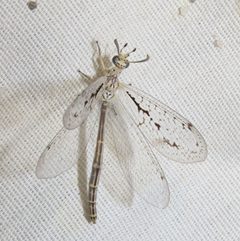
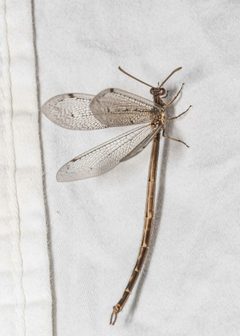
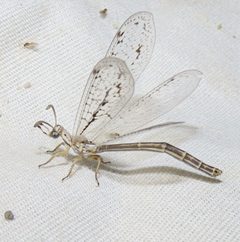
9Scotoleon is a of antlions ( Myrmeleontidae, order Neuroptera) containing more than 20 described . Scotoleon are delicate, slender insects with lacy wings that superficially resemble damselflies but possess short, thick, clubbed . Males frequently exhibit a much longer tipped with bracket-like claspers. The genus was established by Banks in 1913.
Pronunciation
How to pronounce Scotoleon: //ˌskoʊtiˈoʊliən//
These audio files are automatically generated. While they are not always 100% accurate, they are a good starting point.
Identification
distinguished from damselflies by short, thick, clubbed (damselflies have thread-like antennae). Males of Scotoleon have notably longer with bracket-like claspers compared to other antlion . Distinguished from other antlion genera by male genitalic characters and wing venation patterns. Adults are cryptic and align themselves flat against grass stems or twigs to become nearly invisible.
Images
Distribution
North America; recorded in Colorado, Arizona, and other western and southwestern United States. The occurs north of Mexico among 18 antlion genera recorded in this region.
Life Cycle
Complete with larval, pupal, and stages. Larvae pupate inside a silken capsule spun underground, incorporating grains of sand into the cocoon.
Behavior
fly clumsily and are most often seen among tall grasses, especially at dusk. Adults exhibit strong : upon alighting on grass stems or twigs, they instantly align themselves to flatten seamlessly against the substrate, rendering them essentially invisible. Adults frequently attracted to lights at night.
Similar Taxa
- MyrmeleonBoth are antlion with lacy-winged , but Myrmeleon larvae construct trademark funnel pits in fine soil while Scotoleon larvae are sit-and-wait that bury themselves just below the surface without digging pits; Myrmeleon males lack the elongated with bracket-like claspers characteristic of Scotoleon males
- Damselflies (Zygoptera) superficially resemble damselflies in slender body and lacy wings, but distinguished by short, thick, clubbed versus thread-like antennae in damselflies; also distinguished by wing venation and resting posture
More Details
Male morphology
The elongated male with bracket-like claspers is especially pronounced in Scotoleon compared to other antlion .
Larval ecology
Unlike Myrmeleon larvae which construct pit traps, Scotoleon larvae are sit-and-wait that bury themselves just below the soil surface without constructing funnel pits.