
Myrmeleon immaculatus
De Geer, 1773
Doodlebug
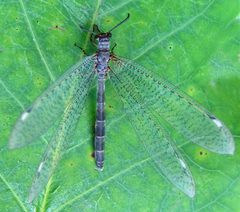
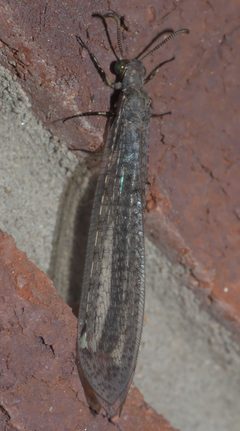
Myrmeleon immaculatus is a pit-trapping antlion in the Myrmeleontidae. are approximately 30 mm in length and typically blue-grey in color. The species is particularly common in the eastern United States, though its range extends across North America and into Central America. Like other members of the Myrmeleon, its larvae construct characteristic conical pits in sandy soil to capture prey.
Pronunciation
How to pronounce Myrmeleon immaculatus: //mɪərˈmiːliən ˌɪməˈkjʊlətəs//
These audio files are automatically generated. While they are not always 100% accurate, they are a good starting point.
Identification
are distinguished from damselflies by their short, clubbed (damselflies have thread-like antennae). Within antlions, M. immaculatus can be recognized by its blue-grey coloration and moderate size (30 mm). The Myrmeleon is the only North American antlion genus whose larvae construct conical pits; other genera simply bury themselves just below the soil surface. Larvae are identified by their pit-building and backward-only pattern.
Images
Habitat
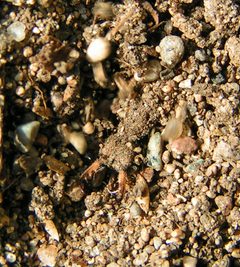
are found among tall grasses, particularly at dusk. Larval pits occur in fine, powdery soils or sawdust around rotten logs, typically in dry, sheltered locations such as beneath rock overhangs, under bridges, at the base of trees, or in the dirt floors of old barns and sheds. Colonies are rarely found in fully exposed situations.
Distribution
Occurs in North America and Central America. Particularly common in the eastern United States. Recorded from Vermont and sand prairie in Missouri.
Seasonality
are most frequently observed at dusk. Activity in sand prairie has been documented in early autumn (September).
Life Cycle
Complete with four stages: , larva, pupa, and . Larvae dig conical pits in sandy soil and lie in wait beneath the bottom of the pit. occurs underground within a sand-incorporated silken cocoon. Adults are short-lived and do not feed extensively.
Behavior
Larvae walk only backwards, rapidly, and dig pits by moving in reverse in a spiral pattern while throwing sand with their jaws and the flattened top of their . When prey contacts the unstable pit walls, the larva senses vibrations and throws additional sand to accelerate the prey's descent. The larva then impales the victim with hollow , injects paralyzing that pre-digest tissues, and sucks out the liquified contents. The dry carcass is ejected from the pit with a violent head thrust. Larvae leave winding, spiraling trails in sand while searching for suitable trap locations— that gives rise to the "doodlebug." are weak, clumsy fliers and exhibit remarkable cryptic behavior: upon alighting on vegetation, they align their bodies so precisely with stems or twigs as to become essentially invisible.
Ecological Role
Larvae function as sit-and-wait of small soil-dwelling arthropods, particularly ants. Their pit-trapping represents a specialized foraging strategy that contributes to nutrient cycling in dry, sandy .
Human Relevance
Larvae are familiar to many people as "doodlebugs" and are sometimes kept in captivity for observation. They can be induced to throw sand or grasp objects by tickling them with grass blades or twigs. They have been used in educational contexts to demonstrate -prey interactions and trap-building in insects.
Similar Taxa
- ScotoleonAnother antlion in North America; have much longer in males with more prominent bracket-like claspers. Larvae do not build pits, instead burying themselves just below the soil surface.
- GlenurusAntlion with spectacular black, white, and pink wingtips; much more visually distinctive than the blue-grey M. immaculatus.
- VellaGiant antlion with wingspan of 100-120 mm or more; frequently attracted to lights at night, unlike the more cryptic M. immaculatus.
- Damselflies (suborder Zygoptera)Superficially similar appearance with slender bodies and membranous wings, but distinguished by thread-like versus the clubbed antennae of antlions.
More Details
Taxonomic note
The was first described by De Geer in 1773. Some sources list it as a synonym, though GBIF recognizes it as accepted.