
Glenurus
Hagen, 1866
Picture-winged Antlions
Species Guides
3- Glenurus gratus(pleasing picture-winged antlion)
- Glenurus luniger(Western Picture-winged Antlion)
- Glenurus snowii(Snow's Picture-winged Antlion)
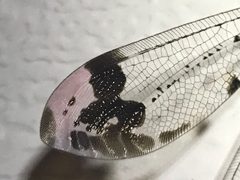
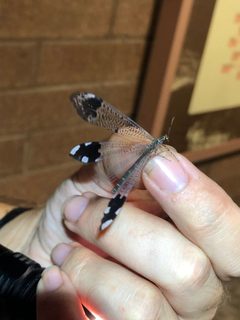
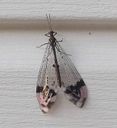
Glenurus is a New World of antlions in the Myrmeleontidae, comprising approximately 12 described . The genus is distinguished by striking wing patterning, with some species displaying black, white, and pink wingtips. are delicate, slender insects with lacy wings that superficially resemble but possess short, thick, clubbed . The "picture-winged antlions" refers to this distinctive wing coloration.
Pronunciation
How to pronounce Glenurus: //ɡlɛˈnʊ.rʊs//
These audio files are automatically generated. While they are not always 100% accurate, they are a good starting point.
Identification
are distinguished from and by their short, clubbed (Odonata have long, thread-like antennae). Within Myrmeleontidae, Glenurus is recognized by its distinctive wing patterning—black, white, and pink markings on the wingtips in some —setting it apart from the more uniformly colored wings of most other antlion . Larvae lack the pit-building characteristic of Myrmeleon and instead remain buried just below the surface.
Images
Habitat
frequent vegetation, particularly tall grasses, and are often found near dusk. Larvae inhabit dry, sandy or powdery soils where they bury themselves beneath the surface to ambush prey. Suitable larval substrates include fine soil or sawdust around rotten logs, at the base of trees, beneath rock overhangs, under bridges, and in the dirt floors of old barns and sheds—situations that remain perpetually dry.
Distribution
New World distribution spanning North, Central, and South America. Records include the United States (Arizona, Colorado, Florida, Massachusetts, Ohio, Texas), Mexico, Guatemala, the Antilles, Peru (Amazon), and Brazil. The is the type genus of the tribe Glenurini.
Seasonality
are most frequently observed at dusk and are attracted to outdoor lights at night. Activity patterns vary by and region.
Life Cycle
Complete with , larva, pupa, and stages. Females lay eggs in sandy soil. Larvae are subterranean that develop through multiple instars. occurs within a silken cocoon spun underground, with sand grains incorporated into the cocoon structure. The from larva to pupa to adult takes place within this cocoon.
Behavior
are weak, clumsy fliers. They exhibit remarkable : upon alighting on vegetation, they align their bodies to flatten seamlessly against the substrate, rendering them nearly invisible. Larvae are sit-and-wait that remain buried just below the soil surface with jaws agape, detecting prey through vibrations. They do not construct pit traps. When prey contacts the larva, it is seized with hollow and injected with paralyzing ; liquefied tissues are then imbibed.
Ecological Role
Larvae function as subterranean of small ground-dwelling arthropods, including ants and other insects. may consume soft-bodied insects and pollen, though feeding habits are poorly documented.
Human Relevance
Larvae are sometimes kept in captivity for observation, requiring a deep container of fine sand and periodic provision of prey such as ants. The "doodlebug" is sometimes applied broadly to antlion larvae, though this name specifically refers to the pit-building of Myrmeleon larvae in North America. occasionally appear at window screens and porch lights, attracting attention due to their distinctive appearance.
Similar Taxa
- MyrmeleonBoth are antlion with similar , but Myrmeleon larvae construct distinctive funnel-shaped pit traps in sandy soil, whereas Glenurus larvae bury themselves without building pits. Myrmeleon adults lack the bold black, white, and pink wingtip patterning characteristic of some Glenurus .
- VellaBoth are large antlion with striking appearance, but Vella are true giants with wingspans of 100–120 mm or more, substantially larger than Glenurus. Vella is restricted to the southern third of the United States, while Glenurus has broader distribution.
- ScotoleonBoth are antlion with elongated male and bracket-like claspers, but Scotoleon lacks the distinctive wing patterning of Glenurus and has different geographic distribution.
Misconceptions
antlions are frequently mistaken for or due to their slender bodies and lacy wings. The "doodlebug" is often applied to all antlion larvae, but strictly refers to the pit-building larvae of Myrmeleon; Glenurus larvae do not create pits and thus do not produce the "doodle" trails in sand associated with the name's origin.
More Details
Taxonomic History
The Glenurus was established by Hagen in 1866 and serves as the type genus for the tribe Glenurini. Glenurus incalis Banks, described nearly a century ago from a single female specimen from the Peruvian Amazon, remained known from only that specimen until its rediscovery in Brazil with four additional specimens.
Research Gaps
Biological details for most Glenurus remain poorly documented. The larvae of only two species have been formally described. Feeding habits of , specific associations, and detailed data require further study.
Sources and further reading
- BugGuide
- Wikipedia
- GBIF taxonomy match
- iNaturalist taxon
- NCBI Taxonomy
- Catalogue of Life
- Pits of despair for ground dwelling insects: Antlions, Family Myrmeleontidae — Bug of the Week
- Bug Eric: "Doodlebugs" (Antlions)
- Rediscovery of Glenurus incalis Banks (Neuroptera: Myrmeleontidae), and notes on the Brazilian species of Glenurus Hagen
- Antlion, Glenurus gratus (Say) (Insecta: Neuroptera: Myrmeleontidae)
- Picture-Winged Antlions, the Glenurus Hagen (Neuroptera: Myrmeleontidae) from Mexico and Central America: Key, Redescriptions and Description of Two New Species