
Myrmeleon exitialis
Walker, 1853
antlion
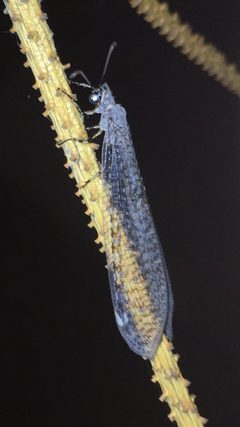
Myrmeleon exitialis is a of antlion in the Myrmeleontidae. It is found in North America. As a member of the Myrmeleon, its larvae construct the characteristic funnel-shaped pitfall traps in sandy soil to capture prey. are delicate, slender insects with lacy wings that superficially resemble damselflies but possess short, clubbed .
Pronunciation
How to pronounce Myrmeleon exitialis: /mɪr.mɛˈleɪ.ɒn ɛkˈsɪ.ti.ˌæl.ɪs/
These audio files are automatically generated. While they are not always 100% accurate, they are a good starting point.
Identification
distinguished from damselflies by short, clubbed (damselflies have long, thread-like antennae). When at rest, adults align themselves flat against vegetation with wings folded, becoming nearly invisible due to disruptive wing patterning. Larvae identified by their pit-building —only Myrmeleon larvae in North America construct funnel-shaped traps; other antlion bury themselves just below the surface without pits.
Images
Habitat
Larvae occur in fine, powdery soil or sawdust, particularly in perpetually dry situations: beneath rock overhangs, at the base of trees, under bridges, in dirt floors of old barns and sheds. Colonies often clustered in sheltered locations protected from rain. found among tall grasses, especially at dusk.
Distribution
North America. Documented from Colorado and other western states.
Seasonality
most frequently observed at dusk. Attracted to outdoor lights at night. Larval pits present year-round in suitable dry where substrate remains undisturbed.
Life Cycle
Complete . Larva constructs silken cocoon underground incorporating sand grains, in which it pupates. emerges from pupa at later date. laid in sandy soil where they hatch into subterranean larvae.
Behavior
Larvae walk only backwards, rapidly. Dig pits by in reverse in a spiral, throwing sand with jaws and flattened top of , then lie in wait beneath soil at pit bottom. Sense prey through vibrations; when detected, throw additional sand onto victim to hasten descent. Prey seized with hollow ; injected to paralyze and externally digest tissues, then liquified contents imbibed. Dry carcass catapulted from pit with violent head thrust. fly clumsily and demonstrate strong , aligning with substrate to become essentially invisible when at rest.
Ecological Role
Larval antlions function as sit-and-wait of small ground-dwelling arthropods, particularly ants. Their pitfall traps represent a distinctive foraging strategy within sandy .
Human Relevance
Larvae known colloquially as "doodlebugs," possibly from the cursive trails they create when seeking new pit locations. Sometimes kept in captivity by providing containers of fine sand and feeding ants or other small . Can be induced to throw sand or grasp objects by tickling with grass blades or twigs.
Similar Taxa
- Damselflies (Zygoptera) antlions superficially resemble damselflies in body form and wing posture, but distinguished by short, clubbed versus long, thread-like antennae in damselflies.
- Other antlion genera (e.g., Brachynemurus, Glenurus, Vella, Scotoleon)Only Myrmeleon larvae construct funnel-shaped pits in North America; larvae of other bury themselves just below soil surface without constructing visible traps.
More Details
Pit size variation
Pit diameter ranges from dime-sized to larger than a quarter, depending on soil texture and slope rather than larva size. Steeper slopes generally produce larger pits.
Taxonomic note
Catalogue of Life lists this as a synonym, but GBIF and NCBI recognize it as accepted. Walker, 1853 is the original authority.