
Polystoechotes punctata
(Fabricius, 1793)
giant lacewing
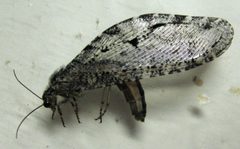
Polystoechotes punctata is a giant in the Ithonidae, reaching up to two inches in length. The was considered extirpated from eastern North America by the 1950s but was rediscovered in Fayetteville, Arkansas in 2012 when an individual was found on a Walmart facade. The specimen was misidentified until 2020. The species shows evidence of a distributional shift, with eastern declining and western populations becoming more prominent.
Pronunciation
How to pronounce Polystoechotes punctata: //ˌpɒliˈstɛkoʊtiːz ˈpʌŋk.teɪtə//
These audio files are automatically generated. While they are not always 100% accurate, they are a good starting point.
Identification
Distinguished from other Neuroptera by large body size (up to 2 inches) and Ithonidae characteristics. The 2012 Arkansas rediscovery was initially misidentified, suggesting close similarity to other that may require expert examination for correct determination.
Images
Appearance
Distribution
Recorded from Central America and North America. Historically present in eastern United States with apparent decline and possible extirpation from eastern North America by the 1950s. Recent records indicate presence in western North America, with a notable 2012 rediscovery in Fayetteville, Arkansas.
Human Relevance
Rediscovery in 2012 at a Walmart in Arkansas generated public interest in insect conservation and urban biodiversity. The delayed correct identification until 2020 highlights challenges in recognizing rare .
More Details
Rediscovery context
The 2012 rediscovery represents one of the most serendipitous insect finds in recent North American entomology, occurring on a commercial building facade rather than in natural . This suggests the may persist in overlooked microhabitats or undergo undetected .
Sources and further reading
- BugGuide
- Wikipedia
- GBIF taxonomy match
- iNaturalist taxon
- NCBI Taxonomy
- Catalogue of Life
- Why bugs matter to me... - Buglife Blog - Buglife
- Wolbachia in Cockroaches: A New Paradigm for Urban Pest Management?
- Sand Prairie Conservation Area | Beetles In The Bush
- Polystoechotes punctata (Fabricius, 1793) (Neuroptera: Ithonidae) in North America: A Changing Distribution Over Time