
Ithonidae
moth lacewings, giant lacewings
Genus Guides
3- Oliarces
- Platystoechotes
- Polystoechotes(giant lacewings)
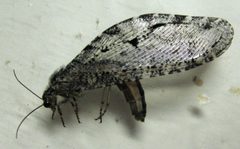
is a small of neuropteran insects comprising ten living and over a dozen extinct genera known from fossils. The family represents one of the most primitive lineages within Neuroptera. are medium to large-sized with distinctive wing venation. Larvae exhibit a highly unusual -like (scarabaeiform) body form with stout , unique among lacewings, and lead a subterranean lifestyle. The modern distribution is notably disjunct, with genera occurring in Australia, the Americas, and Asia, while fossil evidence indicates a formerly broader global range from the Early Jurassic to Late Eocene.
Pronunciation
How to pronounce Ithonidae: /ɪˈθoʊnɪˌdeɪ/
These audio files are automatically generated. While they are not always 100% accurate, they are a good starting point.
Identification
distinguished from other neuropteran by wing venation characters and overall robust build. Larvae immediately recognizable by their unique scarabaeiform body shape—compact, C-shaped, with shovel-like and massive —unlike the slender, predatory larvae with long stylets typical of other lacewings. The combination of subterranean habits and -like is diagnostic for the family. Fossil assigned to informal groups based on wing venation patterns, particularly the specialized MP and CuA characteristic of the Principiala group.
Images
Habitat
Modern occupy two distinct types: arid regions and forested areas. Arid-adapted include Ithone, Varnia, and Oliarces. Forest-dwelling genera inhabit microthermal to lower mesothermal climates, with Polystoechotes punctatus ranging across North American forests south to Panama, and P. gazullai and Fontecilla graphicus in Central Chilean forests. Platystoechotes lineatus is restricted to Sierra Nevada mountain forests in California. Larvae are exclusively subterranean, burrowing in soil.
Distribution
Modern distribution is disjunct and relictual. Western Hemisphere: three in , four in . Eastern Hemisphere: three in Australasian realm (Australia), one in Indomalaya. Specific modern ranges include Australia (Ithone, Megalithone, Varnia), western North America (Oliarces, Platystoechotes, Polystoechotes punctatus), Central America (Adamsiana, Narodona), Mexico (Narodona), and Chile (Polystoechotes gazullai, Fontecilla graphicus). Historical range far broader: fossil evidence from Early Jurassic to Late Eocene across China, Kazakhstan, Kyrgyzstan, Tajikistan, Brazil, England, Denmark, western North America (Colorado, Washington, British Columbia), and Baltic amber. Polystoechotes punctatus has undergone significant range contraction, disappearing from eastern North America by the 1950s and now restricted to western North America.
Seasonality
Mass emergences of recorded for Oliarces and Ithone, typically associated with seasonal rains. Specific seasonal activity patterns for other not documented.
Diet
Larvae are , equipped with poison glands and dual channels for subduing prey—contradicting earlier hypotheses of . diet varies: at least some are , though comprehensive data lacking for most .
Life Cycle
Development includes five larval instars, unlike the three typical of most lacewings. First instar is -like, resembling scarabaeiform larvae. Larval stage is entirely subterranean. Duration of developmental stages and site not documented.
Behavior
Larvae are obligate burrowers in soil, using their compact shovel-shaped and robust legs for excavation. Mass emergences of occur in some following seasonal rains. Adults of at least some are or , as suggested by reduced visual systems in larvae and adult attraction to lights.
Ecological Role
Larvae function as subterranean , representing a unique ecological guild among neuropterans. Their specialized indicates to on soil-dwelling . predatory habits suggest role as predators in forest and arid , though quantitative ecological impact unknown. The 's primitive phylogenetic position and relict distribution make it significant for understanding neuropteran evolution and historical .
Human Relevance
Limited direct interaction with humans. Occasionally encountered by entomologists and naturalists during mass events. Some have experienced range contraction (notably Polystoechotes punctatus in eastern North America), potentially indicating sensitivity to disturbance or climate change, though causal factors not established. Fossil are important for understanding Mesozoic-Cenozoic insect faunas and phylogenetic relationships within Neuroptera.
Similar Taxa
- Ascalaphidae (owlflies) owlflies share large size and broad wings with ithonids, but have distinctly clubbed and large divided —features absent in . Larval owlflies are terrestrial with elongate bodies and prominent jaws, not subterranean scarabaeiform .
- Myrmeleontidae (antlions) antlions resemble ithonids in general neuropteran wing plan, but have shorter, clubbed and different wing venation. Antlion larvae are pit-building in sandy soils with elongate bodies and forward-projecting jaws, contrasting sharply with the burrowing -like ithonid larvae.
- Sisyridae (spongillaflies)Larval Sisyridae are unusual among lacewings in being aquatic, feeding on freshwater sponges—completely different and from subterranean ithonid larvae. are much smaller and more delicate than ithonids.
- Former Rapismatidae and PolystoechotidaeThese have been synonymized with based on phylogenetic analyses; they are no longer considered distinct but rather nested clades within an expanded Ithonidae sensu lato.
Misconceptions
Larvae were historically described as by Tillyard (1922) based on , then reinterpreted as phytophagous by Faulkner (1990)—the only plant-feeding lacewings known. Recent morphological study (2020) has confirmed predatory habits, with poison glands and dual channels indicating active , correcting the hypothesis.
More Details
Phylogenetic significance
is considered the most primitive living of Neuroptera, forming the sister group to all other families in suborder Hemerobiiformia. The family's unusual larval represents a major evolutionary departure from the typical neuropteran ground plan.
Taxonomic history
boundaries expanded twice: first to include Rapisma (formerly Rapismatidae), then in 2010 to include formerly in Polystoechotidae. Both groups nest within sensu lato based on molecular and morphological .
Fossil record importance
Extinct demonstrate far greater past diversity and global distribution than modern relictual pattern suggests. Fossil range spans Early Jurassic to Late Eocene, with amber inclusions particularly rare—the mid-Cretaceous Burmese amber genus Burmithone and Baltic amber genus Elektrithone are notable exceptions.
Conservation concern
Polystoechotes punctatus has experienced dramatic range reduction in North America, disappearing from eastern by the 1950s. Cause unknown but may reflect loss, climate change, or other anthropogenic factors. Current restricted distribution in western North America warrants monitoring.
Sources and further reading
- BugGuide
- Wikipedia
- GBIF taxonomy match
- iNaturalist taxon
- NCBI Taxonomy
- Catalogue of Life
- Polystoechotes punctata (Fabricius, 1793) (Neuroptera: Ithonidae) in North America: A Changing Distribution Over Time
- A new genus and first Cenozoic fossil record of moth lacewings (Neuroptera: Ithonidae) from the Early Eocene of North America
- Diversity and fossil record of larvae of three groups of lacewings with unusual ecology and functional morphology: Ithonidae, Coniopterygidae and Sisyridae
- Observations on the Biology ofPolystoechotes punctatus(Fabricius) (Neuroptera: Ithonidae): Adult Trophic Status, Description of the Male Reproductive System, and Associations with Mites
- A new moth lacewing genus (Insecta: Neuroptera: Ithonidae) with proliferated and specialized wing venation from the mid-Cretaceous of northern Myanmar
- Unearthing underground predators: The head morphology of larvae of the moth lacewing genus Ithone Newman (Neuroptera: Ithonidae) and its functional and phylogenetic implications
- A New Interesting Moth Lacewing (Neuroptera: Ithonidae) from the Mid-Cretaceous Kachin Amber.
- New Mitochondrial Genomes of Ithonidae (Neuroptera) and Higher Phylogenetic Implications.