
Myrmeleontini
Latreille, 1802
Pit-trapping Antlions
Genus Guides
1- Myrmeleon(antlion)
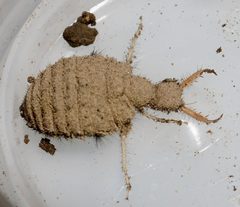
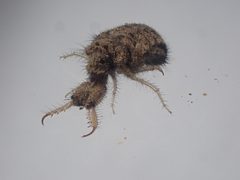
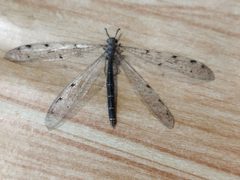
Myrmeleontini is a tribe of antlions within the Myrmeleontinae, comprising approximately 12 including Myrmeleon, Euroleon, and Baliga. The tribe is distinguished by pit-trapping predatory in larval stages, where larvae construct conical pits in loose substrate to capture prey. are aerial with elongated bodies and large, transparent wings. The group has a broad geographic distribution spanning Europe, Asia, and Australia.
Pronunciation
How to pronounce Myrmeleontini: //mɪərˌmiːliˈɒntɪnaɪ//
These audio files are automatically generated. While they are not always 100% accurate, they are a good starting point.
Identification
distinguished from other antlion tribes by combination of wing venation patterns, antennal club shape, and male genitalia structure. Larvae identified by pit-constructing and ; pit-trapping behavior is diagnostic for the tribe versus other antlion groups that hunt under debris or ambush from burrows. -level identification requires examination of wing venation details, body proportions, and male terminalia.
Images
Habitat
Larvae inhabit loose, dry, sandy or fine-grained soils suitable for pit construction, including riverbanks, dunes, forest edges, and disturbed ground. frequent open, warm with available prey, often found resting on vegetation or flying at dusk.
Distribution
Palearctic region (Europe, North Africa, Asia), extending through Central Asia to the Himalayas and into Southeast Asia. Australeon and Weeleus occur in Australia. Records confirmed from Pakistan, Iran, India, China, and multiple European countries.
Seasonality
activity peaks during warm months; timing varies by latitude and . In temperate regions, adults emerge in late spring through summer. Larvae present year-round in suitable substrates, with activity reduced during cold or wet periods.
Behavior
Larvae construct conical pits by flicking sand outward while moving backward in circular patterns. Pit walls maintained at angle of repose; larvae buried at bottom with exposed. Prey detection via substrate vibration triggers sand-flicking response to dislodge and capture falling prey. are aerial , capturing small flying insects in .
Ecological Role
Larvae function as sit-and-wait in sandy substrate , regulating of small arthropods. serve as aerial predators in open . Both life stages provide prey for larger , reptiles, birds, and small mammals.
Human Relevance
Larvae, known as "doodlebugs" in North American vernacular, are familiar to children and naturalists for their pit traps. No economic significance; occasionally studied in behavioral research for -prey dynamics and vibration-sensing mechanisms.
Similar Taxa
- AcanthaclisiniAnother pit-trapping antlion tribe; distinguished by larval tooth formula and wing venation patterns, particularly the arrangement of costal crossveins.
- BrachynemuriniLarvae are debris-dwelling ambush rather than pit-constructors; differ in antennal club and wing shape.
- DendroleontiniLarvae typically arboreal or found in tree holes and leaf litter, not ground-dwelling pit-trappers; wing venation shows distinct differences in radial sector branching.
More Details
Generic composition
Tribe comprises 12 recognized : Australeon, Baliga, Callistoleon, Dictyoleon, Euroleon, Hagenomyia, Kirghizoleon, Megistoleon, Myrmeleon, Porrerus, and Weeleus. Genus Myrmeleon is the largest and most widespread, with numerous across the Palearctic.
Behavioral research significance
Pit-constructing of Myrmeleontini larvae has been extensively studied as a model system for theory, biomechanics of materials, and vibration-based sensory .