
Myrmeleontiformia
Antlions, Owlflies, and Allies
Family Guides
2- Myrmeleontidae(Antlions)
- Nymphidae(Split-footed Lacewings)
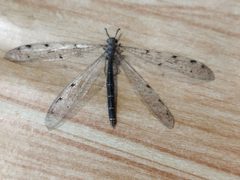
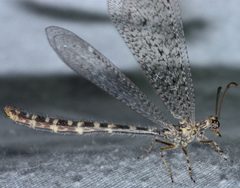
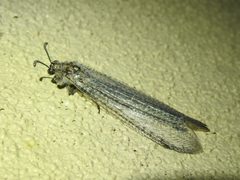
is a monophyletic suborder of lacewings (Neuroptera) containing approximately 2,160 described across two superfamilies: Myrmeleontoidea (antlions, owlflies, spoonwings, and split-footed lacewings) and Psychopsoidea (silky lacewings and extinct ). The group is predominantly diverse in arid tropical and subtropical regions. Members exhibit diverse larval strategies, including the famous pit-building of some antlions.
Pronunciation
How to pronounce Myrmeleontiformia: //mɪərˌmiːliːˌɒntɪˈfɔːrmiə//
These audio files are automatically generated. While they are not always 100% accurate, they are a good starting point.
Identification
distinguished from other Neuroptera by combination of: forewing length 10–75 mm; elongated bodies with large, often clubbed in ; highly modified ribbon-like or spoon-shaped hindwings in Nemopteridae; reduced wing venation in some groups. Larvae recognized by prominent, forward-projecting sickle-shaped and forming ; some with elongate, slender bodies for hunting in confined spaces.
Images
Habitat
Predominantly arid and semi-arid environments: sand and stone deserts, coastal dunes, dry river valleys (wadis), submountain and mountain regions (573–2089 m elevation), eremial high ranges, rocky with dry low vegetation. Some in coastal dunes where Carex grows. Larvae occupy diverse microhabitats: sand for pit-building species, soil crevices, tree bark, and confined spaces.
Distribution
Worldwide; centers of diversity in arid areas of tropical and subtropical regions. Documented from: North Africa (Morocco, Algeria, Tunisia, Libya, Egypt), sub-Saharan Africa (Sudan, Kenya, Eritrea, Somalia, Mali, Senegal), Europe (Spain, Southern Europe), Middle East (Israel, Arabian Peninsula, Jordan, Syria, Lebanon, Iran), Asia (Korea, Japan, China, Russia, Malaysia, Vietnam, India, Myanmar), and fossil record (Cretaceous Kachin amber, ~100 Ma).
Seasonality
periods vary by region: mainly spring (May), summer (June–July), and autumn (September) in temperate zones; year-round activity possible in tropical regions. Daytime activity limited to morning (until 10am) and late afternoon (after 4pm) in hot climates due to temperature constraints; some fly both day and night.
Diet
are skilled ; some feed on pollen. Larvae are ambush predators using prominent to capture prey.
Life Cycle
Holometabolous development: , larva, pupa (in cocoon), and stages. Larvae of various developmental stages observed simultaneously in field . Some larvae construct conical pits in sand; others conceal themselves in substrate without pit construction. Field-collected larvae can be reared to adulthood in laboratory conditions.
Behavior
strongly attracted to UV light (160W mixed light lamps, 8W blacklight UV tubes). Larval strategies include: pit-building (conical sand traps), substrate concealment with rapid to capture prey, and hunting in confined spaces. When prey detected, larvae rapidly emerge from sand, crawl forward to hunt, then crawl backward to rebury themselves, often leaving only prey exposed. Night collecting hindered by extreme wind in desert .
Ecological Role
Larval contributes to regulation of small in arid . predation and potential pollen feeding suggest roles in both arthropod population control and incidental pollination.
Human Relevance
Antlion larvae (doodlebugs) are familiar to naturalists for their pit traps. Group has received limited taxonomic attention in some regions, with significant gaps in knowledge (e.g., Korea until 2021). Some of conservation concern due to specificity and restricted distributions.
Similar Taxa
- HemerobiiformiaOther major neuropteran suborder, but and not a natural group; distinguished by generally smaller size, different wing venation patterns, and larval habits (many are foliage-dwelling rather than ground-dwelling ambush predators)
- Neuroptera (other families)Green lacewings (Chrysopidae) and brown lacewings (Hemerobiidae) have soft bodies, different wing venation with numerous crossveins, and larvae with sucking mouthparts but different body forms and hunting strategies
More Details
Taxonomic History
Historically treated as a suborder; phylogenetic studies using mitochondrial support its monophyly while revealing that 'Hemerobiiformia' is . Contains both extant and significant extinct families known only from Cretaceous fossils.
Fossil Record
Cretaceous amber fossils (e.g., Ankyloleon from ~100 Ma Kachin amber, Myanmar) reveal substantially different larval morphologies than modern fauna, indicating major evolutionary changes in body plan and presumably since the Mesozoic.
Research Gaps
Biological information remains limited for many ; most studies focus on and distribution rather than . associations, detailed reproductive , and precise diet composition poorly known for most .
Sources and further reading
- BugGuide
- Wikipedia
- iNaturalist taxon
- NCBI Taxonomy
- New data to the Moroccan Myrmeleontiformia (Nemopteridae, Myrmeleontidae, Ascalaphidae) fauna
- New details of the enigmatic 100 million years old antlion-like larvae of Ankyloleon (Myrmeleontiformia, Neuroptera)
- A taxonomic review of the family Myrmeleontidae Latreille (Neuroptera, Myrmeleontiformia) from the Korean peninsula, highlighting the conservation value of this family