
Nemopteridae
Spoonwings, Thread-winged Antlions
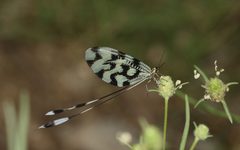
, commonly known as spoonwings or thread-winged antlions, is a of neuropteran insects distinguished by with dramatically elongated, spatulate hindwings that trail conspicuously during . The family is distributed across the Ethiopian, Palearctic, Australasian, and , with notable absence from North America despite fossil evidence from Colorado. Adults exhibit delicate, circling flight and possess highly modified mouthparts adapted for nectar and pollen feeding. Larvae are predatory, feeding on small insects including ants, and do not construct the pit traps characteristic of true antlions (Myrmeleontidae). The family comprises two : Crocinae, primarily and of arid zones, and Nemopterinae, predominantly with greater .
Pronunciation
How to pronounce Nemopteridae: /nɛˌmɒpˈtɛrɪdiː/
These audio files are automatically generated. While they are not always 100% accurate, they are a good starting point.
Identification
Distinguished from other Neuroptera by the extreme elongation of the hindwings into ribbon-like or spoon-shaped structures, often several times the length of the body. have elongated with weak and rod-like, and adapted for nectar feeding. Males possess a bulla (-dispersing structure) on the wing margin or base. Larvae resemble those of Myrmeleontidae but lack the enlarged, sickle-shaped mandibles of pit-digging antlions; instead, they have slender mandibles suited for active .
Images
Habitat
Primarily associated with arid and semi-arid environments. Crocinae occupy desert zones, dry rocky , sandy dunes, and dry river valleys with sparse vegetation. Nemopterinae species occur in diverse habitats including Mediterranean-type shrublands, with some such as Afroptera specialized to Fynbos and Succulent Karoo biomes. frequently found near flowering vegetation.
Distribution
Ethiopian, Palearctic, Australasian, and . Absent from North America except for fossil records from Colorado. Strong representation in southern Africa, North Africa, the Middle East, and Australia. Southern Africa represents a major evolutionary center with high , particularly in western arid biomes.
Seasonality
activity varies by : Crocinae primarily and , flying mainly May-July in North African ; Nemopterinae species predominantly . Specific periods documented for some species: Dielocroce berlandi flies June-July, Dielocroce chobauti and Croce aristata in June, Dielocroce harterti in early May.
Diet
Larvae are , feeding on small insects including ants. feed on nectar and pollen; Nemoptera sinuata has been observed to collect pollen using both mouthparts and foreleg .
Life Cycle
Complete with , larval, pupal, and stages. Larval stage is free-living, hiding under objects or within sand to ambush prey; does not construct pit traps. occurs in soil.
Behavior
is delicate and characteristically circling, particularly when confined indoors near walls. Mate attraction mediated by female in at least some ; males possess wing bullae for pheromone . Males of Palmipenna aeoleoptera use enlarged, pigmented hindwings in gliding flight during mate attraction, hypothesized to serve dual aerodynamic and visual signaling functions. Eversible abdominal vesicles occur in both sexes but function remains unknown; not observed everted even during mating trials.
Ecological Role
are flower visitors with potential for pollination. Larvae function as of small soil-dwelling insects.
Human Relevance
Limited direct economic importance. Potential value as biological indicators of arid health and as subjects for studies on wing and . Some attracted to UV light, facilitating collection and study.
Similar Taxa
- MyrmeleontidaeTrue antlions share similar larval body plan and predatory habits, but larvae lack enlarged sickle-shaped and do not construct pit traps; distinguished by elongated hindwings versus broad, similarly-sized wing pairs in Myrmeleontidae.
- PsychopsidaeSilky lacewings share southern African center of diversity and neuropteran affinities, but have broad, hairy wings without elongated hindwing streamers; larvae differ in and .
Sources and further reading
- BugGuide
- Wikipedia
- GBIF taxonomy match
- iNaturalist taxon
- NCBI Taxonomy
- Catalogue of Life
- Lions in South Africa | Beetles In The Bush
- Lions in South Africa | Beetles In The Bush
- A Revision of the Australian Crocinae (Neuroptera: Nemopteridae)
- New data to the Moroccan Myrmeleontiformia (Nemopteridae, Myrmeleontidae, Ascalaphidae) fauna
- Flower visiting Neuroptera: Mouthparts and feeding behaviour of Nemoptera sinuata (Nemopteridae)
- Contribution to the knowledge of the Turkish tail-wings (Neuroptera: Nemopteridae)
- First record of Croce filipennis Westwood, 1841 (Neuroptera: Nemopteridae) from Punjab, Pakistan
- First Record of <i>Croce filipennis</i> Westwood, 1841 (Neuroptera: Nemopteridae) from Kerala
- An unusual species of spoon‐wing lacewing (Neuroptera: Nemopteridae) from South Africa, with notes on its biology
- First record of the lacewing species Croce filipennis (Neuroptera: Nemopteridae) and its family from Bangladesh based on morphological and molecular identification
- Eversible abdominal vesicles and some observations of the male reproductive system of the spoon wing lacewing Palmipenna (Neuroptera: Nemopteridae)
- Phylogeny and historical biogeography of the southern African lacewing genus Afroptera ( Neuroptera: Nemopteridae: Nemopterinae )