
Scotoleon carrizonus
(Hagen, 1888)
Scotoleon carrizonus is a of antlion in the Myrmeleontidae. The Scotoleon is found in North America and Central America. males of Scotoleon species frequently have a much longer tipped with bracket-like claspers. The larvae of Scotoleon species do not construct the trademark pit traps associated with the genus Myrmeleon; instead, they bury themselves just below the soil surface and wait for prey.
Pronunciation
How to pronounce Scotoleon carrizonus: //ˌskoʊtiˈoʊliːən kəˈrɪzoʊnəs//
These audio files are automatically generated. While they are not always 100% accurate, they are a good starting point.
Identification
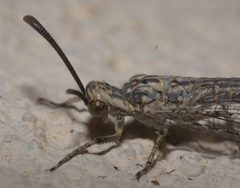
can be distinguished from damselflies by their short, thick, clubbed . Males are identifiable by their longer with bracket-like claspers at the tip. Scotoleon are distinguished from Myrmeleon by larval : Scotoleon larvae do not dig pit traps, instead burying themselves just below the soil surface. Adults are cryptic and align themselves flat against grass stems or twigs to become essentially invisible.
Images
Habitat
Larvae inhabit dry, sandy or powdery soil conditions. are most often seen among tall grasses, especially at dusk.
Distribution
Recorded from North America and Central America (Middle America).
Diet
Larvae are predatory, feeding on ants and other small insects that come within reach of their jaws. Prey is captured with hollow that inject paralyzing ; the larva then imbibes liquified tissues through .
Life Cycle
Complete with , larva, pupa, and stages. Larvae pupate underground in a silken cocoon incorporating sand grains. Adults emerge from the pupal stage.
Behavior
Larvae are sit-and-wait that bury themselves just below the soil surface with jaws agape. They sense prey vibrations and may throw sand to hasten prey capture. fly clumsily and are highly cryptic, aligning themselves flat against substrates to break up their outline and become nearly invisible. Adults are frequently attracted to lights at night.
Ecological Role
Larvae function as of small soil-dwelling arthropods, particularly ants. may serve as prey for other predators such as praying mantises.
Human Relevance
Similar Taxa
- MyrmeleonMyrmeleon larvae dig trademark conical pit traps in sandy soil, whereas Scotoleon larvae do not dig pits and instead bury themselves just below the surface.
- Damselflies (Zygoptera) antlions superficially resemble damselflies in body form and wing appearance, but are distinguished by short, thick, clubbed versus the long, thread-like antennae of damselflies.
- GlenurusGlenurus are spectacular antlions with distinctive black, white, and pink wingtips, unlike the more cryptic coloration of Scotoleon.
- VellaVella are true giants with wingspans of 100-120 mm or more, much larger than Scotoleon species.