
Nolima pinal
Rehn, 1939
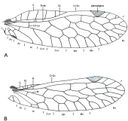
Nolima pinal is a mantidfly to the southwestern United States, ranging from Arizona to Nevada. First described by Rehn in 1939, the species was redescribed in a 2019 taxonomic revision that synonymized N. dine and N. kantsi under it. The species is distinguished by distinctive male abdominal cuticular structures and genitalic , including a strongly projecting, deeply bifid male mediuncus apex and a female spermatheca with a accessory gland. Its forewing has a short subcostal space with Sc contacting C near the middle of the costal margin, distal to the pterostigma base.


Pronunciation
How to pronounce Nolima pinal: /noʊˈliːmə ˈpiːnæl/
These audio files are automatically generated. While they are not always 100% accurate, they are a good starting point.
Identification
Nolima pinal can be distinguished from by male abdominal cuticular structures that are circular or polygonal in shape. The male mediuncus apex is strongly projecting posteriorly and deeply bifid. Females possess a spermatheca with a accessory gland. Wing venation is diagnostic: the forewing has a short subcostal space, and the subcostal (Sc) contacts the costal margin (C) near its middle, positioned distal to the pterostigma base. These characters separate it from N. infensa and N. victor, the other redescribed in the .
Images
Distribution
Southwestern United States: Arizona and Nevada. The is to the New World. A new distribution record from Nevada was documented in the 2019 revision, expanding its known range beyond Arizona.
Similar Taxa
- Nolima infensaSimilar congeneric mantidfly distinguished by different male abdominal cuticular structures and genitalic ; occurs in Guatemala and Honduras
- Nolima victorSimilar congeneric mantidfly distinguished by different male mediuncus structure and female spermatheca ; occurs in Mexico (Puebla) and Rica
- Nolima costaricensisSimilar congeneric mantidfly described from Rica in the same revision; distinguished by morphological differences in genitalia
Sources and further reading
- BugGuide
- GBIF taxonomy match
- iNaturalist taxon
- NCBI Taxonomy
- Catalogue of Life
- The Pest Management Methods That Deliver Picture-Perfect Christmas Trees
- Why Has This Moth Turned Into a (Sometimes) Destructive Forest Pest?
- Volunteer “community scientists” do a pretty darn good job generating usable data | Blog
- community science | Blog
- citizen scientists | Blog
- ecology | Blog - Part 10
- Taxonomic review of the mantidfly genus Nolima Navás (Neuroptera, Mantispidae, Calomantispinae)