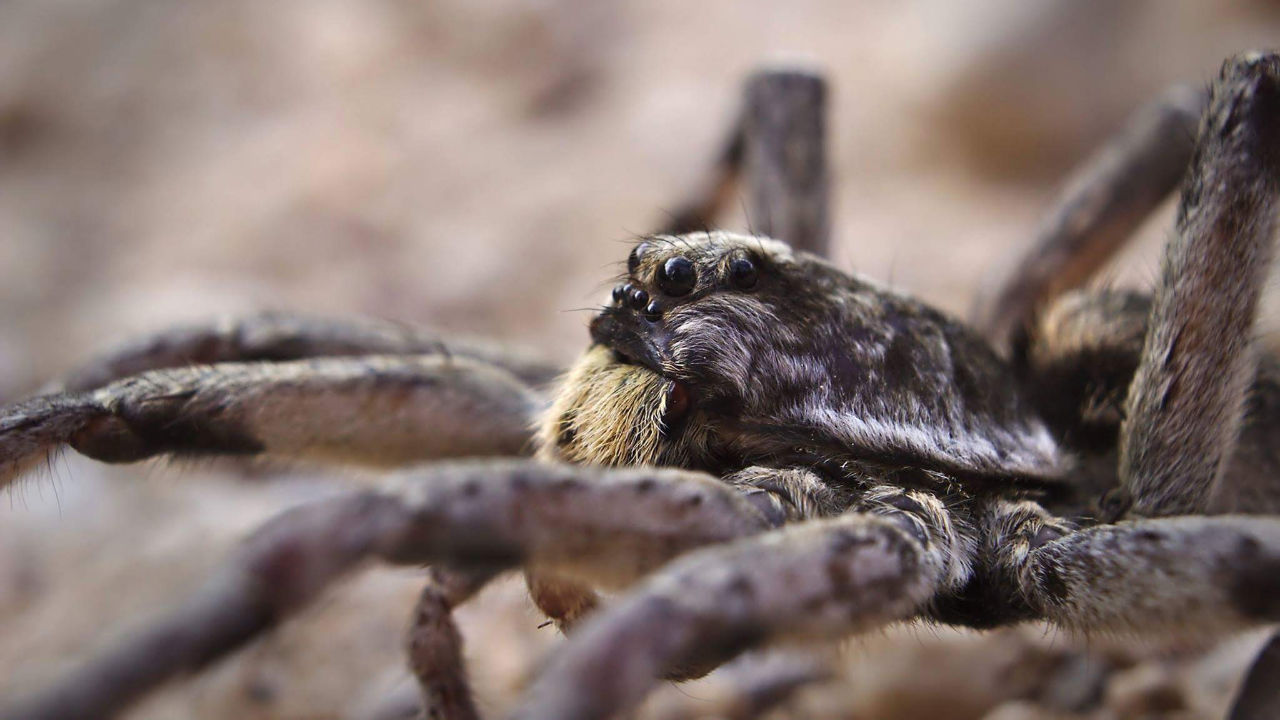
Giant Hairy Desert Scorpion, Desert Hairy Scorpion
Hadrurus is a genus of large scorpions in the family Hadruridae, native to sandy deserts and xeric habitats of the southwestern United States and northwestern Mexico. Members of this genus rank among the largest scorpions in the world, exceeded in size only by Hadogenes, Pandinus, Heterometrus, and Hoffmannihadrurus. The genus currently contains seven recognized species, including the well-known Hadrurus arizonensis, commonly called the Giant Hairy Desert Scorpion. These scorpions are characterized by their robust, hairy bodies with yellowish coloration, though Hadrurus spadix notably exhibits a dark, nearly black prosoma and mesosoma.
Anza-Borrego Hairy Scorpion
Hadrurus anzaborrego is a large scorpion endemic to the western Colorado Desert of southern California and extreme northern Baja California. It is a medium-sized member of the genus Hadrurus, reaching up to 11 cm in length. The species exhibits two distinct color phenotypes: light individuals are pale yellow, while dark individuals have a melanic posterior carapace and mesosoma. Both forms display a characteristic dark, v-shaped pattern near the eyes. The species name derives from Anza-Borrego Desert State Park, where the holotype was collected.
giant desert hairy scorpion, giant hairy scorpion, Arizona Desert hairy scorpion
Hadrurus arizonensis is the largest scorpion in North America, reaching up to 14 cm in length. This arachnid inhabits the Sonoran and Mojave deserts, where it constructs elaborate burrows up to 2.5 meters deep. It is a nocturnal predator that employs a 'sit and wait' hunting strategy, using sensory hairs to detect ground vibrations. Despite its imposing size, its venom is relatively mild with an LD50 of 168-198 mg/kg, comparable in pain to a honeybee sting. The species is viviparous, with young remaining on the mother's back for over a week after birth.
halacarid mites, marine mites
Halacaridae is a family of meiobenthic mites comprising over 1,100 described species in 64 genera, representing the largest marine radiation of arachnids. Members occupy marine, brackish, and freshwater habitats worldwide, from intertidal zones to deep-sea hydrothermal vents. The family exhibits diverse feeding strategies including predation, algivory, scavenging, and parasitism.
Lynx spider
Hamataliwa grisea is a species of lynx spider in the family Oxyopidae, first described by Keyserling in 1887. This small to medium-sized spider is known from the southwestern United States and Mexico. Like other oxyopids, it is an active hunter that relies on vision and speed rather than web-building to capture prey. The species is part of a genus characterized by distinctive eye arrangements and spiny legs adapted for ambush predation.
Haplodrassus bicornis is a species of ground spider in the family Gnaphosidae, first described by Emerton in 1909. This species is found in North America, specifically in the United States and Canada. Like other members of the genus Haplodrassus, it is a ground-dwelling spider that hunts without building webs. The specific epithet 'bicornis' refers to a pair of horn-like structures, likely describing a diagnostic morphological feature.
dwarf spiders
Helophora is a genus of dwarf spiders (family Linyphiidae) first described by Anton Menge in 1866. The genus contains five species with a disjunct distribution spanning North America, Europe, and East Asia. Members of this genus are small-bodied sheet-web weavers, characteristic of their family.
windscorpion, sun spider, camel spider
Hemerotrecha is a genus of solifuges (windscorpions) in the family Eremobatidae, first described by Nathan Banks in 1903. The genus comprises more than 30 described species distributed in arid regions of North America. These fast-moving, non-venomous arachnids are characterized by their large chelicerae and lack of silk-producing structures. They are active predators that hunt primarily at night.
windscorpion, sun spider
Hemerotrecha cornuta is a species of solifuge (windscorpion or sun spider) in the family Eremobatidae, described by Brookhart & Cushing in 2002. Solifuges are arachnids characterized by their large chelicerae and rapid running ability, though they lack venom and do not spin silk. As a member of the genus Hemerotrecha, this species belongs to a group of primarily North American eremobatids.
Hemerotrecha prenticei is a species of solifuge (sun spider) in the family Eremobatidae, described in 2008 from North America. It belongs to the genus Hemerotrecha, a group of small to medium-sized solifuges found primarily in arid and semi-arid regions. The species is poorly known, with limited observational records.
windscorpion, sun spider, camel spider
Hemerotrecha sevilleta is a species of solifuge (windscorpion) in the family Eremobatidae, described in 2002 from New Mexico. The species epithet references the Sevilleta National Wildlife Refuge, where long-term ecological research has been conducted. As with other solifuges, it is a fast-moving, non-venomous arachnid often mistaken for a spider or scorpion.
Hemerotrecha vetteri is a species of solifuge (sun spider) in the family Eremobatidae, described by Brookhart and Cushing in 2008. As a member of the genus Hemerotrecha, it belongs to a group of medium-sized solifuges found in arid and semi-arid regions of North America. The species is part of the subfamily Therobatinae, which is characterized by specific morphological traits of the pedipalps and chelicerae. Very few observations of this species have been recorded, with only 8 documented observations on iNaturalist as of the knowledge cutoff.
Heser is a genus of ground spiders (Gnaphosidae) in the Zelotes group, established in 2004. The genus comprises 11 species of small to medium-sized spiders distributed across Africa, Asia, Europe, and North America. Several species have been introduced to the United States and Mexico. The type species is Heser malefactor from Kazakhstan.
Hesperocranum is a monotypic genus of spiders in the family Liocranidae. It was established in 1991 by arachnologists Darrell Ubick and Norman Platnick. The genus contains a single species, Hesperocranum rothi, known from the United States. Very little is known about its biology or ecology.
Hibana cambridgei is a small ghost spider in the family Anyphaenidae. Like other members of its genus, it is pale in coloration and nocturnal in habit. The species is native to North America and has been recorded from the United States and Mexico. Very few specific observations of this species have been documented in scientific literature.
ghost spider
Hibana incursa is a species of ghost spider in the family Anyphaenidae, first described by Chamberlin in 1919. It is a small, pale-colored, nocturnal hunting spider distributed from the United States through Panama. Like other ghost spiders, it does not build webs to capture prey but instead actively prowls vegetation for insects.
Yellow Ghost Spider
Hibana velox, commonly known as the yellow ghost spider, is a small nocturnal hunting spider native to North America. Formerly classified as Aysha velox, this species belongs to the family Anyphaenidae and is recognized for its pale coloration and active predation on small insects. It occupies diverse habitats ranging from natural vegetation to human dwellings, and has been documented as an effective biological control agent against agricultural pests such as the citrus leafminer.
American sand assassin
Homalonychus theologus is a true spider in the obscure family Homalonychidae, found in the southwestern United States and northwestern Mexico. It is one of only two species in its genus. The species exhibits distinctive sand-encrusted camouflage achieved through specialized setae that trap soil particles. It does not construct webs and has been observed employing self-burying behavior during molting and mating.
windscorpion
Horribates bantai is a species of solifuge, commonly known as a windscorpion, in the family Eremobatidae. The species was described by Muma in 1989 and belongs to the genus Horribates. Very little specific information is documented about this particular species.
Belkin's Short-tailed Whipscorpion
Hubbardia belkini is a species of short-tailed whipscorpion in the family Hubbardiidae. It is one of several species in the genus Hubbardia, which is endemic to the southwestern United States and Mexico. The species was described in 1957 and is known from limited collection records. Short-tailed whipscorpions are small, cryptic arachnids that inhabit moist microhabitats in arid and semi-arid regions.
short-tailed whipscorpion
Hubbardia pentapeltis is a species of short-tailed whipscorpion in the family Hubbardiidae, first described by Cook in 1899. It belongs to the order Schizomida, a small group of arachnids characterized by their compact bodies and reduced flagellum. The species is known from North America and has been documented in citizen science observations.
dwarf spiders
Hybauchenidium is a genus of dwarf spiders in the family Linyphiidae, first described by Å. Holm in 1973. The genus contains four species distributed across high-latitude regions of the Northern Hemisphere, including boreal and arctic areas of North America, Europe, and Asia. Species in this genus are small-bodied spiders characteristic of the sheet-web building Linyphiidae.
Hydrodromidae is a family of mites in the order Trombidiformes, classified within the superfamily Hydryphantoidea. The family contains at least one recognized genus, Hydrodroma, including the described species H. despiciens. These mites are part of the diverse prostigmatan assemblage, a large group of often predatory or parasitic arachnids.
A rare spider species in the family Hypochilidae, described by Catley in 1994. The specific epithet "bernardino" references the San Bernardino Mountains of southern California, where the species was first discovered. Hypochilidae is a small family of spiders with distinctive morphological features and limited geographic distribution.
Triangle Web Spiders, Triangle Spiders
Hyptiotes is a genus of small cribellate spiders in the family Uloboridae, commonly known as triangle web spiders. These arachnids are distinguished by their unique triangular webs—rudimentary orb webs consisting of four radii connected to a single anchor thread. They are notable as the only spiders in North America that lack venom glands, relying instead on specialized silk to capture and subdue prey. Adult females measure 3-4 mm, while males are 2-3 mm. Four species occur in North America, with three primarily western and one eastern species (H. cavatus).
Gertsch's Triangleweaver
Hyptiotes gertschi is a cribellate orb-weaving spider in the family Uloboridae, commonly known as Gertsch's Triangleweaver. Like other members of its genus, it constructs a distinctive triangular web—a reduced sector of a typical orb web. The species is one of four Hyptiotes species in North America and is distributed across the United States and Canada, with records from Alberta, British Columbia, and Manitoba.
Illinichernes distinctus is a species of pseudoscorpion in the family Chernetidae, first described by Hoff in 1949. Pseudoscorpions are small arachnids that superficially resemble true scorpions but lack a stinging tail and are typically less than 10 mm in length. Members of the family Chernetidae are among the most diverse and widespread of pseudoscorpion families. The species is known from limited records in North America and Middle America.
The Iuridae are a family of scorpions established by Thorell in 1876. The family comprises six genera—Anatoliurus, Calchas, Iurus, Letoiurus, Metaiurus, Neocalchas, and Protoiurus—with at least 20 described species. Iuridae is distinguished from the large family Buthidae by possessing monocentric chromosomes rather than holocentric chromosomes. The family is part of the order Scorpiones within the class Arachnida.
ticks
Ixodida is the order comprising ticks, obligate blood-feeding arachnids within the subclass Acari. The order includes approximately 850-1000 described species worldwide, classified into three families: Ixodidae (hard ticks), Argasidae (soft ticks), and Nuttalliellidae (a monotypic family). Ticks are ectoparasites of mammals, birds, and reptiles, with significant medical and veterinary importance as vectors of bacterial, viral, protozoan, and rickettsial pathogens. They possess a unique life cycle involving multiple developmental stages and host associations.
Kibramoa madrona is a true spider in the family Plectreuridae, described by Gertsch in 1958. It is found in the United States. Members of this family are typically found in arid and semi-arid regions of western North America.
Kochius sonorae is a scorpion species in the family Vaejovidae, originally described by Williams in 1971 as Vaejovis sonorae before being transferred to the genus Kochius. The species is known from Middle America with distribution records indicating presence in the region. As a member of Vaejovidae, it belongs to a diverse family of scorpions primarily distributed in North and Central America.
Kulcania tomentosa is a species of cribellate spider in the family Dictynidae. The genus Kulcania was established by Lehtinen in 1967, with species characterized by their cribellate silk production and association with specific habitat types. Dictynidae spiders are generally small to medium-sized web-builders that construct irregular, tangled webs often called 'cobwebs' or 'mesh webs.' The specific epithet 'tomentosa' refers to a hairy or woolly appearance, likely describing the spider's pubescence.
Larinia borealis is an orb-weaving spider in the family Araneidae. It is found in North America, with confirmed records from Canada (Alberta, British Columbia) and the United States. As an orb-weaver, it constructs characteristic circular webs to capture prey. The species was first described by Nathan Banks in 1894.
Lauricius hooki is a species of spider in the family Zoropsidae, commonly known as false wolf spiders or wandering spiders. The species was described by Gertsch in 1941 and is known from the United States. As a member of Zoropsidae, it shares morphological characteristics with wolf spiders (Lycosidae) but belongs to a distinct family within the spider order Araneae.
Leiobunum townsendi is a species of harvestman (order Opiliones) in the family Sclerosomatidae, native to North America. Like other members of the genus Leiobunum, it possesses the characteristic long, slender legs and compact body typical of long-legged harvestmen. The species was described by Weed in 1893.
Early-Season Group
Leiobunum ventricosum is a species of harvestman in the family Sclerosomatidae, first described by Wood in 1868. It belongs to the genus Leiobunum, a group of long-legged harvestmen that are notoriously difficult to identify to species level. The species is found in North America, with confirmed records from Vermont and other regions. Like other members of its genus, it possesses distinctive morphological features including an ocularium—a raised structure bearing the eyes—and elongated legs, with the second pair often held aloft and waved as sensory appendages.
Warty Harvestman
Leiobunum verrucosum is a species of harvestman in the family Sclerosomatidae, commonly known as the Warty Harvestman. It is native to North America. The species belongs to a genus whose members are known for their exceptionally long legs and are common inhabitants of wooded habitats.
Leptobunus aureus is a species of harvestman (order Opiliones) in the family Phalangiidae, first described by Cokendolpher in 1985. It belongs to the subgenus Slimlepto within Leptobunus. The species is known from North America. Like other phalangiid harvestmen, it is a long-legged arachnid with a fused body structure, though specific morphological details distinguishing it from congeners remain poorly documented in accessible literature.
Leptobunus californicus is a species of harvestman (order Opiliones) in the family Phalangiidae, first described by Banks in 1893. It is found in North America. Harvestmen are arachnids characterized by a fused body structure and long, slender legs, though specific morphological details for this species are limited in available sources.
Leptobunus parvulus is a species of harvestman (order Opiliones) in the family Phalangiidae. It is native to North America. The species was first described by Banks in 1894. As a harvestman, it is an arachnid but not a spider, lacking venom and silk glands.
Red Freshwater Mite
Limnochares americana is a species of freshwater mite in the family Limnocharidae, first described by Lundblad in 1941. It belongs to the order Trombidiformes, a group that includes many aquatic and terrestrial mites. As a member of the infraorder Hydrachnidia (water mites), this species is adapted to life in freshwater habitats. The common name "Red Freshwater Mite" reflects its aquatic ecology and likely coloration.
Litopyllus temporarius is a ground spider species in the family Gnaphosidae, described by Chamberlin in 1922. It belongs to the infraorder Araneomorphae, the group containing most modern spider species. The species is known only from the United States, though specific habitat details and ecological information remain undocumented.
Arizona brown spider, Arizona Recluse
Loxosceles arizonica, commonly known as the Arizona brown spider or Arizona Recluse, is a recluse spider species in the family Sicariidae. Field studies indicate that ants constitute its primary prey, particularly species in the genera Novomessor and Camponotus. Like other Loxosceles species, it possesses cytotoxic venom capable of causing necrotic lesions, though documented cases of envenomation in humans appear limited compared to more widespread relatives such as L. reclusa.
Big Bend Recluse
Loxosceles blanda, commonly known as the Big Bend recluse, is a species of recluse spider in the family Sicariidae. It was described in 1983 by Gertsch and Ennik. The species is native to the United States, with its common name suggesting association with the Big Bend region of Texas. Like other members of the genus Loxosceles, it possesses cytotoxic venom that can cause tissue necrosis in humans, though documented cases specific to this species are limited.
ghost spider
Lupettiana mordax is a species of ghost spider in the family Anyphaenidae. It has been recorded across a broad geographic range extending from the United States through Central America to Peru and Brazil. The species belongs to a family of wandering spiders that are active hunters rather than web-builders.
Mexican Social Spiders
Mallos is a genus of cribellate araneomorph spiders in the family Dictynidae, first described by O. Pickard-Cambridge in 1902. The genus is notable for including social spider species, particularly *Mallos gregalis*, which lives in groups and communicates through web vibrations. These spiders produce cribellate silk, a type of woolly, non-sticky silk used in prey capture. The genus has been the subject of systematic research, including studies on their spinning apparatus evolution.
Mallos pallidus is a species of mesh web weaver spider in the family Dictynidae, first described by Banks in 1904. It is found in the United States and Mexico. The genus Mallos belongs to the cribellate spider lineage, characterized by the presence of a cribellum—a silk-producing organ that generates woolly, non-sticky silk used in prey capture.
Mallos pearcei is a species of mesh-web weaving spider in the family Dictynidae, first described by Chamberlin and Gertsch in 1958. As a member of the genus Mallos, it shares the characteristic cribellate silk production common to this group. The species is known from the United States, though specific details about its biology remain poorly documented.
lined orbweaver
Mangora gibberosa is a species of orb-weaving spider in the family Araneidae, native to North America. It is commonly misidentified as Cyclosa turbinata due to similar appearance and web architecture. The species is part of a genus of small to medium-sized orbweavers known for their often distinctive abdominal markings and vertical orb webs.
Marchena minuta is a small jumping spider and the sole described species in its genus. It is endemic to western North America, where it inhabits the bark of coniferous trees. The species represents the only North American member of the subfamily Heliophaninae. Its distribution is concentrated along the Pacific coast, with records from California, Washington, and Nevada.