
Hibana velox
(Becker, 1879)
Yellow Ghost Spider
Hibana velox, commonly known as the yellow ghost spider, is a small hunting spider native to North America. Formerly classified as Aysha velox, this belongs to the Anyphaenidae and is recognized for its pale coloration and active on small insects. It occupies diverse ranging from natural vegetation to human dwellings, and has been documented as an effective agent against agricultural pests such as the citrus leafminer.
Pronunciation
How to pronounce Hibana velox: //hɪˈbɑːnə ˈviːlɒks//
These audio files are automatically generated. While they are not always 100% accurate, they are a good starting point.
Identification
Distinguished from similar ghost spiders (Anyphaenidae) by combination of short retrolateral tibial and lack of tibial apophysis in males. Pale coloration and foliage-dwelling habits separate it from darker or web-building spiders. Differs from longlegged sac spiders (Cheiracanthium) by abdominal placement and arrangement. May be confused with other Hibana ; precise identification requires examination of male genitalic structures.
Images
Appearance
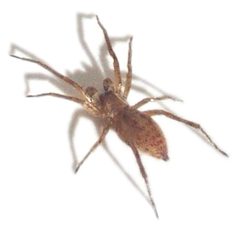
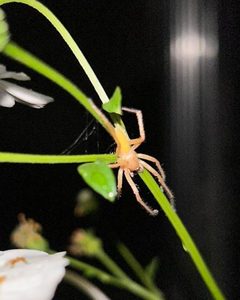
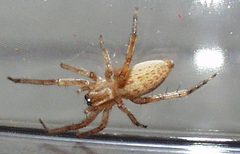
Small spider with body length ranging from 6 to 12 millimeters (approximately 1/4 to 1/2 inch). elongated with positioned near the epigastric furrow. Coloration variable: brown and yellow, beige and tan, or with dark markings. Possesses eight small arranged in two sets of four. with four promarginal teeth and eight retromarginal denticles despite relatively small mouthparts. Males distinguished by short retrolateral tibial and absence of tibial apophysis.
Habitat
Occupies hot, humid environments including tropical and subtropical regions. Natural retreats constructed under rocks, behind tree bark, and within leaf litter. Frequently colonizes human structures including houses, particularly in Florida where persist year-round. In coastal areas, has been observed establishing populations on mangrove islands.
Distribution
Native to North America with range extending from southern Canada through the eastern and southern United States to South America. Core distribution spans from Texas eastward through Florida and the Carolinas, with northern limit reaching into Canada. Documented from Bermuda, Cuba, and throughout the Caribbean region. Most abundant in southeastern United States, particularly Florida.
Seasonality
Active year-round in subtropical portions of range (e.g., Florida). In temperate regions, activity peaks during warmer months. activity pattern with seclusion in silken retreats.
Diet
feeding on small insects and other arthropods. Documented prey includes citrus leafminer (Phyllocnistis citrella, Gracillariidae). Dietary records indicate consumption of lepidopteran , spider egg sacs, and small . Exhibits opportunistic oophagy, particularly targeting lepidopteran and spider eggs. Observed to consume coleopteran eggs when available.
Host Associations
- Phyllocnistis citrella - preycitrus leafminer, significant agricultural pest
Life Cycle
Incomplete data on specific parameters for this . As with other Anyphaenidae, likely produces sacs within silken retreats. Spiderlings emerge and may initially occupy maternal retreat before dispersing. Developmental stages include egg, spiderling, instars, and . Detailed undocumented in available sources.
Behavior
Strictly , remaining concealed in silken retreats during daylight hours. Constructs new silken retreat after each night of activity; does not reuse retreats. Active hunter that prowls vegetation and structures in search of prey. Attracted to artificial lighting which concentrates insect prey. Rapid, agile movement when disturbed.
Ecological Role
contributing to regulation of insect . Documented as agent in citrus orchards, suppressing citrus leafminer populations. Serves as prey for larger predators and possibly small vertebrates. Role in native not extensively studied.
Human Relevance
Beneficial in agricultural contexts, particularly citrus production, through on economically significant pests. Occasional indoor presence in residential structures; not considered dangerous despite venomous bite used for subduing prey. Bites to humans rarely problematic though may cause localized swelling and soreness; reported in untreated cases. No documented medical significance comparable to medically important spider .
Similar Taxa
- Cheiracanthium spp.Longlegged sac spiders share pale coloration and indoor occurrence; distinguished by groove, abdominal setal tufts, and different placement
- Hibana gracilisCongeneric ghost spider with similar habits and appearance; requires examination of male genitalia for definitive separation
- Clubiona spp.Sac spiders in Clubionidae historically confused with Anyphaenidae; distinguished by groove and abdominal setal characteristics
Misconceptions
Despite "ghost spider" and pale appearance, not closely related to or behaviorally similar to the "yellow sac spider" Cheiracanthium mildei, which has been erroneously associated with necrotic bites. The Anyphaenidae is distinct from Clubionidae despite historical classification overlap and similar common names.
More Details
Taxonomic History
Originally described as Aysha velox by Becker in 1879. Transferred to Hibana following Brescovit's 1991 revision of Anyphaenidae. Genus Hibana was established to accommodate New World ghost spiders previously placed in Aysha.
Agricultural Significance
Studied as a agent for citrus leafminer (Phyllocnistis citrella) in Florida citrus orchards. Research has examined selectivity to preserve this while controlling pest .