
Clubiona lutescens
Westring, 1851
yellow sac spider, sac spider
Clubiona lutescens is a sac spider in the Clubionidae, found across Europe, Turkey, the Caucasus, Russia through Kazakhstan, Korea, and Japan. It has been introduced to North America. The constructs silken retreats rather than prey-capture webs and hunts actively on foot. It is primarily and has been observed in both natural and human-modified .
Pronunciation
How to pronounce Clubiona lutescens: //kluːˈbaɪə.nə luːˈtɛs.ɛnz//
These audio files are automatically generated. While they are not always 100% accurate, they are a good starting point.
Identification
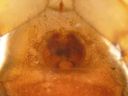
Distinguished from similar sac spiders, particularly Cheiracanthium , by the presence of a distinct groove in the center of the and a tuft of curved setae on the front edge of the . Cheiracanthium lacks both of these characters. Clubiona species are also less commonly encountered indoors compared to Cheiracanthium.
Images
Appearance
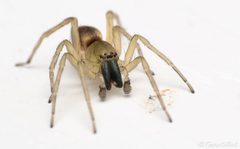
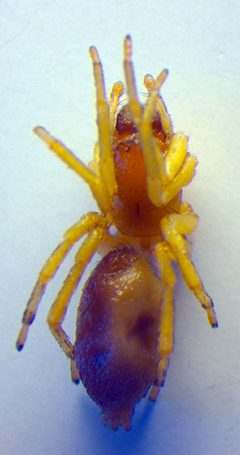
Medium-sized spider with a yellowish to pale greenish coloration. The possesses a distinct central groove. The has a tuft of curved setae on its front edge. Legs are relatively long and slender. Body coloration tends toward yellowish or lutescent tones, consistent with the epithet.
Habitat
Found in varied including forests, meadows, and human-modified environments. In natural settings, occupies leaf litter and vegetation. Has been observed on exterior walls of buildings and structures. Less strongly associated with indoor environments than some related .
Distribution
Native to Europe, Turkey, Caucasus region, Russia (extending to the Far East), Iran, Kazakhstan, Korea, and Japan. Introduced to North America, with established documented.
Diet
Active that hunts small insects and other arthropods on foot rather than using a web for prey capture. Specific prey records have not been documented for this .
Behavior
hunter that constructs silken retreats for daytime shelter. Retreats are typically not reused. The spider does not build prey-capture webs, instead relying on active pursuit. Capable of rapid movement across surfaces including vertical ones, aided by tarsal claw tufts.
Ecological Role
of small arthropods. Serves as prey for spider wasps including Priocnemis minorata, which has been documented to parasitize related Clubiona .
Human Relevance
Occasionally encountered in and around human dwellings, though less commonly indoors than related such as Cheiracanthium. No documented medical significance; not considered dangerously venomous. May cause minor concern due to rapid movement and activity patterns.
Similar Taxa
- CheiracanthiumLacks the distinct central groove and abdominal setal tuft present in Clubiona; more frequently encountered indoors
More Details
Taxonomic note
The Clubiona has historically been confused with Cheiracanthium, and both were formerly classified in Clubionidae. Cheiracanthium is now placed in Eutichuridae.