
Phyllocnistis citrella
Stainton, 1856
Citrus Leafminer, CLM
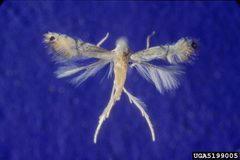
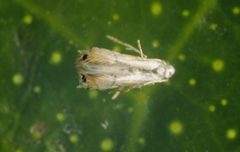
Phyllocnistis citrella, commonly known as the or CLM, is a small in the Gracillariidae. Native to tropical Asia, it has become a globally distributed agricultural pest of citrus since its discovery in Florida in 1993. The larvae create distinctive serpentine mines in citrus leaves, protected within the leaf from many topical treatments. The is managed through strategies including with introduced , using , and cultural practices.
Pronunciation
How to pronounce Phyllocnistis citrella: //ˌfɪ.ləˈknɪs.tɪs sɪˈtrɛl.ə//
These audio files are automatically generated. While they are not always 100% accurate, they are a good starting point.
Identification
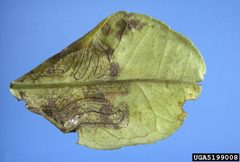
Larval activity is identified by the characteristic serpentine mines in citrus leaves—long, winding epidermal tunnels with a visible dark line running centrally through the mine. Mines are primarily lower-surface. The pupal chamber at the mine terminus, formed under a folded leaf margin, is also distinctive. are extremely small (5 mm wingspan) and require microscopic examination or genitalia dissection for reliable identification to . Similar Phyllocnistis species may occur on non-citrus ; confirmation requires host association and morphological analysis.
Images
Habitat
Agricultural and ornamental citrus-growing environments, including commercial orchards, nurseries, and backyard citrus plantings. Found in tropical, subtropical, and warm temperate regions where citrus occurs. Developmental stages show vertical stratification within the tree , with oviposition concentrated in upper canopy zones and larval development favoring leaves with surface areas between 2–6 cm².
Distribution
Native to tropical Asia (India, Southeast Asia, East Asia). Introduced and established in: North America (USA: Florida since 1993, Texas, Louisiana, Alabama; Mexico), Central America and Caribbean, South America (Argentina, Brazil, Chile, Colombia, Peru, Venezuela), Europe (Spain, Portugal, Italy, Greece, France, Corsica, Malta, Croatia, Cyprus), Africa (South Africa, Egypt, Ethiopia, Mauritius, Reunion, North Africa), Oceania (Australia, Papua New Guinea, Pacific Islands), and Middle East. Present in virtually all major citrus-producing regions globally.
Seasonality
Activity patterns vary by climate. In temperate and subtropical regions, peak during warmer months with multiple overlapping per year. In Florida and similar climates, year-round activity occurs with population increases in spring and summer. Seasonal abundance is influenced by citrus flushing patterns, as females preferentially oviposit on young, actively growing leaves.
Diet
Larvae feed as leaf miners within the of citrus leaves, consuming mesophyll tissue between upper and lower leaf surfaces. The sap-feeding habit involves utilization of plant sap components; larval development is favored by leaves with higher carbon content and suitable carbon-to-nitrogen ratios, despite elevated phenolic compound levels.
Host Associations
- Citrus sinensis - larval sweet orange
- Citrus reticulata - larval mandarin/tangerine
- Citrus limon - larval lemon
- Citrus paradisi - larval grapefruit
- Citrus maxima - larval pomelo
- Citrofortunella microcarpa - larval calamondin
- Fortunella margarita - larval kumquat
- Poncirus trifoliata - larval trifoliate orange
- Aegle marmelos - larval bael
- Atalantia - larval in Rutaceae
- Murraya paniculata - larval orange jasmine
- Garcinia mangostana - recorded larval mangosteen
- Pongamia pinnata - recorded larval
- Alseodaphne semecarpifolia - recorded larval
- Loranthus - recorded larval mistletoe
- Jasminum sambac - recorded larval Arabian jasmine
Life Cycle
Complete (holometabolous). are deposited on young leaves, preferentially on leaf surfaces smaller than 2 cm². Larvae develop through three instars, creating progressively longer serpentine mines within the leaf . Larvae are most abundant on leaves with surface areas smaller than 6 cm². occurs in a terminal chamber under a folded leaf margin. emerge and reproduce sexually. Multiple overlapping occur annually in suitable climates, with generation time varying by temperature.
Behavior
Females exhibit oviposition site selection favoring young, actively growing leaves with high nutritional quality. Larval mining creates protective epidermal tunnels that shield larvae from many contact and natural enemies. are and attracted to light. Mating is mediated by female-emitted , specifically a blend of (7Z,11Z)-7,11-hexadecadienal (diene) and (7Z,11Z,E)-7,11,13-hexadecatrienal (triene) in approximately 3:1 ratio. The demonstrates vertical stratification within tree , with deposition and adult concentrated in upper canopy zones.
Ecological Role
Agricultural pest that reduces photosynthetic capacity of citrus through leaf mining damage. Heavy can compromise tree vigor, particularly in nurseries and young plantings. The mines may also facilitate entry of secondary . The serves as for multiple , including Ageniaspis citricola, Cirrospilus phyllocnistoides, Semielacher petiolatus, and Quadrastichus species, which have been introduced for . These parasitoids can substantially reduce leafminer , with reported rates varying seasonally and geographically.
Human Relevance
Major economic pest of citrus worldwide, causing significant damage to nursery stock, young trees, and mature orchard plantings. Leaf mining reduces and tree growth; damage is particularly consequential for nursery operations and new plantings. Management relies on combining (introduced ), using synthetic , cultural practices (removal of flush growth), and selective applications. The was first detected in Florida in 1993 and subsequently spread throughout global citrus production areas. -based monitoring and mass trapping systems have been developed for detection and management.
Similar Taxa
- Phyllocnistis species on non-citrus hostsOther Phyllocnistis create similar serpentine leaf mines but occur on different plants; identification requires host association and morphological examination
- Other Gracillariidae leaf minersSome related create blotch or blotch-serpentine mines in citrus and other plants; mine pattern and line characteristics differ
More Details
Pheromone Biology
The female consists of two volatile compounds: (7Z,11Z)-7,11-hexadecadienal (diene) and (7Z,11Z,E)-7,11,13-hexadecatrienal (triene) in a 3:1 triene:diene ratio. This blend is both necessary and sufficient for male attraction. using synthetic (e.g., SPLAT CLM) has been registered with the US EPA and can achieve suppression at remarkably low release rates.
Biological Control History
In Brazil, introduction of Ageniaspis citricola in 1998 dramatically reduced leafminer and secondary citrus canker . In Florida, seasonal by native and introduced can exceed 80% but varies considerably. The parasitoid Quadrastichus citrella failed to establish effectively in Spain, possibly due to temperature-related biological constraints.
Canopy Distribution Patterns
Research in Uzbekistan demonstrated clear vertical stratification: 53.2% of in upper , 27.1% middle, 18.5% lower; 58.3% larval development in upper zone; 61.4% in upper canopy. This pattern has implications for targeted monitoring and control efforts.
Sources and further reading
- BugGuide
- Wikipedia
- GBIF taxonomy match
- iNaturalist taxon
- NCBI Taxonomy
- Catalogue of Life
- Biological Control in Brazil is Used on an Area that is Larger than Belgium
- Bug Eric: Don't Ignore the Small Bugs!
- Bug Eric: November 2016
- Bug Eric: 2016
- Phyllocnistis citrella . [Distribution map].
- Phyllocnistis citrella . [Distribution map].
- Citrus Leafminer, Phyllocnistis citrella Stainton (Insecta: Lepidoptera: Phyllocnistinae)
- SITRUS INLI KUYASI - PHYLLOCNISTIS CITRELLA S.NING ZARAR KELTIRISH DARAJASI
- Temperature Requirements may Explain why the Introduced Parasitoid Quadrastichus citrella Failed to Control Phyllocnistis citrella in Spain
- PHYLLOCNISTIS CITRELLA (LEPIDOPTERA: GRACILLARIIDAE) AND ITS PARASITOIDS IN CITRUS IN ECUADOR
- Μελέτη βιολογικών χαρακτηριστικών παρασιτοειδών του phyllocnistis citrella stainton και της επίδρασης τους στη δυναμική του πληθυσμού του
- Nutritional quality of Citrus clementina leaves affects infestation distribution of Phyllocnistis citrella Stainton (Lepidoptera; Gracillariidae)
- Seasonal Abundance of Phyllocnistis citrella (Lepidoptera: Gracillariidae) and its Parasitoids South Florida Citrus
- Spatial distribution of Phyllocnistis citrella Stainton (Lepidoptera: Gracillariidae) larvae in three scales
- Phyllocnistis citrella Stainton, 1856 Control Methods in the Lankaran-Astara Region
- Distribution pattern of developmental stages of Phyllocnistis citrella Stainton (Lepidoptera: Gracillariidae) on the surface of citrus leaves