
Quadrastichus
Girault, 1913
Quadrastichus is a of small parasitic in the Eulophidae, Tetrastichinae. The genus includes with diverse ecological roles: some are gall-inducing pests of trees, while others are ectoparasitoids used in programs. Notable species include Quadrastichus erythrinae, an gall wasp that damages Erythrina (coral trees) in tropical and subtropical regions, and Q. mendeli, an obligate ectoparasitoid of the eucalyptus pest Leptocybe invasa that has been successfully established for biological control across multiple countries.
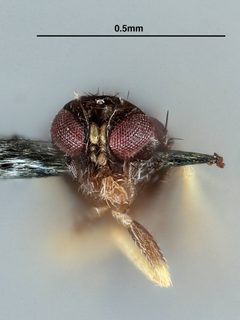
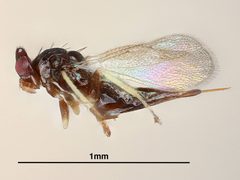
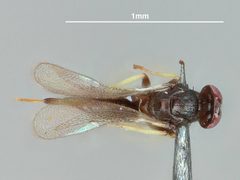
Pronunciation
How to pronounce Quadrastichus: /kwɑːˈdræstɪkəs/
These audio files are automatically generated. While they are not always 100% accurate, they are a good starting point.
Identification
Members of Quadrastichus can be distinguished from related eulophid by characters of the female and mesosoma; a key to Chinese based on female has been published. Species-level identification typically requires examination of microscopic features and is not reliably accomplished from field observations alone.
Images
Habitat
varies by : Q. erythrinae is associated with Erythrina trees (Fabaceae) in tropical and subtropical environments; Q. mendeli occurs in eucalyptus plantations.
Distribution
The has been recorded from Africa (Tanzania, South Africa, Mauritius, Reunion), Asia (China, India, Japan, Singapore, Sri Lanka, Taiwan, Thailand, Vietnam, Cambodia, Laos), Australia, North America (USA: Hawaii, Florida), Oceania (American Samoa, Guam), and South America (Paraguay). Distribution is -specific; Q. erythrinae is native to East Africa and elsewhere, while Q. mendeli has been deliberately introduced to multiple countries for .
Host Associations
- Erythrina variegata - plant of gall-inducerFor Q. erythrinae
- Erythrina spp. - plant of gall-inducerFor Q. erythrinae; includes ornamental and native coral trees
- Leptocybe invasa - of For Q. mendeli; ectoparasitoid of young and mature larvae
- Eucalyptus - plant plant of L. invasa, the host of Q. mendeli
- Phyllocnistis citrella - of For Quadrastichus sp. ( )
- Chromatomyia horticola - of For Q. plaquoi
Ecological Role
in this occupy contrasting ecological roles: Q. erythrinae acts as a pest that damages native and ornamental trees through gall formation, while Q. mendeli and other species serve as agents that parasitize gall-inducing or leaf-mining insects. Q. mendeli has been credited with successful control of Leptocybe invasa in eucalyptus plantations across multiple countries.
Human Relevance
Q. erythrinae is a significant pest in Hawaii and other tropical regions, causing severe defoliation and tree death in Erythrina including the wiliwili (E. sandwicensis), with control costs exceeding USD $1 million on O'ahu alone. Q. mendeli is a commercially valuable agent deployed in eucalyptus plantations in Australia, China, Cambodia, India, Israel, Italy, Kenya, Laos, South Africa, Thailand, and Vietnam.
Similar Taxa
- AprostocetusBoth belong to Tetrastichinae and share similar body plans; Aprostocetus exertus has been described as a of Q. erythrinae
- Eurytoma erythrinaeA eurytomid also used for of Q. erythrinae; different but similar ecological role and
- Cirrospilus brevisNative competitor of Quadrastichus sp. as of Phyllocnistis citrella in citrus
Sources and further reading
- BugGuide
- Wikipedia
- GBIF taxonomy match
- iNaturalist taxon
- NCBI Taxonomy
- Catalogue of Life
- Quadrastichus erythrinae . [Distribution Map].
- Sensory gene identification in the transcriptome of the ectoparasitoid Quadrastichus mendeli
- A new parasitoid of the Erythrina Gall Wasp, Quadrastichus erythrinae Kim (Hymenoptera: Eulophidae)
- Systemically Applied Insecticides for Treatment of Erythrina Gall Wasp, Quadrastichus erythrinae Kim (Hymenoptera: Eulophidae)
- Avaliação de dispositivos para liberação do parasitoide Quadrastichus mendeli (Hymenoptera: Eulophidae) em laboratório
- Sensory Geneidentificationin the Transcriptome of the Ectoparasitoid Quadrastichus Mendeliinthe Eucalyptus Gall wasp Leptocybe Invasa
- Saving wiliwili trees in Hawaii from the Erythrina gall wasp, Quadrastichuserythrinae, with a eurytomid parasitoid,Eurytomaerythrinae
- Leptocybe invasa males and the parasitoid Quadrastichus mendeli (Hym.: Eulophidae): First report in Paraguay
- Three new species of Quadrastichus Girault (Hymenoptera, Eulophidae) from China with a key to Chinese species
- Classical biological control of the erythrina gall wasp, Quadrastichus erythrinae, in Hawaii: Conserving an endangered habitat
- Biological traits of Quadrastichus mendeli (Hymenoptera, Eulophidae), parasitoid of the eucalyptus gall wasp Leptocybe invasa (Hymenoptera, Eulophidae) in Thailand
- Using host plant relationships to help determine origins of the invasive Erythrina gall wasp, Quadrastichus erythrinae Kim (Hymenoptera: Eulophidae)
- Temperature Requirements may Explain why the Introduced Parasitoid Quadrastichus citrella Failed to Control Phyllocnistis citrella in Spain
- New Record of Quadrastichus plaquoi (Hymenoptera: Eulophidae) as Parasitoid of Chromatomyia horticola (Diptera: Agromyzidae)
- Interspecific competition between two ectoparasitoids of Phyllocnistis citrella (Lepidoptera: Gracillariidae): Cirrospilus brevis and the exotic Quadrastichus sp. (Hymenoptera: Eulophidae)
- Aprostocetus nitens (Hymenoptera: Eulophidae), an Ectoparasitoid Proposed for Biological Control of the Destructive Erythrina Gall Wasp, Quadrastichus erythrinae, in Hawai'i.