
Cirrospilus
Westwood, 1832
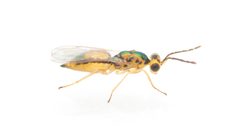
Cirrospilus is a of small in the Eulophidae (Hymenoptera: Chalcidoidea). within this genus are primarily ectoparasitoids of leaf-mining insects, particularly gracillariid such as the citrus leafminer (Phyllocnistis citrella). Several species have been investigated and employed as agents against agricultural pests, with notable examples including C. ingenuus, C. diallus, C. pictus, and C. coachellae. The genus exhibits variation in specificity, , and developmental rates influenced by temperature and host stage.
Pronunciation
How to pronounce Cirrospilus: /sɪˈroʊspɪləs/
These audio files are automatically generated. While they are not always 100% accurate, they are a good starting point.
Identification
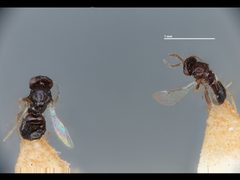
Identification to level requires examination of morphological characters including segmentation, wing venation patterns, and body coloration. Some species exhibit seasonal color variation; for example, C. pictus are yellow-green in summer months and darker pigmented in autumn and winter. The can be distinguished from similar eulophid genera by features of the mesosoma and metasoma structure, though precise diagnostic characters vary among species.
Images
Habitat
Associated with agricultural and natural environments where leaf-mining insects occur. Frequently found in citrus orchards, vineyards, and forests. Specific occupy distinct : C. ingenuus and C. pictus in citrus orchards infested with Phyllocnistis citrella; C. coachellae in vineyards with Marmara gulosa ; C. vittatus in coniferous forests with diprionid hosts.
Distribution
Records from Alberta, British Columbia, California, Florida, Bihar, and other regions. C. ingenuus established in Florida after intentional introduction for . C. pictus reported from Sicily, Italy. C. vittatus recorded from New Brunswick, Newfoundland, and Wisconsin in North America. Distribution varies by , with some showing broad geographic ranges and others more restricted.
Seasonality
Activity patterns vary by and climate. C. pictus exhibits seasonal body color variation correlated with temperature, with yellow-green forms in summer and darker forms in autumn and winter. Development rates are temperature-dependent, with faster development at higher temperatures within viable ranges.
Host Associations
- Phyllocnistis citrella - primary Citrus leafminer; attacked by C. ingenuus, C. diallus, C. pictus, C. brevis, and C. sp. near lyncus
- Marmara gulosa - primary Citrus peelminer; attacked by C. coachellae
- Neodiprion abietis - primary Balsam fir sawfly; parasitized by C. vittatus
- Neodiprion nanulus nanulus - primary ; parasitized by C. vittatus in Wisconsin
Life Cycle
Development is temperature-dependent and varies among . C. diallus completes development in 17-18 days at 26°C; C. pictus in 11 days at 26°C, 16 days at 21°C, or 21 days at 16°C. Sex allocation varies by instar: male-biased sex ratios emerge from 2nd-3rd instar hosts, female-biased from 4th instar larvae and pupae. Arrhenotokous has been documented in some species.
Behavior
Females exhibit -feeding ( on host tissues) in addition to oviposition. Host mortality from stings without successful oviposition occurs: 31.25% in C. pictus and 37.73% in C. diallus. has been observed, representing 6.92% of hosts killed by field-collected C. neotropicus females and 3.51% by laboratory females. Courtship and mating behavior described in C. pictus.
Ecological Role
Primary of leaf-mining Lepidoptera, functioning as agents in natural and agricultural . Some interact competitively with other parasitoid species sharing the same . C. ingenuus was successfully established in Florida and contributes to suppression of citrus leafminer . C. coachellae has been evaluated for release against citrus peelminer in California vineyards.
Human Relevance
Several are important agents in agriculture. C. ingenuus was introduced to Florida for of citrus leafminer. C. diallus and C. pictus have been studied for their potential in citrus pest management. C. coachellae has been investigated for control of Marmara gulosa in table grape production. The represents a significant component of guilds attacking leaf-mining pests.
Similar Taxa
- QuadrastichusBoth are eulophid of Phyllocnistis citrella; Cirrospilus brevis competes with Quadrastichus sp. in studies
- AprostocetusBoth belong to Eulophidae with similar body plans; distinguished by antennal structure and wing venation
More Details
Taxonomic notes
Cirrospilus flavoviridis Crawford has been synonymized under C. vittatus Walker. The contains multiple with similar ecological roles but distinct ranges and geographic distributions.
Research importance
Extensively studied for applications, particularly against the citrus leafminer Phyllocnistis citrella which spread globally in the 1990s. Research has focused on specificity, temperature-dependent development, and competitive interactions with other .
Sources and further reading
- BugGuide
- Wikipedia
- GBIF taxonomy match
- iNaturalist taxon
- NCBI Taxonomy
- Catalogue of Life
- Publications | Entomology Research Museum
- Biology and Behaviour of Cirrospilus diallus and Cirrospilus pictus, Parasitoids of Phyllocnistis citrella
- Parasitoid of the Citrus Leafminer, Cirrospilus ingenuus Gahan (Insecta: Hymenoptera: Eulophidae)
- Fecundity and Development of Cirrospilus coachellae (Hymenoptera: Eulophidae), a Parasitoid of Marmara gulosa (Lepidoptera: Gracillariidae)
- A New Species of Cirrospilus (Hymenoptera: Eulophidae) and Two New Synonymies of Parasitoids Reared from the Citrus Leafminer, Phyllocnistis citrella (Lepidoptera: Gracillariidae)
- Evidence of Seasonal Variation in Body Color in Adults of the Parasitoid Cirrospilus pictus (Hymenoptera: Eulophidae) in Sicily, Italy
- New synonymy and new sawfly host records for Cirrospilus vittatus (Hymenoptera: Eulophidae) in North America
- Effect of Temperature on the Life History of Cirrospilus sp. near lyncus (Hymenoptera: Eulophidae), a Parasitoid of Phyllocnistis citrella (Lepidoptera: Gracillariidae)
- Interspecific competition between two ectoparasitoids of Phyllocnistis citrella (Lepidoptera: Gracillariidae): Cirrospilus brevis and the exotic Quadrastichus sp. (Hymenoptera: Eulophidae)
- Effect of Variable Photoperiod on Development and Survival of Cirrospilus sp. nr. Lyncus (Hymenoptera: Eulophidae), an Ectoparasitoid of Phyllocnistis citrella (Lepidoptera: Gracillariidae)
- Parasitoid guild of the citrus leafminer, Phyllocnistis citrella Stainton (Lepidoptera: Gracillariidae) in Tunisian citrus orchards and a new report of Cirrospilus ingenuus Gahan (Hymenoptera: Eulophidae)
- Fecundity and Development of <I>Cirrospilus coachellae</I> (Hymenoptera: Eulophidae), a Parasitoid of <I>Marmara gulosa</I> (Lepidoptera: Gracillariidae)
- Preferred host stages, clutch size, and sex allocation by Cirrospilus coachellae (Hymenoptera: Eulophidae), a parasitoid of the citrus peelminer Marmara gulosa (Lepidoptera: Gracillariidae) with a view to its rearing and release as a biological control agent
- Predation and Parasitism of Cirrospilus Neotropicus (Hymenoptera: Eulophidae) On Phyllocnistis Citrella (Lepidoptera: Gracillariidae) In Laboratory
- Effect of Temperature on Development and Survival ofCirrospilussp. nearlyncus(Hymenoptera: Eulophidae), Parasitoid ofPhyllocnistis citrella(Lepidoptera: Gracillariidae)
- Effect of Temperature on Life History of <I>Cirrospilus vittatus</I> (Hymenoptera: Eulophidae), an Ectoparasitoid of <I>Phyllocnistis citrella</I> (Lepidoptera: Gracillariidae)