
Marmara gulosa
Guillén & Davis, 2001
Citrus Peelminer
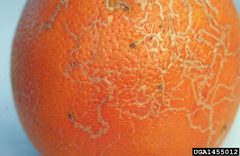
is a small gracillariid , approximately 4 mm in length, commonly known as the . Native to the United States where it originally fed on willow (Salix lasiolepis), the has undergone a documented -shift to non-native plants including citrus varieties and ornamentals such as oleander. It is known from California, Arizona, Texas, and Florida, as well as Cuba. The species is of economic concern as a pest of citrus, particularly grapefruit in southwestern growing regions. A distinct species from the similar Marmara salictella, it was formally described in 2001.
Pronunciation
How to pronounce Marmara gulosa: /mɑrˈmɑrə ɡuˈloʊsə/
These audio files are automatically generated. While they are not always 100% accurate, they are a good starting point.
Identification
are extremely small (~4 mm) with dark-gray coloration and mottled white and brown markings, requiring magnification for confident identification. Distinguished from Marmara salictella by association and subtle morphological differences; microscopic examination may be necessary. Larvae create serpentine leaf mines in host foliage. In Florida, at least three Marmara occur, complicating field identification.
Images
Appearance
A small approximately 4 mm in length. are dark-gray with mottled white and brown markings. Wings show subtle patterning. Larvae are leafminers, creating serpentine mines in foliage.
Habitat
Originally associated with native willow in riparian or wetland . Now found in agricultural settings, particularly citrus groves, and ornamental plantings. plants include willow (native), citrus (all varieties), oleander, avocado, cotton, grape, and melon.
Distribution
United States: California, Arizona, Texas, and Florida (confirmed in Polk County). Cuba. California distribution includes the Coachella Valley where it infests grapefruit.
Diet
Larvae feed internally in leaf mines of plants. Documented host plants include: Nerium oleander (oleander), Citrullus vulgaris (watermelon), Prosopis (mesquite), Persea americana (avocado), Gossypium hirsutum (cotton), Citrus paradisi (grapefruit), Salix lasiolepis (willow), and Vitis vinifera (grape).
Host Associations
- Salix lasiolepis - native Original in native range
- Citrus paradisi - pest Economic pest in southwestern US grapefruit
- Nerium oleander - ornamental Non-native ornamental
- Persea americana - agricultural Avocado
- Vitis vinifera - agricultural Grape
- Citrullus vulgaris - agricultural Watermelon/melon
- Gossypium hirsutum - agricultural Cotton
- Prosopis - Mesquite
Life Cycle
Larval stage consists of leafmining in foliage. occurs within the mine or in shelter constructed from mined leaf material. timing not explicitly documented in available sources. Developmental rates likely vary with temperature and host plant.
Behavior
Larvae are internal leafminers, feeding between leaf surfaces and creating serpentine mines. have been captured using experimental lures, indicating attraction to synthetic . Documented -shift from native willow to multiple non-native agricultural and ornamental plants.
Ecological Role
Herbivore and agricultural pest. Serves as for Cirrospilus coachellae (Hymenoptera: Eulophidae), which has been investigated as a potential agent.
Human Relevance
Economic pest of citrus, particularly grapefruit in California's Coachella Valley and potentially other citrus-growing regions. Also damages ornamentals including oleander. Subject of ongoing research for improved monitoring ( lures) and .
Similar Taxa
- Marmara salictellaOriginally confused with M. gulosa; distinguished by preference and subtle morphological differences, now recognized as distinct
- Other Marmara species in FloridaAt least three Marmara occur in Florida; microscopic examination required for separation
More Details
Taxonomic History
Originally identified as Marmara salictella when found on Citrus . Subsequent research demonstrated this represented a distinct species, formally described as M. gulosa by Guillén & Davis in 2001.
Monitoring Research
Experimental lures under development at University of California, Riverside have confirmed captures in Florida, though the lure remains under development and is not yet commercially available.
Biological Control
The eulophid Cirrospilus coachellae has been studied for potential release as a agent, with research examining stage preferences, clutch size, and sex allocation to optimize rearing protocols.
Sources and further reading
- BugGuide
- Wikipedia
- GBIF taxonomy match
- iNaturalist taxon
- NCBI Taxonomy
- Catalogue of Life
- A Tiny and Beautiful Moth from Texas | Bug Squad
- Bug Eric: Priocnemis minorata
- Bug Eric: Wasp Wednesday: Anoplius aethiops
- Uncategorized | Blog - Part 41
- Uncategorized | Blog - Part 18
- Citrus peelminer Marmara gulosa Guillèn and Davis (Insecta: Lepidoptera: Gracillariidae)
- Fecundity and Development of Cirrospilus coachellae (Hymenoptera: Eulophidae), a Parasitoid of Marmara gulosa (Lepidoptera: Gracillariidae)
- Fecundity and Development of <I>Cirrospilus coachellae</I> (Hymenoptera: Eulophidae), a Parasitoid of <I>Marmara gulosa</I> (Lepidoptera: Gracillariidae)
- Preferred host stages, clutch size, and sex allocation by Cirrospilus coachellae (Hymenoptera: Eulophidae), a parasitoid of the citrus peelminer Marmara gulosa (Lepidoptera: Gracillariidae) with a view to its rearing and release as a biological control agent