
Heser
Tuneva, 2004
Species Guides
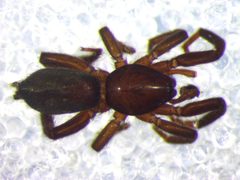
2Heser is a of ground spiders (Gnaphosidae) in the Zelotes group, established in 2004. The genus comprises 11 of small to medium-sized spiders distributed across Africa, Asia, Europe, and North America. Several species have been introduced to the United States and Mexico. The type species is Heser malefactor from Kazakhstan.
Pronunciation
How to pronounce Heser: /ˈhe.sɛɾ/
These audio files are automatically generated. While they are not always 100% accurate, they are a good starting point.
Identification
Distinguished from related by preening combs on III and IV. Male Heser stoevi can be distinguished from H. aradensis by a longer embolus, smaller and flattened conductor, and lack of retrolateral tibial . Females have well-developed copulatory openings leading to coiled insemination ducts connected with coiled spermathecae.
Images
Habitat
H. stoevi found under stones in arid grassland at elevations of 860-1150 m in the Koytendag Mountains, Turkmenistan. Other occur in diverse terrestrial habitats across their range.
Distribution
Native to Africa, Asia, Europe, and North America. Specific records include: Israel (H. aradensis, H. hierosolymitanus), Spain and Algeria (H. bernardi, H. bonneti), Spain (H. hispanus), Tanzania, Egypt, and Israel (H. infumatus), Kazakhstan (H. malefactor), Mediterranean region and Canary Islands with introductions to USA and Mexico (H. nilicola), Spain, Madeira, and Canary Islands with introductions to USA (H. schmitzi), Turkmenistan (H. stoevi), and India (H. vijayanagara).
Human Relevance
H. nilicola and H. schmitzi have been introduced to the United States; H. nilicola also introduced to Mexico. No documented economic or medical significance.
Similar Taxa
- ZelotesBoth belong to the Zelotes group of Gnaphosidae; Heser distinguished by preening combs on III and IV
- Heser aradensisH. stoevi is morphologically close but differs in male genitalia structure and female copulatory organs