
Hyptiotes gertschi
Chamberlin & Ivie, 1935
Gertsch's Triangleweaver
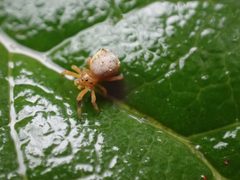
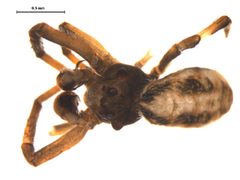
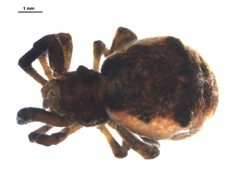
Hyptiotes gertschi is a cribellate orb-weaving spider in the Uloboridae, commonly known as Gertsch's Triangleweaver. Like other members of its , it constructs a distinctive triangular web—a reduced sector of a typical orb web. The is one of four Hyptiotes species in North America and is distributed across the United States and Canada, with records from Alberta, British Columbia, and Manitoba.
Pronunciation
How to pronounce Hyptiotes gertschi: //hɪpˈtaɪ.əˌtiːz ˈɡɜrtʃi//
These audio files are automatically generated. While they are not always 100% accurate, they are a good starting point.
Identification
H. gertschi can be distinguished from the eastern H. cavatus by its western and northern distribution. females measure 3–4 mm, males 2–3 mm. The triangular web shape—essentially a single sector of an orb web with the apex anchored to a twig tip—is diagnostic for the . The spider typically perches at the web apex on the anchor thread.
Images
Habitat
Webs are constructed on twigs of trees and shrubs, in weeds, and on bridges and other structures, typically at waist height.
Distribution
Recorded from the United States and Canada. Canadian provincial records include Alberta, British Columbia, and Manitoba. The has a western and northern distribution relative to H. cavatus.
Behavior
The spider maintains tension on the anchor thread of its triangular web; when prey impacts the web, it releases the thread, causing the web to rebound and further entangle the prey.
Ecological Role
As a non-venomous , subdues prey through web entanglement and silk wrapping rather than venom injection.
Similar Taxa
- Hyptiotes cavatusThe sole eastern North American ; distinguished by geographic distribution and likely range.