
Homalonychus theologus
Chamberlin, 1924
American sand assassin
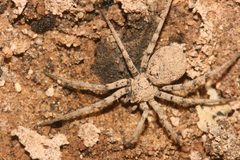
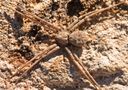
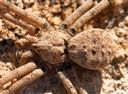
Homalonychus theologus is a true spider in the obscure Homalonychidae, found in the southwestern United States and northwestern Mexico. It is one of only two in its . The species exhibits distinctive sand-encrusted camouflage achieved through specialized setae that trap soil particles. It does not construct webs and has been observed employing self-burying during molting and mating.
Pronunciation
How to pronounce Homalonychus theologus: //hoʊˌmæloʊˈnaɪkəs θiˈɑːləˌɡəs//
These audio files are automatically generated. While they are not always 100% accurate, they are a good starting point.
Identification
Distinguished from by molecular and morphological characteristics; H. theologus can be separated from H. selenopoides through analysis and subtle morphological differences. The sprawling resting posture and encrusted appearance from debris-covered setae are field characteristics of the . Females measure 8.5–10 mm in body length, males 6.5–7 mm. Possesses three pairs of but does not spin webs.
Images
Habitat
Arid and semi-arid regions including desert environments. Found under surface objects such as rocks, old railroad ties, and dead cacti when rocks are absent. Occurs in sandy or fine soil substrates that enable debris adhesion to the body.
Distribution
Southwestern United States (southern California, Nevada, Arizona) and northwestern Mexico including the Baja California peninsula.
Diet
. Observed feeding on insects in the order Zygentoma (silverfish relatives) and engaging in . Accepts pomace flies (Drosophila) and crickets in laboratory conditions.
Life Cycle
Suspected to be long-lived, with potential lifespan of at least two years in the wild. Mated females construct silken sacs covered with small pebbles and debris particles.
Behavior
Does not spin webs or produce draglines during movement. Males use silk to loosely bind female legs during mating. Exhibits self-burying , covering itself with sand during molting. Assumes a sprawling posture at rest. Females display a potential defensive posture when disturbed. Juveniles show limited , contributing to localized structure.
Ecological Role
in arid . structure suggests limited and patchy distribution.
Human Relevance
Occasionally encountered in human structures in desert regions. One of the few documented observations from the Dale Mining District outside Twentynine Palms, California, involved specimens found inside a house.
Similar Taxa
- Homalonychus selenopoidesOnly other in ; distinguished by molecular studies and subtle morphological differences; ranges overlap in southwestern North America
- SicariidaeSome members bury themselves in loose sand, but Homalonychus achieves camouflage through debris adhesion to setae rather than burial; also distinguished by three pairs of and lack of web-building