
Homalonychidae
Simon, 1893
encrusted spiders, dusty desert spiders, American sand assassins
Genus Guides
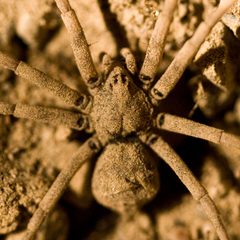
1Homalonychidae is a small of spiders containing a single , Homalonychus, with three described . These spiders are characterized by their distinctive 'encrusted' appearance caused by soil and debris adhering to short, stiff setae covering their bodies. They are medium-sized, non-web-building spiders found in arid regions of southwestern North America and northwestern Mexico. Their phylogenetic placement remains uncertain due to a combination of advanced morphological features and primitive behavioral traits.
Pronunciation
How to pronounce Homalonychidae: //hɒmæl.oʊˈnɪkɪˌdeɪ//
These audio files are automatically generated. While they are not always 100% accurate, they are a good starting point.
Identification
Distinguished from other ground-dwelling spiders by the combination of: (1) debris-encrusted appearance from setae-trapped particles, unlike the cleaner appearance of most spiders; (2) three pairs of (most spiders have two pairs); (3) sprawling posture at rest; and (4) absence of web-building . They differ from Sicariidae (which includes sand-dwelling ) by not burying themselves in loose sand. The two North American species, H. theologus and H. selenopoides, require molecular or detailed morphological analysis for reliable separation.
Images
Appearance
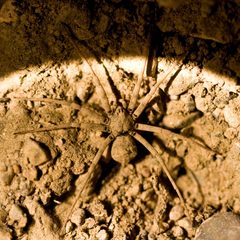
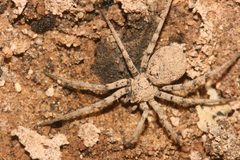
Medium-sized spiders with females measuring 8.5–10 mm and males 6.5–7 mm in body length. The body and legs are covered with short, stiff setae that trap particles of sand, soil, and fine debris, giving them a distinctive encrusted or dusty appearance. They possess three pairs of . At rest, they adopt a characteristic sprawling posture that makes them appear larger than their actual size. The and are both covered in these debris-catching setae.
Habitat
Arid and semi-arid environments including desert regions. Found under surface debris such as old railroad ties, rocks, and other ground cover. Occupies soil crevices and similar sheltered microhabitats. Not a burrower in loose sand, though one exhibits self-burying in specific contexts.
Distribution
Southwestern North America: southern California, Nevada, and Arizona in the United States; Baja California peninsula; northwestern Mexico. Distribution of constituent is narrow and potentially fragmented into localized .
Seasonality
Observed active in April; likely active year-round in suitable microhabitats given suspected long lifespan. Specific seasonal patterns not well documented.
Diet
observed on insects related to silverfish (order Zygentoma). documented. Laboratory specimens accept pomace flies (Drosophila) and crickets. Whether specialization occurs in natural is unknown.
Life Cycle
Females construct silken sacs and cover them with small pebbles and debris particles. Suspected to survive at least two years in the wild, suggesting extended lifespan relative to many spider .
Behavior
Non-web-building; does not spin webs or lay draglines while moving. Males use silk to loosely bind female legs during mating. Males perform involving leg tapping and body vibrations. Males may engage in mate guarding. Self-burying observed in at least one . Adopts potential defensive postures when disturbed. Described as docile in human encounters.
Ecological Role
in arid ground-dwelling . Potential role in controlling of soil-dwelling insects such as Zygentoma. suggests intraguild dynamics. Limited ability likely results in localized population structure.
Human Relevance
Occasionally encountered in human structures in desert regions. No documented medical or economic importance. Subject of scientific interest due to uncertain phylogenetic placement and unusual combination of morphological and behavioral traits.
Similar Taxa
- SicariidaeIncludes sand-dwelling , but Homalonychidae differ by not burying themselves in loose sand and by having debris-encrusted appearance from setae rather than active sand-covering
- ZodariidaeFormerly included the Indian now placed in Storenomorpha; distinguished by different morphological features and geographic distribution
More Details
Phylogenetic uncertainty
The 's placement within Araneae remains unresolved. Homalonychidae possess relatively advanced physical features but mostly primitive , complicating phylogenetic analysis.
Taxonomic history
An additional was formerly attributed to this from India, but has been reassigned to Storenomorpha in the family Zodariidae.
Population structure
Suspected limited likely results in scattered, localized despite potential for high local abundance.
Sources and further reading
- BugGuide
- GBIF taxonomy match
- iNaturalist taxon
- NCBI Taxonomy
- Catalogue of Life
- Bug Eric: Spider Sunday: Homalonychus
- Reproductive behavior of Homalonychus selenopoides (Araneae: Homalonychidae)
- MATING AND SELF-BURYING BEHAVIOR OF HOMALONYCHUS THEOLOGUS CHAMBERLIN (ARANEAE, HOMALONYCHIDAE) IN BAJA CALIFORNIA SUR