
Zodariidae
Thorell, 1881
Ant-eating Spiders, Ant Spiders
Genus Guides
2Zodariidae, commonly known as -eating spiders, is a of small to medium-sized eight-eyed spiders found worldwide in tropical to warm temperate regions. The family comprises approximately 90 and 1,249 , with the highest diversity in Australia. Members are predominantly ground-dwelling, free-living that do not construct webs for prey capture. Many species exhibit specialized ant-eating habits and , disguising themselves as ants to hunt their primary prey. The family has relatively few species in North America compared to other regions.
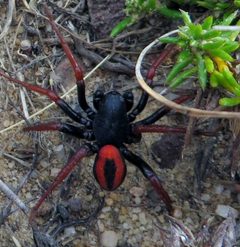
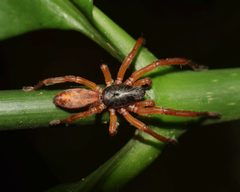
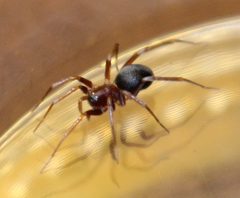
Pronunciation
How to pronounce Zodariidae: /zoʊˈdɛəriˌaɪdiː/
These audio files are automatically generated. While they are not always 100% accurate, they are a good starting point.
Images
Habitat
Ground-dwelling; free-living. Many occupy terrestrial including woodland, Jarrah forest, sand plain vegetation, and montane forest. Some , such as Asceua, exhibit -dwelling , which is unusual for this . Members of the genus Zodarion construct igloo-shaped stone retreats attached to the underside of rocks or dead wood for daytime shelter.
Distribution
All continents except Antarctica. Highest in Australia. Significant representation in Europe, Asia, and North Africa, with at least 35 reported from the Iberian Peninsula alone. Present in the Afrotropical region, Southeast Asia (including Thailand and Vietnam), Indonesia (Sundaland), and the Americas. Relatively few species in North America.
Diet
Predominantly ; all of the Zodarion are compulsory ant eaters. Some species have been observed feeding on insects related to silverfish (order Zygentoma) and exhibit . Laboratory specimens accept pomace flies (Drosophila) and crickets.
Host Associations
Behavior
wanderers, mainly active in twilight. Many perform , disguising as ants to aid in hunting and prey capture. During daylight, spiders remain hidden in carefully constructed retreats. Males of some use silk to loosely bind female legs during mating. Mated females construct silken sacs covered with small pebbles and debris.
Ecological Role
Terrestrial ; important role in services. Some contribute to through . May serve as for .
Similar Taxa
- HomalonychidaeBoth contain ground-dwelling spiders with encrusted appearances from debris adherence; historically confused due to similar and preferences. Homalonychidae differs in having three pairs of and lacking the specialized -eating habits of Zodariidae.
- SicariidaeSome sicariids bury themselves in loose sand, whereas zodariids do not; both are ground-dwelling but differ in prey specialization and retreat construction
More Details
Phylogenetic significance
The Cyrioctea, basal in the , shows a temperate Gondwanaland distribution pattern, implying greater age of Zodariidae than currently accepted. Unlike most Gondwanan , Cyrioctea exhibits high with small distribution areas, suggesting recent radiation after prolonged stasis.
Taxonomic diversity
The includes three : Lachesaninae, Storeninae, and Zodariinae. Recent revisions have described numerous new from Iran, Turkmenistan, Turkey, Indonesia, and Africa, with seventeen new species described from Iran and Turkmenistan alone in a single 2021 study.
Sources and further reading
- BugGuide
- GBIF taxonomy match
- iNaturalist taxon
- NCBI Taxonomy
- Catalogue of Life
- Bug Eric: Spider Sunday: Homalonychus
- Uncategorized | Blog - Part 42
- Survival of the fittest: predator wasps breed at the expense of spider juveniles | Blog
- Datasets of traits of zodariid spiders (Araneae: Zodariidae)
- Two new species of Zodarion Walckenaer, 1826 (Araneae: Zodariidae) from Turkey
- Ballomma, a new Afrotropical genus in the Cryptothelinae (Araneae, Zodariidae): eyes on the run
- Five new Mallinella species from the Sundaland of Indonesia (Araneae, Zodariidae)
- A revision of the genus Cicynethus Simon, 1910 (Araneae, Zodariidae), a tale of colour patterns
- On Vietnamese representatives of the ant spider genus Heradion (Araneae: Zodariidae)
- New data on the distribution of Zodarion rubidum Simon, 1914 (Araneae, Zodariidae) in Poland
- On Vietnamese representatives of the ant spider genus Heradion (Araneae: Zodariidae)
- Cyrioctea (Araneae, Zodariidae) in Africa: temperate Gondwanaland relict, recent radiation, or both?
- Diet and predatory behavior of the Asian ant-eating spider, Asceua (formerly Doosia) japonica (Araneae: Zodariidae)
- Revision of the spider family Zodariidae (Arachnida, Araneae) in Iran and Turkmenistan, with seventeen new species
- A revision of Afrotropical Asceua (Araneae, Zodariidae), ant-eating spiders with puzzling distributions