
Leiobunum ventricosum
(Wood, 1868)
Early-Season Group
Leiobunum ventricosum is a of harvestman in the Sclerosomatidae, first described by Wood in 1868. It belongs to the Leiobunum, a group of long-legged harvestmen that are notoriously difficult to identify to species level. The species is found in North America, with confirmed records from Vermont and other regions. Like other members of its genus, it possesses distinctive morphological features including an ocularium—a raised structure bearing the —and elongated legs, with the second pair often held aloft and waved as sensory appendages.
Pronunciation
How to pronounce Leiobunum ventricosum: /ˌlaɪ.oʊˈbjuː.nəm vɛn.trɪˈkoʊ.sʌm/
These audio files are automatically generated. While they are not always 100% accurate, they are a good starting point.
Identification
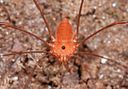
in the Leiobunum are notoriously difficult to identify, and L. ventricosum requires careful examination for definitive determination. The ocularium (a raised bearing the ) is a key structure visible in lateral profile. Males typically exhibit elongated palps with knees that extend dorsally well above the level of the ocularium. The body generally shows a dark stripe with a pointed . The second pair of legs is disproportionately long and characteristically waved in the air as pseudo-, a that can complicate close observation and photography.
Images
Habitat
Wooded across eastern North America. The occupies forested environments where it can be found on downed logs, tree trunks, and branches.
Distribution
North America. Confirmed present in Vermont, United States, with broader distribution across the eastern United States and North American range.
Seasonality
Early-season activity pattern suggested by the 'Early-Season Group', though specific phenological details require further documentation.
Behavior
Individuals characteristically wave their elongated second pair of legs in the air as pseudo-, serving a sensory function. This makes close approach difficult, as contact with any object triggers rapid escape. When distracted by prey, individuals may become temporarily stationary, allowing observation. The has been observed feeding on small arthropods, including nymphal blattodeans.
Similar Taxa
- Leiobunum vittatumClose relative with similar super long legs, dark stripe, pointed , and very long palps with dorsally extended knees. L. vittatum is a common inhabitant of wooded across the eastern U.S. and shares morphological features that make field identification challenging without detailed examination.
- Leiobunum crassipalpeClose relative ranging from southern Missouri, northern Arkansas, and eastern Oklahoma that shares the general Leiobunum body plan and requires careful examination of palpal and body proportions for separation from L. ventricosum.
More Details
Taxonomic Note
Leiobunum ventricosum was described by Wood in 1868. The Leiobunum belongs to the suborder Eupnoi, characterized by long legs and generally slender bodies compared to the short-legged Laniatores.
Observation Challenges
The extreme length of the second pair of legs and their constant waving motion makes photography and close observation technically difficult. Lateral profile shots, which best show the ocularium and body proportions, require patience or distraction of the subject with prey.