
Leiobunum vittatum
(Say, 1821)
eastern harvestman
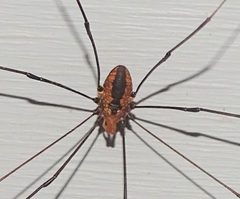
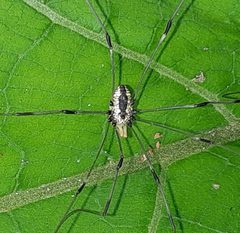
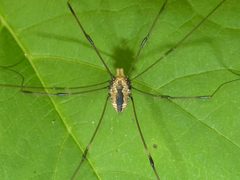
Leiobunum vittatum, commonly known as the eastern harvestman, is a of harvestman in the Sclerosomatidae. It occurs in North America and is most active from late spring to early fall. Males display elongated, spiny and are known to wave their second pair of legs as pseudo-. The species exhibits autumn in tree holes or other shelters for .
Pronunciation
How to pronounce Leiobunum vittatum: /ˌlaɪəˈbjuːnəm vɪˈteɪtəm/
These audio files are automatically generated. While they are not always 100% accurate, they are a good starting point.
Identification
Males possess elongated, spiny that extend dorsally well above the ocularium. The body typically shows a dark stripe with a pointed . The second pair of legs is notably elongate and waved in the air as pseudo-. The ocularium (optical ) is prominent, bearing the ocelli. -level identification within Leiobunum is notoriously difficult; L. vittatum is suggested by the combination of super long legs, dark dorsal stripe, pointed abdomen, and very long palps with 'knees' extending dorsally above the ocularium level.
Images
Habitat
Wooded including mesic deciduous forest and dry-mesic upland forest. Observed on tree trunks such as shagbark hickory (Carya ovata).
Distribution
North America; specifically recorded from eastern United States including Missouri and Vermont.
Seasonality
Most active from late spring to early fall. are laid in late summer. Autumn occur for .
Diet
: feeds on plant fluids, fungi, and other arthropods.
Life Cycle
laid in late summer. Developmental stages beyond this are not documented in available sources.
Behavior
Males wave the second pair of legs in the air as pseudo-. During autumn, individuals gather in groups in tree holes or other shelters to stay warm. When disturbed, they scamper rapidly. Males may display elongated .
Similar Taxa
- Leiobunum species complex in Leiobunum are notoriously difficult to identify; L. vittatum is distinguished by the specific combination of long legs, dark stripe, pointed , and male structure.