
Leiobunum
Koch, 1839
harvestmen, daddy long-legs
Species Guides
17Leiobunum is a of harvestmen (order Opiliones, Sclerosomatidae) comprising over 100 described . Members are characterized by exceptionally long legs relative to body size, with the second pair serving as sensory appendages rather than locomotory structures. The genus exhibits pronounced gregarious , with many species forming dense on vertical surfaces. Leiobunum species are found across North America, Europe, and Asia, with some demonstrating rapid spread in Europe.
Pronunciation
How to pronounce Leiobunum: //laɪˈɒb.jʊ.nəm//
These audio files are automatically generated. While they are not always 100% accurate, they are a good starting point.
Identification
Distinguished from other harvestman by the extreme elongation of the second leg pair, which is waved continuously as sensory structures. The combination of long legs, dark stripe, pointed , and elevated ocularium separates Leiobunum from shorter-legged sclerosomatids. -level identification requires examination of male genitalia and is notoriously difficult; palp structure and body proportions provide useful characters. Gregarious on walls and fences are diagnostic behavioral indicators for several common species.
Images
Appearance
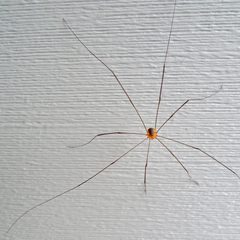
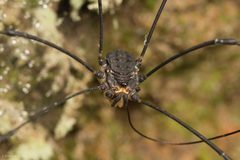
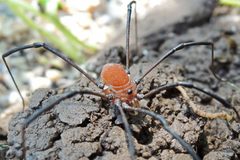
Body small and compact relative to leg length, typically 5–10 mm in body length with legs extending several centimeters. surface often with brownish-black coloration and darker longitudinal stripe; sides frequently brighter. Second pair of legs distinctly elongated, functioning as sensory appendages waved in air as pseudo-. Males possess elongated, spiny used in clasping females during mating. Ocularium (ocular ) present, bearing two ; a pale yellow longitudinal line often visible between eyes. evident: males smaller with flattened, oval bodies and parvum; females larger with raised abdominal profile. Male genitalia with slender, whitish, feebly sclerotized bearing strongly elongated glans; female ovipositor whitish, 25–27 segmented.
Habitat
Inhabits tree trunks, fences, walls (including building walls and stone walls), and shaded building corners. frequently observed on industrial sites, window ledges, beneath roof gutters, and brick oven walls. Negative drives selection of shaded microhabitats. occupy similar anthropogenic structures in Europe.
Distribution
Native range spans North America (widespread across United States, from California to eastern seaboard), Europe (including Alps, Germany, Spain, France, Italy, Austria), and Asia (Japan, Korea, Taiwan, China, Russia). established in Netherlands since approximately 2000, subsequently spreading to Germany, Switzerland, and Austria. Additional records from Mexico, Central America, Morocco, Turkey, and Cyprus.
Seasonality
Active during warmer months; observations peak in late summer and autumn. European observed year-round in sheltered microhabitats. Mating and deposition occur during active season.
Diet
with predatory, scavenging, and detritivorous components. Primary prey includes earthworms (Oligochaeta), with Coleoptera as secondary prey. Scavenges on dead earthworms and spent spider prey. Consumes vegetable matter including blackberries; feeds on bird droppings. Smaller unable to attack large earthworms rely more heavily on scavenging. Foraging occurs above ground level to reduce competition.
Life Cycle
deposition occurs in holes and crevices of walls and other sheltered structures. Females deposit eggs in protected locations; males guard egg-depositing females. Developmental stages include egg and forms resembling miniature . No distinct larval instars; growth occurs through molting.
Behavior
Highly gregarious, forming dense of dozens to hundreds of individuals on vertical surfaces— pronounced in some but absent in others (e.g., Polish remain dispersed). Leg employed as anti- defense; loss of three or more legs significantly impairs mobility, foraging , and male mating success. Males engage in intraspecific combat for access to females, with guarding males defending -depositing females against rival males. Second leg pair continuously waved as sensory structures, providing tactile and chemical information about environment.
Ecological Role
and scavenger of soil and litter ; contributes to nutrient cycling through detritivory. Prey for spiders including Araneus diadematus, Larinioides sericatus, Marpissa mucosa, and Zygiella x-notata. Facilitates energy transfer between ground and above-ground through vertical foraging . Gregarious may influence local microclimate and predator detection.
Human Relevance
Common in anthropogenic environments, frequently observed on building walls and fences. Subject of persistent misconception that they are spiders or possess venom (they are neither spiders nor venomous). Some demonstrate potential, with unidentified Leiobunum species rapidly colonizing urban environments in Western Europe. Occasionally studied as model organisms for behavioral , particularly regarding and the costs of .
Similar Taxa
- PhalangiumBoth long-legged harvestmen in Sclerosomatidae; Phalangium typically has shorter legs relative to body and lacks the extreme second leg elongation characteristic of Leiobunum.
- NelimaNelima have shorter, stouter legs and more robust body form; lack the distinctive waving of the second leg pair seen in Leiobunum.
- HadrobunusNorth American sclerosomatid with shorter legs and different body proportions; does not form the dense wall typical of many Leiobunum .
Misconceptions
Despite 'daddy long-legs,' Leiobunum are not spiders (order Araneae) but harvestmen (order Opiliones). They lack venom glands entirely and pose no threat to humans. The myth that they possess highly toxic venom unable to penetrate human skin is false—they have no venom apparatus.
More Details
Invasive potential
An undescribed Leiobunum has demonstrated rapid spread across Western Europe since approximately 2000, with established in Netherlands, Germany, Switzerland, and Austria. This species is distinct from native Central European fauna and occupies urban and industrial .
Geographic variation
Japanese Leiobunum hiraiwai exhibits extensive geographic variation in number (2n = 18–22) and somatic across eight recognized geographic races, representing a polytypic .
Mating system complexity
Mating in L. vittatum involves multiple distinct stages: initial struggle where male secures female using , followed by tactile exchanges and transfer. Male pedipalp length correlates with success in initial clasping, while relative body size determines speed of embrace formation.
Sources and further reading
- BugGuide
- Wikipedia
- GBIF taxonomy match
- iNaturalist taxon
- NCBI Taxonomy
- Catalogue of Life
- Answer to Super Crop Challenge #1 | Beetles In The Bush
- October | 2021 | Beetles In The Bush
- Costs associated with leg autotomy in the harvestmenLeiobunum nigripesandLeiobunum vittatum(Arachnida: Opiliones)
- Costs associated with leg autotomy in the harvestmen <i>Leiobunum nigripes</i> and<i> Leiobunum vittatum</i> (Arachnida: Opiliones)
- Notes on the biology of the unidentified invasive harvestmanLeiobunumsp. (Arachnida: Opiliones)
- Geographic variation of chromosomes and somatic morphology in the Japanese polymorphic species Leiobunum hiraiwai (Arachnida: Opiliones: Sclerosomatidae)
- Sexual Differences in the Behavior of the Harvestman Leiobunum vittatum (Opiliones, Sclerosomatidae) Towards Conspecific Cues
- Mating in the harvestman Leiobunum vittatum (Arachnida: Opiliones): from premating struggles to solicitous tactile engagement
- Contrasting patterns of divergence and gene flow in subspecies of a forest-dwelling harvestman Leiobunum japanense (Eupnoi: Opiliones: Arachnida)