
Leiobunum flavum
Banks, 1894
Golden Harvestman
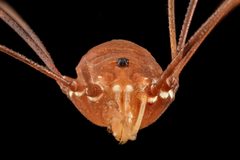
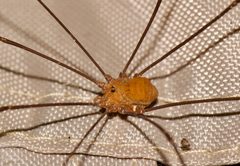
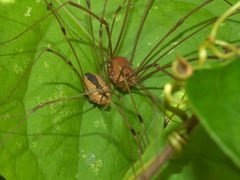
Leiobunum flavum is a of harvestman (order Opiliones) in the Sclerosomatidae. It is commonly known as the Golden Harvestman. The species has been documented in North America, with specific records from Vermont. Like other members of the Leiobunum, it possesses the characteristic long legs and body form typical of long-legged harvestmen.
Pronunciation
How to pronounce Leiobunum flavum: /ˌlaɪoʊˈbjuːnəm ˈfleɪvəm/
These audio files are automatically generated. While they are not always 100% accurate, they are a good starting point.
Identification
Identification to within Leiobunum is notoriously difficult and typically requires examination of male and other genitalic structures. Leiobunum flavum is closely related to L. vittatum and other eastern North American . Species in this generally exhibit long, slender legs (especially the second pair), an elongate body, and males often possess elongated, spiny pedipalps. The specific distinguishing characters of L. flavum relative to its congeners are not well documented in accessible literature.
Images
Habitat
Specific preferences for L. flavum are not well documented. Related in the Leiobunum are typically found in wooded habitats, including mesic deciduous forests and riparian areas. Members of this genus are often observed on tree trunks, logs, and vegetation.
Distribution
Documented from North America, with specific occurrence records from Vermont, United States. The full extent of its range within North America is not precisely defined in available sources.
Behavior
As with other Leiobunum , individuals may exhibit leg-waving , where the elongated second pair of legs is raised and moved in the air, serving a sensory function analogous to . This behavior can make close approach for photography difficult as the legs detect nearby objects.
Similar Taxa
- Leiobunum vittatumA common eastern North American with overlapping range and similar general appearance. Males of both possess elongated . Accurate differentiation requires detailed examination of pedipalp and genitalic .
- Leiobunum crassipalpeAnother close relative found in southern Missouri, northern Arkansas, and eastern Oklahoma. Similar body plan and preferences; -level identification requires examination.
More Details
Taxonomic note
The Leiobunum contains numerous that are morphologically similar and difficult to distinguish without detailed examination. Published identification resources for North American species remain limited, and many records likely represent misidentifications or unresolved .