
Leiobunum crassipalpe
Banks, 1900
Leiobunum crassipalpe is a harvestman in the Sclerosomatidae, first described by Nathan Banks in 1900. It belongs to a characterized by exceptionally long legs and elongated body forms. The species occurs in the south-central United States, where it inhabits wooded . Males possess distinctive enlarged that extend dorsally above the ocularium.
Pronunciation
How to pronounce Leiobunum crassipalpe: //ˌlaɪoʊˈbjuːnəm ˌkræsɪˈpælpi//
These audio files are automatically generated. While they are not always 100% accurate, they are a good starting point.
Identification
Distinguished from the closely related Leiobunum vittatum by details of ; specifically, the structure and proportions of the male pedipalps differ between the two . The combination of extremely long legs, dark stripe, pointed , and pedipalps extending above the ocularium indicates membership in the L. vittatum . Definitive identification requires examination of male pedipalp structure.
Images
Appearance
Long-legged harvestman with elongated body and very long second pair of legs that are waved in the air as pseudo-. Males have enlarged, spiny with 'knees' that extend dorsally to a level well above the ocularium. Body typically shows a dark stripe with pointed . The ocularium (ocular ) is prominent and contains the ocelli.
Habitat
Inhabits wooded , particularly mesic deciduous forests. Has been observed on tree trunks and fallen logs in forested areas.
Distribution
South-central United States: southern Missouri, northern Arkansas, and eastern Oklahoma. Records from this region represent the core of its known range.
Seasonality
Active during warmer months; observations from October suggest fall activity. Specific details are not well documented.
Behavior
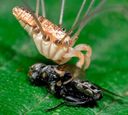
Exhibits leg-waving , particularly with the elongate second pair of legs, which are held in the air and function as pseudo- to detect environmental stimuli. This behavior makes close approach difficult as contact with any object triggers rapid escape. Individuals have been observed feeding on small prey items including nymphal blattodeans ( ).
Ecological Role
of small in forest floor and trunk . Serves as prey for larger arthropods and potentially small vertebrates.
Similar Taxa
- Leiobunum vittatumExtremely similar and shared preferences; distinguished by subtle differences in male structure. L. vittatum has a broader eastern U.S. distribution, while L. crassipalpe is restricted to the south-central region.
More Details
Taxonomic History
First described by Nathan Banks in 1900. Long confused with or considered a variant of Leiobunum vittatum due to morphological similarity. -level distinction confirmed through detailed examination of male .
Photographic Challenges
The combination of long working distance requirements for macro photography and the ' sensitive leg-waving escape response makes lateral profile photography particularly difficult. Successful images typically require encountering individuals distracted by feeding or other activities.