
Nelima
Roewer, 1910
Species Guides
2- Nelima elegans
- Nelima paessleri(Aggregating Harvestman)
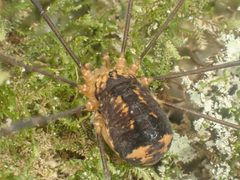
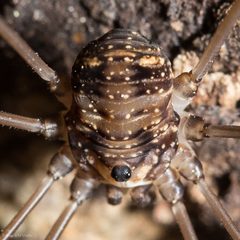
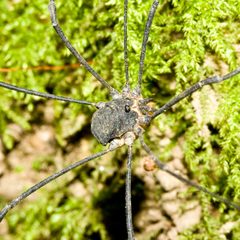
Nelima is a of harvestmen (Opiliones) in the Sclerosomatidae, established by Roewer in 1910. The genus contains 37 as of 2025, distributed across Europe and Asia. Some species occupy specialized : Nelima gothica is abundant in coastal sand dunes, Nelima silvatica occurs in woodland habitats, and Nelima aurantiaca has been recorded in cave . The genus exhibits diverse ecological preferences from coastal dunes to forests and subterranean environments.
Pronunciation
How to pronounce Nelima: //nɛˈliːma//
These audio files are automatically generated. While they are not always 100% accurate, they are a good starting point.
Identification
Nelima can be distinguished from the similar Leiobunum by genital ; male genitalia show species-specific differences useful for identification. External characters require comparison with related genera in the Leiobuninae . Species-level identification typically requires examination of male genital structures.
Images
Habitat
varies by : Nelima gothica occupies coastal sand dunes, particularly dense Ammophila arenaria vegetation without active sand shifting; Nelima silvatica inhabits woodland and forested areas; Nelima aurantiaca has been documented in cave . Some species show patchy distribution with high local abundance but absence from nearby suitable sites.
Distribution
Europe and Asia. Documented from Denmark, Norway, Sweden, Great Britain, France (Haute-Savoie), and Japan (Hokkaido). Nelima gothica shows potential distribution along western Danish coastal dunes, Wadden Sea area, and eastern Danish coasts. Nelima silvatica is recorded as the harvestman on Skokholm Island, Great Britain.
Seasonality
Nelima gothica exhibits an life-cycle with development in late spring and summer, autumn , and -stage hibernation. This follows the typical pattern of North-European Phalangiidae and Leiobuninae.
Life Cycle
Nelima gothica has an life-cycle: juveniles develop through late spring and summer, occurs in autumn, and hibernation occurs in the stage. General life-cycle patterns for other Nelima are not documented.
Similar Taxa
More Details
Taxonomic history
The has undergone significant taxonomic revision. Several originally described as Nelima have been synonymized with other genera: Nelima humilis with Gyas annulatus, Nelima melanodorsum with Odiellus aspersus, and Nelima fuscifrons with Leiobunum blackwalli. Nelima insignita and Nelima margaritata are junior synonyms of Nelima nigricoxa albiangulata.
Research gaps
Most ecological and biological information derives from studies of single (particularly N. gothica and N. silvatica). -wide patterns for diet, , and function remain undocumented.
Sources and further reading
- BugGuide
- Wikipedia
- GBIF taxonomy match
- iNaturalist taxon
- NCBI Taxonomy
- Catalogue of Life
- The Harvest‐spider Nelima silvatica (Simon) in Great Britain
- Distribution and life-cycle ofNelima gothica(Opiliones, Sclerosomatidae) in Danish dunes
- Phenology and biology of harvestmen in and near Sapporo, Hokkaido, Japan, with some taxonomical notes on Nelima suzukii n. sp. and allies (Arachnida: Opiliones)
- Notes préliminaires sur la distribution spatiale de Meta menardi, Triphosa dubitata, Triphosa sabaudiata, Nelima aurantiaca et Culex pipiens au sein d'un écosystème cavernicole (Grotte de la Scierie: Hte.-Savoie)