
Odiellus
Roewer, 1923
harvestmen
Species Guides
2- Odiellus nubivagus
- Odiellus pictus(Painted Harvestman)
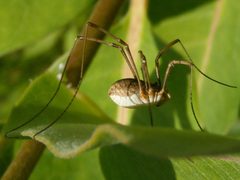
Odiellus is a of harvestmen in the Phalangiidae, containing approximately 17 described distributed across Europe and introduced regions. The genus includes Odiellus spinosus, a well-studied species with a sequenced and documented . Members of this genus are characterized by relatively short legs compared to many other harvestmen and often possess distinctive body ornamentation including spines or granulations.


Pronunciation
How to pronounce Odiellus: //oʊˈdaɪɛləs//
These audio files are automatically generated. While they are not always 100% accurate, they are a good starting point.
Identification
Members of Odiellus can be distinguished from other Phalangiidae by their relatively short legs and often flattened body profile. Odiellus spinosus specifically displays a prominent trident of three large spines to the . Many exhibit or spiny body surface textures. Detailed species-level identification requires examination of genitalia and other fine morphological characters.
Images
Habitat
occupy varied from natural to environments. Odiellus spinosus in its native range prefers dry open areas such as sand-dunes; in introduced regions it occurs in gardens, parks, railway embankments, and near buildings. are laid beneath decaying wood, leaf litter, rocks, or garden vegetation.
Distribution
Native to southern Europe. Odiellus spinosus has been introduced to and is expanding in northern Europe including UK, Belgium, Denmark, Germany, Netherlands, Poland, Sweden, and Switzerland. GBIF records indicate presence in Denmark, Norway, Sweden, and Vermont, USA.
Seasonality
Odiellus spinosus exhibits a one-year with active August–October. hatch late January through March, with development February–July. Adult mortality occurs by December.
Life Cycle
Odiellus spinosus completes development in approximately one year. overwinter without and hatch over an extended period of several months. Juveniles develop for six months before maturing. live approximately three months. Females lay two batches of eggs with 16–27 days between batches, producing a mean of 245 eggs (maximum 318). Eggs are large (up to 1.4 mm diameter) and laid in sheltered locations rather than buried.
Behavior
Males possess a 4 mm for direct insemination. Females have ovipositors extending up to 1.45 times body length, an for placement in concealed microhabitats.
Human Relevance
Odiellus spinosus has become established in urban and suburban environments in northern Europe, occurring in gardens and parks. The was selected for sequencing as part of the Darwin Tree of Life Project, yielding a 443.70 Mb genome assembly.
Similar Taxa
- PhalangiumAlso in Phalangiidae with long legs; Odiellus have proportionally shorter legs and often more pronounced body spination or granulation.
- OligolophusCongeneric in Oligolophinae; requires examination of , ocular structure, and male genitalia for reliable separation.