
Phalangium
Linnaeus, 1758
harvestmen, daddy long-legs
Species Guides
1- Phalangium opilio(European Harvestman)
Phalangium is a of harvestmen (Opiliones) occurring primarily in the Old World, with Phalangium opilio being the most widespread and well-known . The genus belongs to the Phalangiidae and contains approximately 17 currently recognized valid species. P. opilio has become globally distributed in temperate regions through human activity and is commonly encountered in anthropogenic environments.
Pronunciation
How to pronounce Phalangium: //fəˈlæŋɡiəm//
These audio files are automatically generated. While they are not always 100% accurate, they are a good starting point.
Identification
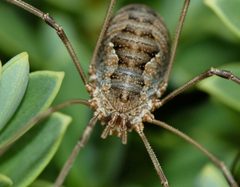
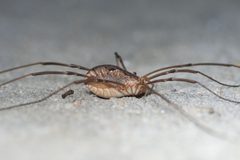
Members of Phalangium can be distinguished from other harvestman by features of the Phalangiidae, including a characteristic diamond-shaped 'saddle' marking on the . Males exhibit pronounced with cheliceral horns and elongated compared to females. P. opilio specifically can be recognized by its relatively small body size, long slender legs, and the distinctive dorsal pattern. Accurate identification within the genus typically requires examination of genitalia and other microscopic features.
Images
Habitat
in this occupy diverse terrestrial . P. opilio is particularly abundant in anthropogenic environments including meadows, gardens, agricultural fields, and urban areas. Field studies demonstrate strong substrate preferences, with wood favored over concrete, tile, or styrofoam due to more stable thermal and moisture conditions. The genus occurs across various temperate and subtropical zones.
Distribution
Primarily Old World in native range, with P. opilio now in temperate regions worldwide. Documented from Europe, Asia, North Africa, and introduced in North America and other regions. Study records include Slovenia, France, and Colorado (USA) for P. opilio.
Seasonality
P. opilio can survive winter as , , or specimens, enabling year-round presence in suitable climates. Activity patterns vary with local conditions; in temperate regions, adults may be encountered across multiple seasons including unseasonably warm periods in autumn and early winter.
Life Cycle
Development includes , , and stages. Eggs are laid in soil or concealed locations. P. opilio overwinters in any life stage. Sexual maturity is reached after several ; males develop sexually dimorphic structures (cheliceral horns, elongated ) upon maturity.
Behavior
P. opilio exhibits fine- thermoregulatory , actively selecting substrates that provide stable temperature and moisture conditions. Males engage in -to-face contests using cheliceral horns as pushing surfaces while rapidly tapping against opponents; larger males almost invariably win, with losers fleeing rapidly. During mating, males use elongated pedipalps to grasp female legs IV (or legs III in males with shorter pedipalps). Post-copulation, males typically bend over females and position cheliceral horns against the female dorsum. Both contest and mating behaviors involve specialized mechanoreceptors on pedipalps that detect contact intensity and frequency.
Human Relevance
P. opilio is frequently encountered by humans due to its abundance in anthropogenic and is commonly called simply 'harvestman' in many regions. The is harmless to humans and serves as a familiar example of arachnid diversity in educational contexts. Its global distribution makes it a subject of numerous ecological and behavioral studies.
Similar Taxa
- MetaphalangiumFormerly included now synonymized; distinguished by genitalic and somatic characters
- Bactrophalangium synonymized into Phalangium; previously recognized as distinct but now included within Phalangium
- LeiobunumAnother common phalangiid harvestman ; differs in body proportions, coloration, and male genital
More Details
Taxonomic History
The has undergone extensive taxonomic revision. Of 35 historical names, only 6 were valid as of 2014: P. ligusticum, P. opilio, P. punctipes, P. riedeli, P. savignyi, and P. targionii. The type species is P. opilio (designated by Latreille, 1810), not P. iberica. The genus Bactrophalangium (2 species) has been synonymized into Phalangium, and 8 additional species were described since 2005, bringing the current total to approximately 17 valid species.
Research Significance
P. opilio serves as a model organism for studies of arachnid , , and sensory due to its abundance, ease of observation, and pronounced male . Research has documented intrasexual contest behavior, mate-guarding tactics, and substrate selection in this .
Sources and further reading
- BugGuide
- Wikipedia
- iNaturalist taxon
- NCBI Taxonomy
- Catalogue of Life
- Bug Eric: ArachNovember?
- Bug Eric: My Personal National Moth Week, 2017
- Development and behaviour of Myzostoma alatum and Pulvinomyzostomum pulvinar, two myzostomid symbiotes of the comatulid Leptometra phalangium (Echinodermata)
- Preferences for different substrates in Phalangium opilio (Opiliones: Phalangiidae) in natural environment
- The Social Structure of Inachus phalangium, a Spider Crab Associated with the Sea Anemone
- Behavioral roles of the sexually dimorphic structures in the male harvestman, Phalangium opilio (Opiliones, Phalangiidae)