
Phalangium opilio
Linnaeus, 1758
European Harvestman, Common Harvestman, Brown Harvestman, Daddy Longlegs
Phalangium opilio is the most widespread harvestman globally, native to Europe and much of Asia and introduced to North America, North Africa, and New Zealand. It is a species that thrives in human-modified environments including agricultural fields, gardens, and urban green spaces. The species has become a model organism for arachnid developmental and comparative due to its ease of laboratory culture and continuous . are and scavengers that contribute to biological pest control in agricultural systems.
Pronunciation
How to pronounce Phalangium opilio: /fəˈlændʒiəm oʊˈpɪlioʊ/
These audio files are automatically generated. While they are not always 100% accurate, they are a good starting point.
Identification
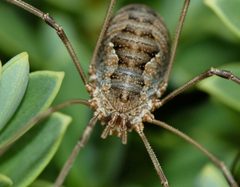
Distinguished from the similar Mitopus morio by two pale denticles (small tooth-like structures) below the margin of the , and by the long forward-pointing horns on the second segment of male . The diamond-shaped 'saddle' marking on the surface is characteristic of Phalangiidae. Males can be identified by their cheliceral horns and longer ; females lack these structures.
Images
Appearance
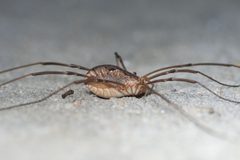
have a short, rounded body 3.5–9 mm long with extremely long, slender legs. The body and legs are covered with spines. Coloration is light brown to gray, often with a cream-colored underside. Males have smaller bodies than females but possess noticeably larger and prominent forward-pointing horn-like outgrowths on the side of the second segment of the . The second pair of legs is elongated and -like, used primarily as sensory appendages for feeling surroundings. Legs have seven segments with numerous tarsomeres making them prehensile for climbing.
Habitat
Occurs in diverse open including meadows, bogs, and forests. Most abundant in anthropogenic habitats: gardens, agroecosystems, hedgerows, lawns, quarries, urban green spaces, walls, and bridges. In agricultural settings, common in temperate cropland among corn, alfalfa, small grains, potatoes, cabbage, strawberries, and apple. Prefers vertical surfaces including tree trunks, fences, and walls, with particular preference for wood substrate due to thermal stability and moisture retention. Occupies different vertical levels based on life stage and available cover: early instars mostly on ground, later instars and use broader vertical range including vegetation.
Distribution
Native to Europe, North and Central Asia, and Asia Minor. Introduced to North America (non-desert regions of southern Canada and United States), North Africa, and New Zealand. Most widespread harvestman worldwide. Holarctic distribution pattern.
Seasonality
Activity is strongly , with approximately 90% of total activity occurring between 18:00 and 06:00. walk more from nightfall to midnight; males walk longer into early morning (until 03:00), possibly seeking mates. In Europe, with one per year, as . In some North American areas, two or more generations per year possible, with eggs, immatures, and adults potentially overwintering. In Kentucky, three generations per year with overwintering in egg stage. In Wisconsin , continuous possible in captivity without requirement.
Diet
and scavenger feeding on soft-bodied animals including aphids, caterpillars, leafhoppers, larvae, and mites. Also scavenges hard-bodied arthropods including other harvestmen. Known to feed on Helicoverpa zea in soybean crops.
Life Cycle
are smooth, spherical, about 0.55 mm diameter, laid in clusters of 10 to several hundred (typically ~250) in moist areas. Eggs hatch in 3–5 months; development rate temperature-dependent, fastest at 20–30°C, ceasing below 10°C. Juveniles undergo seven stages: non-feeding postembryo (larva) emerging from egg, molting to first instar within hours, followed by six instars. Immatures resemble but with shorter legs relative to body size. Male cheliceral horns become noticeable at instar. Juveniles reach maturity in 2–3 months. Adult lifespan 40–60 days.
Behavior
Spends most time stationary but exhibits , leg palpating (tapping with sensory legs), drinking, feeding, and . activity pattern with leg palpating occurring only at night; females and nymphs leg-palpate more than males, possibly as foraging strategy. Males engage in -to-face contests using cheliceral horns to push opponents while rapidly tapping ; larger males almost always win. During sexual interactions, males use longer pedipalps to hold female legs IV (or legs III if pedipalps shorter). After copulation, males typically bend over female positioning cheliceral horns against female dorsum. Exhibits vertical microhabitat : medium-sized nymphs remain in vegetation at night to avoid , while larger nymphs and adults move to ground at nightfall; adult males remain on ground longer than females and large nymphs; females migrate to top of plants at 03:00, males follow at 06:00. Takes cover in low vegetation during rain.
Ecological Role
contributing to biological pest control in agricultural systems. Preys on agricultural pests including Helicoverpa zea , aphids, and other crop pests. Not sole suppressor of pest but contributes alongside other generalist predators. Generalist feeding habits and intraspecific may allow population persistence when pest is low, enabling suppression of early pest stages.
Human Relevance
Important model organism for developmental and comparative of arachnids; first harvestman with draft assembled (2021). Used to study embryonic development, Hox gene function, and appendage evolution. Provides biological pest control in agriculture, particularly in soybean crops against Helicoverpa zea. Highly susceptible to broad-spectrum ; conservation encouraged through reduced insecticide use or use of targeted products like Bt toxins. species commonly encountered in human environments.
Similar Taxa
- Mitopus morioVery similar appearance, but P. opilio distinguished by two pale denticles below margin and male cheliceral horns
- Leiobunum spp.Different (Sclerosomatidae), typically with longer legs relative to body and different patterning; super long legs with 'waving' second pair
Misconceptions
Despite 'daddy longlegs,' not closely related to spiders (order Araneae) and lacks venom or silk glands. Does not possess venom dangerous to humans; this is a persistent myth. Has six , not one pair as long thought—two pairs are , corresponding to eyes of sea spiders and lateral eyes of spiders/scorpions.
More Details
Developmental genetics model
Sole model for order Opiliones. interference established, enabling gene function testing. Studies revealed dachshund gene essential for cheliceral segment reduction, and Hox gene logic specifying appendage identity. 'Daddy short legs' variants created through gene of Deformed and Sex combs reduced genes, producing shortened legs and homeotic .
Substrate preferences
Field experiments demonstrate strong preference for wood over concrete, tile, or styrofoam due to thermal and moisture stability. Wood provides most stable microclimate for this thermophilous, moderately hygrophilous .
Sources and further reading
- BugGuide
- Wikipedia
- GBIF taxonomy match
- iNaturalist taxon
- NCBI Taxonomy
- Catalogue of Life
- Bug Eric: ArachNovember?
- Bug Eric: My Personal National Moth Week, 2017
- Opiliones | Blog
- Answer to Super Crop Challenge #1 | Beetles In The Bush
- Cosmetid harvestman with parasitic/phoretic mites in Argentina | Beetles In The Bush
- Phreaky Phalangid | Beetles In The Bush
- Preferences for different substrates in Phalangium opilio (Opiliones: Phalangiidae) in natural environment
- DIEL ACTIVITY PATTERNS AND MICROSPATIAL DISTRIBUTION OF THE HARVESTMAN PHALANGIUM OPILIO (OPILIONES, PHALANGIIDAE) IN SOYBEANS
- Effect of Diet on Development and Reproduction of the HarvestmanPhalangium opilio(Opiliones: Phalangiidae)
- Behavioral roles of the sexually dimorphic structures in the male harvestman, Phalangium opilio (Opiliones, Phalangiidae)
- Distal‐less and dachshund pattern both plesiomorphic and apomorphic structures in chelicerates: RNA interference in the harvestman Phalangium opilio (Opiliones)
- Female Phalangium opilio use fellatio to compensate sexual avoidance.