
Mitopus morio
(Fabricius, 1779)
Saddleback Harvestman
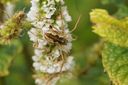
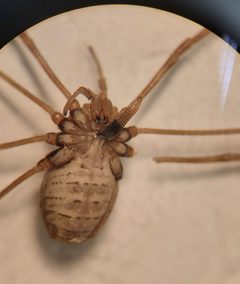
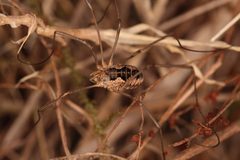
Mitopus morio is a widespread harvestman in the Phalangiidae, commonly known as the Saddleback Harvestman due to the distinctive dark saddle-like marking on its surface. This species exhibits notable morphological variability in size and coloration, with males typically brown and females darker. A distinctive behavioral trait involves using the first, third, and fourth pairs of legs while employing the elongated second pair as sensory appendages to probe the environment. are active from mid-May through mid-November in temperate regions, with hatch occurring in late March.
Pronunciation
How to pronounce Mitopus morio: /ˈmɪtoʊpəs ˈmɔriˌoʊ/
These audio files are automatically generated. While they are not always 100% accurate, they are a good starting point.
Identification
The combination of the dark saddle-like marking, small narrow with spikes around the eyebrow, and the distinctive use of the second leg pair as feelers separates this from other harvestmen. Males can be identified by the sharp tooth under the first cheliceral segment. Most similar to Phalangium opilio females, from which it can be distinguished by body proportions and eye structure.
Images
Habitat
Inhabits diverse including forests (beech, spruce), heath and moorland, meadows, human settlements, and gardens. Occurs from lowlands to mountains, demonstrating broad ecological .
Distribution
Europe, North Africa, Asia, and North America. Widespread across temperate regions of the Northern Hemisphere.
Seasonality
active mid-May to mid-November, varying by location. hatch late March.
Diet
with strong preference for animal food. Feeds on small insects and other small arthropods. Accepts both dead and live prey including meat, insects, and molluscs. Plant material consumed but less readily accepted.
Life Cycle
hatch at end of March. present from mid-May through mid-November. Specific details of development and stages not documented in available sources.
Behavior
Exhibits distinctive locomotor pattern: walks using first, third, and fourth leg pairs while holding second pair forward to probe environment and detect obstacles or prey. This sensory use of the second legs is an unusual among harvestmen.
Ecological Role
and scavenger in forest floor and grassland . feeding contributes to nutrient cycling through both and detritivory.
Human Relevance
Common in gardens and human settlements, where it contributes to control of small . No documented negative impacts on human activities.
Similar Taxa
- Phalangium opilioFemales especially similar; distinguished by body proportions, structure, and lack of the diagnostic second-leg sensory in Mitopus morio
More Details
Photoreceptor ultrastructure
Fine structural studies reveal microvilli in the , varying 1–2 μm in length and ~800 Å wide. Rhabdoms approximately cylindrical, ~40 μm long by 4–6 μm cross-diameter. Retinula contain acetylcholinesterase-positive vesicles associated with the rhabdom, suggesting cholinergic involvement in phototransduction.
Sources and further reading
- BugGuide
- Wikipedia
- GBIF taxonomy match
- iNaturalist taxon
- NCBI Taxonomy
- Catalogue of Life
- Superworms: The Bigger, Brawnier, Hungrier Cousins of Yellow Mealworms
- Study Examines Insects' Role in Plastic Pollution
- Celebrating 10 years of Open Access: Deutsche Entomologische Zeitschrift | Blog
- Two New Beetle Species Identified at NEON Field Site in Hawai'i
- Sitting on top of the world | Blog
- beetle | Blog - Part 2
- The fine structure of photoreceptors in Mitopus morio (phalangida)
- A Contribution to the Feeding Biology of Mitopus morio (F) (Phalangida)