
Leiobunum aldrichi
Weed, 1893
Aldrich's Harvestman
Leiobunum aldrichi is a of harvestman (order Opiliones) in the Sclerosomatidae, native to North America. Like other members of the Leiobunum, it possesses the characteristic long, slender legs typical of long-legged harvestmen. The species was described by Weed in 1893 and is one of numerous Leiobunum species found in eastern North America.
Pronunciation
How to pronounce Leiobunum aldrichi: /ˌlaɪoʊˈbjuːnəm ˈɔːldrɪtaɪ/
These audio files are automatically generated. While they are not always 100% accurate, they are a good starting point.
Identification
Distinguished from similar Leiobunum by geographic range and subtle morphological features. Leiobunum vittatum is a closely related eastern species with similar appearance; accurate identification to species level typically requires examination of male genitalia or detailed morphological analysis. The combination of very long legs, pointed , and male structure suggests membership in the L. vittatum .
Images
Appearance
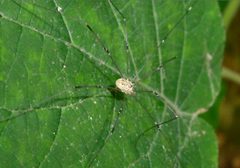
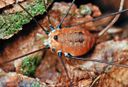
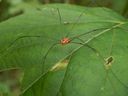
As a member of Leiobunum, possesses extremely long, slender legs with the second pair being the longest and often waved in the air. Body is relatively small compared to leg span. Males have elongated with distinct "knees" that extend dorsally above the ocularium. Body coloration includes a dark stripe. The ocularium ( ) is prominent and positioned centrally on the dorsal surface.
Habitat
Inhabits wooded , including mesic deciduous forests and forest edges. Observed on tree trunks, downed logs, and vegetation in forested environments.
Distribution
North America; recorded from the northeastern United States including Vermont and Maine (Piscataquis County), with broader distribution across eastern North America.
Seasonality
Active during warmer months; observed in late summer and fall. Specific data limited.
Behavior
Exhibits characteristic "leg-waving" , waving the elongated second pair of legs in the air as pseudo- to detect environmental stimuli. This behavior makes close approach difficult as contact with objects triggers rapid escape. Males use elongated in and possibly male-male competition.
Ecological Role
and scavenger in forest floor and arboreal microhabitats. Consumes small and organic matter.
Human Relevance
Harmless to humans; occasionally encountered in forests by hikers and naturalists. Subject of interest in arachnological studies of Opiliones diversity.
Similar Taxa
- Leiobunum vittatumExtremely similar and overlapping range; distinguished by subtle differences in male genitalia and geographic distribution patterns
- Leiobunum crassipalpeClose relative in the same , found in southern Missouri, northern Arkansas, and eastern Oklahoma; distinguished by
More Details
Taxonomic Complexity
-level identification within Leiobunum is notoriously difficult and often requires examination of male genitalia. The has undergone taxonomic revision, and some historically identified as L. vittatum may represent L. aldrichi or other cryptic species.
Observation Notes
The is relatively well-documented on iNaturalist with over 2,600 observations, suggesting it is common and widespread in appropriate , though specific biological details remain poorly documented in scientific literature.