
Marpissa
C. L. Koch, 1846
Species Guides
8- Marpissa bina
- Marpissa formosa
- Marpissa grata(Toothed slender jumping spider)
- Marpissa lineata(Four-lined Slender Jumping Spider)
- Marpissa obtusa
- Marpissa pikei(Pike Slender Jumper)
- Marpissa robusta
- Marpissa sulcosa(Pike Slender Jumper)
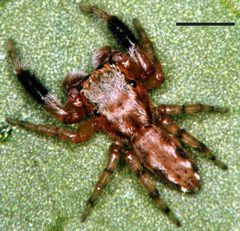
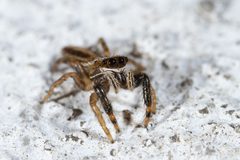
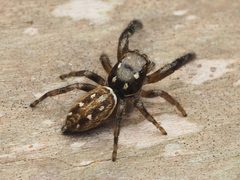
Marpissa is a of jumping spiders (Salticidae) first described by C. L. Koch in 1846. As of July 2024, the genus contains 41 distributed across North America, South America, Africa, Europe, Asia, Polynesian Islands, and the Greater Antilles. Species exhibit notable morphological diversity, including the extremely slender M. pikei with elongated first pair of legs used for prey capture. Visual systems show specialized neural with task-differentiated : principal eyes for object discrimination and secondary eyes for movement detection, though eyes in M. muscosa appear modified and may not serve movement detection. Complex courtship have been documented, with M. marina exhibiting multiple courtship types and mating tactics including unique abdominal rotary waving displays.
Pronunciation
How to pronounce Marpissa: //mɑːrˈpɪsə//
These audio files are automatically generated. While they are not always 100% accurate, they are a good starting point.
Identification
-level identification relies on Salticidae characteristics combined with specific morphological traits. Some , such as M. pikei, are distinguished by extremely elongated, slender bodies with first pair of legs equal to or exceeding body length. Males of M. pikei measure 6–8.2 mm, females 6.5–9.5 mm. Species identification requires examination of genitalia and detailed morphological features; taxonomic keys are available for regional faunas including Bangladesh.
Images
Habitat
varies by . M. pikei occurs in tall grasses, beach grasses, dunes, prairies, and riparian areas with horsetails (Equisetum). M. bengalensis has been documented in citrus orchards. M. marina occupies coastal habitats in New Zealand. Many species appear associated with grassy or herbaceous vegetation where ambush is effective.
Distribution
Widespread across six continents: North America, South America, Africa, Europe, Asia, Polynesian Islands, and the Greater Antilles. Specific regional records include Bangladesh (M. andamanensis, M. bengalensis, M. calcuttaensis, M. decorata, M. dhakuriensis, M. ludhianensis, M. mandali, M. longinoda), New Zealand (M. marina), and North America from eastern U.S. and southeast Canada west to Nebraska, Arizona, and Colorado (M. pikei). European records include Denmark, Norway, and Sweden.
Seasonality
M. pikei active from spring through fall, with mature individuals present even in winter in Florida. M. bengalensis completed in approximately 137 days from hatching to maturity under laboratory conditions.
Diet
Predatory, feeding on insects. Prey captured through ambush and jumping attacks. M. pikei waits in vegetation for insect prey to come within striking distance.
Life Cycle
M. bengalensis: incubation 5–15 days; average 23.8 eggs per cocoon; 73.18% hatching success; spiderlings remain on mother's back 7 days; eight spiderling stages with mean durations of 7.46, 10.23, 19.82, 23.14, 25.86, and 28.08 days respectively; total development from hatching to approximately 137 days. Higher mortality in 3rd and 4th spiderling stages, decreasing to zero by 8th stage.
Behavior
Complex visual and communicatory documented. M. marina males employ two courtship types: visual displays (type 1) for females outside nests, and vibratory displays (type 2) for females inside nests. Three mating tactics: open mating after type 1 courtship; immediate nest mating after type 2 courtship with females; and cohabitation in constructed second chamber on subadult female nests followed by mating after maturation. Unique abdominal rotary waving performed only by males when touching females in nests. Quadrapedal posturing, the most elaborate display, occurs only during male-male interactions. M. pikei uses elongated first legs for prey capture, not for or jumping; walks on remaining six legs. Highly alert and agile, capable of rapid escape movements.
Ecological Role
Predatory in terrestrial . M. bengalensis was the second most abundant predatory in surveyed citrus orchards, suggesting significant role in agricultural pest control.
Human Relevance
Subject of neurobiological research on visual systems due to specialized and neural . Some , such as M. bengalensis, may contribute to in agricultural settings.
Similar Taxa
- Other Salticidae generaShare jumping spider characteristics but differ in body proportions; Marpissa includes with extreme elongation (M. pikei) not typical of most salticids.
- LyssomanesBoth contain slender with elongated legs, requiring careful examination for differentiation.
More Details
Visual System Neuroanatomy
M. muscosa exhibits specialized visual : principal ( ) connect to arcuate body via first and second order visual neuropils; anterior and lateral secondary eyes connect to first order neuropils then to two second order neuropils including shared L2; posterior median eyes lack second order neuropils and project directly to arcuate body, suggesting they do not detect movement. L2 neuropil may integrate secondary eye information for faster movement decisions.
Sexual Selection and Display Evolution
M. marina's complex display repertoire, including -unique abdominal rotary waving, appears driven by rather than species recognition, as no other salticids share its microhabitat in New Zealand's depauperate salticid fauna.
Sources and further reading
- BugGuide
- Wikipedia
- GBIF taxonomy match
- iNaturalist taxon
- NCBI Taxonomy
- Catalogue of Life
- Bug Eric: Spider Sunday: Pike Slender Jumper
- Taxonomic account of jumping spiders – Genus Marpissa C. L. Koch (Archnida: Araneae: Salticidae) from Bangladesh
- Visual pathways in the brain of the jumping spider Marpissa muscosa
- Visual pathways in the brain of the jumping spider Marpissa muscosa
- The complex communicatory behaviour of Marpissa marina , a New Zealand jumping spider (Araneae: Salticidae)
- Life cycle, survivorship and life expectancy of foliage spider (Marpissa bengalensis) in citrus orchard
- Taxonomic account of jumping spider-ii: genus Marpissa c. L. Koch (Arachnida: Araneae: Salticidae) from Bangladesh