
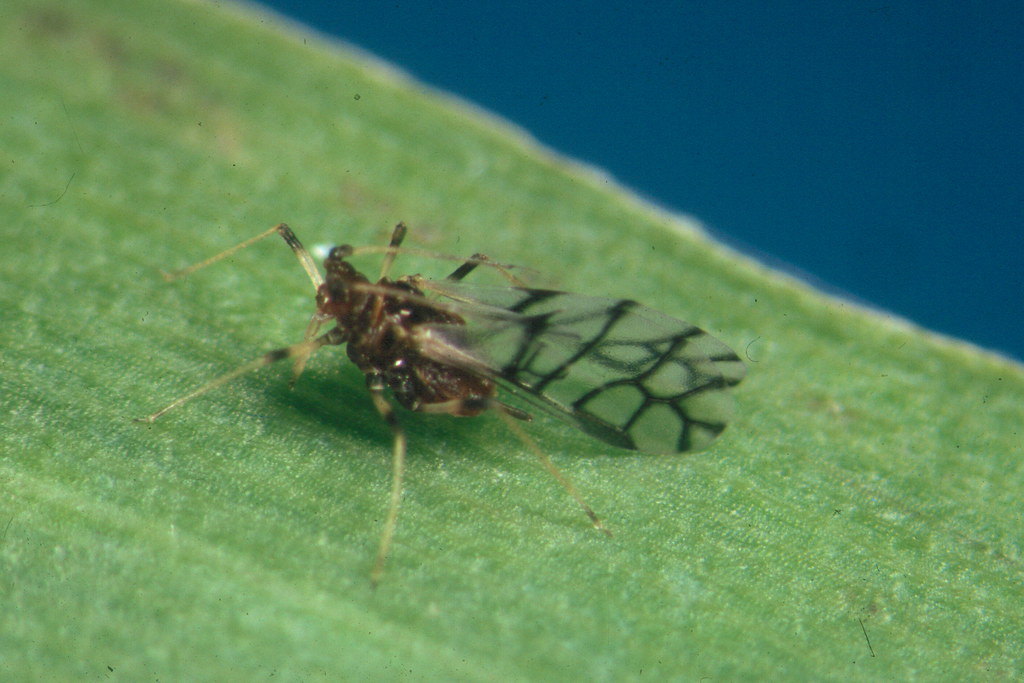
People usually talk about aphids like they are already explained. Tiny green bugs. Bad for the roses. Spray them, squish them, move on. That is not wrong. It is just a very small version of the story.
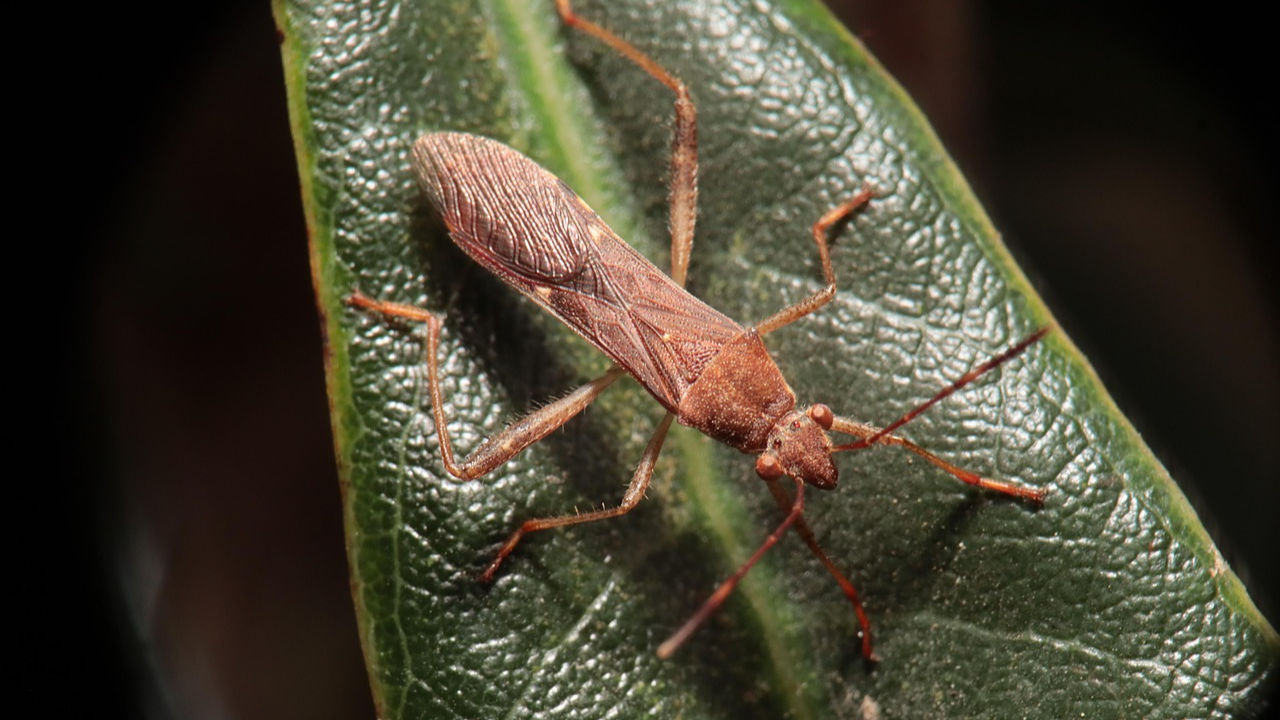
Apache californicum is a small, red planthopper endemic to California. It belongs to the family Derbidae, a group of fulgoroid insects commonly known as planthoppers. Males can be distinguished from the similar Apache degeerii by the presence of two pairs of hooks at the base of the flagellum, whereas A. degeerii has only a single pair.
Apateticus is a genus of predatory stink bugs in the family Pentatomidae, comprising approximately seven described species. Species within this genus are relatively large insects with predatory habits throughout their immature and adult stages. Detailed biological information is available primarily for A. cynicus and A. bracteatus, with limited data on other species. The genus is characterized by specific morphological and chemical traits, including distinctive larval scent glands.
Aphalara monticola is a species of jumping plant louse in the family Aphalaridae, described by Hodkinson in 1973. Like other members of the genus Aphalara, this species is associated with host plants and exhibits the characteristic morphology of psyllids, including membranous wings held roof-like over the body and piercing-sucking mouthparts adapted for feeding on plant sap. The specific epithet 'monticola' suggests an association with mountainous habitats.
jumping plant lice, psyllids, lerp insects
Aphalaridae is a family of sap-sucking insects in the superfamily Psylloidea, commonly known as jumping plant lice or psyllids. The family contains approximately 749 species with worldwide distribution except Antarctica. Members are small, phloem-feeding insects, often highly host-specific. The family was revised in 2012 and 2021 to include seven subfamilies based on molecular and morphological data. Several species are significant agricultural and forestry pests, including the red gum lerp psyllid (Glycaspis brimblecombei) and the common pistachio psyllid (Agonoscena pistaciae).
Aphalaroida californica is a species of jumping plant louse (psyllid) in the family Psyllidae, described by Tuthill in 1939. The specific epithet "californica" indicates its association with California. As a member of Sternorrhyncha, it is a phloem-feeding insect. Very little published information exists on its biology, host associations, or ecology.
Aphalaroida pithecolobia is a psyllid species in the family Psyllidae, described by Crawford in 1914. It belongs to a genus associated with host-specific relationships on leguminous plants. The species has been documented across multiple western North American states based on collection records.
Velvet-striped grasshopper
Aphelonema simplex is a planthopper species in the family Caliscelidae, first described by Uhler in 1876. Despite its common name "Velvet-striped grasshopper," this species is not a true grasshopper (family Acrididae) but belongs to the order Hemiptera. It has been recorded from multiple U.S. states including Colorado, Florida, and Alabama.
aphids, plant lice, greenflies, blackflies, whiteflies
Aphidoidea is a superfamily of small sap-sucking insects within Hemiptera, commonly known as aphids. Members possess piercing-sucking mouthparts adapted for feeding on plant phloem. The superfamily includes approximately 5,000 described species across multiple families, with Aphididae being the largest and most economically significant. Many species exhibit complex life cycles involving both sexual and parthenogenetic reproduction, often with seasonal alternation between host plants.
Black Citrus Aphid, Camellia Aphid
Aphis aurantii is an economically significant aphid species known as the Black Citrus Aphid or Camellia Aphid. It is a major pest in commercial tea plantations and gardens in China, where it causes substantial damage to Camellia sinensis. The species exhibits a broad host range across multiple plant families, with documented specialization on Ficus in sympatric populations suggesting ongoing host-associated divergence. Population genetic studies reveal high haplotype diversity across Chinese populations with evidence of recent expansion events and isolation-by-distance patterns.
Buttonbush aphid
Aphis cephalanthi is a species of aphid in the family Aphididae, described by Thomas in 1878. The common name "Buttonbush aphid" reflects its association with its host plant, buttonbush (Cephalanthus species). Like other aphids in the genus Aphis, it is a sap-feeding insect with a typical aphid life cycle involving parthenogenetic reproduction during favorable conditions. The species is recognized in major taxonomic databases including GBIF, Catalogue of Life, and NCBI, though detailed biological studies appear limited in the available literature.
Tufted Vetch Aphid
Aphis craccae, commonly known as the Tufted Vetch Aphid, is an aphid species in the family Aphididae. It is associated with leguminous host plants, particularly vetch species (Vicia spp.). The species was first described by Linnaeus in 1758. Observations indicate it occurs in parts of Europe including Belgium, Denmark, and Norway.
black bean aphid, blackfly, bean aphid, beet leaf aphid
Aphis fabae is a small, soft-bodied aphid in the family Aphididae, commonly known as the black bean aphid or blackfly. It is a significant agricultural pest with a broad host range, attacking beans, sugar beet, and numerous other crops. The species exhibits a heteroecious life cycle with host alternation between a woody primary host (Euonymus europaeus, spindle tree) and herbaceous secondary hosts. It reproduces parthenogenetically during the growing season and sexually in autumn, producing overwintering eggs. The aphid is capable of rapid population increase through viviparous reproduction, and winged forms develop seasonally to facilitate migration between host plants.
Virginia creeper aphid
Aphis folsomii is an aphid species in the family Aphididae, first described by Davis in 1908. It is commonly known as the Virginia creeper aphid, indicating an association with Parthenocissus species (Virginia creeper). Like other aphids, it possesses piercing-sucking mouthparts and exhibits typical aphid morphology including cornicles on the abdomen. The species is currently accepted as valid, though it was previously listed as a synonym in some sources.
Strawberry Root Aphid
Aphis forbesi is an aphid species in the family Aphididae, first described by Weed in 1889. It is commonly known as the strawberry root aphid, indicating an association with strawberry plants (Fragaria spp.). The species has been recorded in Serbia based on distribution data. Like other aphids in the genus Aphis, it likely possesses piercing-sucking mouthparts and may exhibit complex life cycles involving host alternation or monoecy, though specific biological details remain poorly documented in available sources.
Aphis hederae is an aphid species first described by Kaltenbach in 1843. It is currently listed as an accepted species in major taxonomic databases, though some sources note it as an ambiguous synonym. The species is recorded from the Azores archipelago (Faial, Flores, São Jorge, São Miguel, and Santa Maria islands). As a member of the genus Aphis, it shares the family's characteristic sap-feeding biology on host plants.
Aphis intybi is a species of aphid in the family Aphididae, first described by Koch in 1855. It belongs to the large genus Aphis, which contains numerous economically important plant-feeding species. Distribution records indicate presence in Denmark, Norway, and Sweden. The species epithet 'intybi' suggests an association with Cichorium intybus (chicory), though specific host plant relationships have not been well documented in available literature.
Aphis lupini is a species of aphid in the family Aphididae, described by Gillette and Palmer in 1929. The specific epithet suggests an association with lupine plants (Lupinus spp.), though detailed biological information is limited in available sources. As a member of genus Aphis, it shares the typical aphid characteristics of piercing-sucking mouthparts and complex life cycles often involving host plant alternation. The species is currently accepted in taxonomic databases including GBIF and NCBI, though Catalogue of Life lists it as a synonym.
Spotted Poplar Aphid
Aphis maculatae, commonly known as the Spotted Poplar Aphid, is a species of aphid in the family Aphididae. First described by Oestlund in 1887, this small sap-sucking insect belongs to the large genus Aphis, which contains numerous agricultural and horticultural pest species. Like other aphids, it possesses piercing-sucking mouthparts adapted for feeding on plant phloem.
Evening Primrose Aphid
Aphis oenotherae is an aphid species in the family Aphididae, first described by Oestlund in 1887. It is commonly known as the Evening Primrose Aphid, reflecting its association with plants in the genus Oenothera. The species has been documented in parts of Europe including Belgium, the Czech Republic, and France, with observation records also noted in citizen science databases. Like other aphids in the genus Aphis, it possesses piercing-sucking mouthparts adapted for feeding on plant phloem.
Aphis pawneepae is a species of aphid in the family Aphididae, described by Hottes in 1934. The species is currently accepted in taxonomic databases, though some sources list it as a synonym. Very little is known about its biology, ecology, or distribution. Records indicate it has been observed at least 18 times on iNaturalist, but detailed studies of its morphology, host associations, and life history appear to be lacking in the available literature.
Aphis spiraephila is an aphid species in the family Aphididae, described by Edith Marion Patch in 1914. The specific epithet "spiraephila" suggests an association with Spiraea, a genus of flowering shrubs in the rose family. The species is recorded from Ukraine in distribution databases, though detailed biological information appears limited in available sources. Like other members of genus Aphis, it likely exhibits typical aphid morphology including soft bodies, piercing-sucking mouthparts, and cornicles on the abdomen.
dark green nettle aphid
Aphis urticata, commonly known as the dark green nettle aphid, is a species of aphid in the family Aphididae. It is associated with nettle plants (Urtica species), as suggested by its specific epithet. The species has been recorded in parts of Europe including Belgium and the Azores (São Miguel). Like other aphids, it likely feeds on plant phloem sap.
American Viburnum Aphid
Aphis viburniphila, the American Viburnum Aphid, is a species of aphid described by Edith Marion Patch in 1917. The species epithet 'viburniphila' indicates its association with Viburnum host plants. As a member of the genus Aphis, it shares the typical aphid body plan with piercing-sucking mouthparts adapted for phloem feeding. The species has been documented through 88 observations on iNaturalist.
leafhoppers
Aphrodinae is a subfamily of leafhoppers in the family Cicadellidae, containing approximately 7 genera and at least 20 described species. The subfamily is divided into three tribes: Aphrodini, Sagmatiini, and Xestocephalini. Members are distributed across the Holarctic, Neotropical, and Australasian regions, with some species exhibiting notable morphological variability, particularly in Alpine populations. Species identification relies heavily on male genital morphology and, in some groups, acoustic signaling.
Aphrodini is a tribe of leafhoppers within the subfamily Aphrodinae of the family Cicadellidae. The tribe was established by Haupt in 1927. Members of this tribe are part of a leafhopper group characterized by particular morphological features of the head and wing venation. Aphrodini is one of three tribes within Aphrodinae, alongside Acinopterini and another unnamed or disputed tribal grouping depending on classification system.
conifer spittlebug
Aphrophora canadensis is a species of spittlebug in the family Aphrophoridae, originally described from Canada in 1928. The genus Aphrophora comprises conifer-associated spittlebugs that are frequently attracted to lights at night. This species occurs in western North America, with records from British Columbia, California, and Idaho. Like other members of its genus, it is likely associated with coniferous host plants.
pine spittlebug
Aphrophora cribrata, commonly known as the pine spittlebug, is a species of spittlebug in the family Aphrophoridae. The species is associated with coniferous habitats and has been documented in North America. Taxonomic authorities recognize this species as a synonym of Epipyga cribrata, reflecting ongoing revisions in spittlebug classification. The common name indicates its ecological association with pine trees.
Boreal Spittlebug
Aphrophora gelida, commonly known as the boreal spittlebug, is a species of spittlebug in the family Aphrophoridae. It is native to North America and has been recorded across a broad geographic range including Alabama, Alberta, British Columbia, California, and Connecticut. The species belongs to a genus associated with coniferous habitats.
Conifer spittlebug
Aphrophora maculosa is a species of spittlebug in the family Aphrophoridae, described by Doering in 1941. It belongs to a genus commonly known as conifer spittlebugs, many of which feed on coniferous trees. The species is found in western North America, ranging from British Columbia and Alberta in Canada south through Washington, Oregon, and California in the United States. Like other Aphrophora species, it is attracted to lights at night.
Aphrophora parallella is a species of spittlebug in the family Aphrophoridae, first described by Thomas Say in 1824. The genus Aphrophora comprises conifer spittlebugs, with adults typically found in association with coniferous trees. The species is part of a taxonomically complex group where family-level placement has varied between Aphrophoridae and Cercopidae depending on classification system used. Specific biological details for A. parallella remain poorly documented in available literature.
Aphrophora regina is a species of spittlebug in the family Aphrophoridae, described by Hamilton in 1982. The species is currently recognized as valid, though it has been treated as Peuceptyelus regina in some taxonomic arrangements. Spittlebugs in this genus are commonly known as conifer spittlebugs and are associated with coniferous host plants. The species occurs in western North America, with records from British Columbia.
True Spittlebugs, Spittlebugs, Froghoppers
Aphrophoridae is a family of true bugs in the order Hemiptera, commonly known as spittlebugs or froghoppers. The family contains at least 160 genera and 990 described species. Nymphs are called spittlebugs and produce characteristic frothy masses for protection, while adults are referred to as froghoppers. Many species are xylem sap feeders and some serve as vectors for plant pathogens, particularly Xylella fastidiosa, which causes diseases including olive quick decline syndrome.
Apidaurus is a genus of broad-headed bugs (Alydidae) established by Stål in 1870. These insects belong to the true bug family Alydidae, commonly known as broad-headed bugs due to their characteristically widened head shape. The genus is part of the subfamily Alydinae and is distributed in the Americas, with records from Paraguay and Texas.
California Bee Assassin
Apiomerus californicus is a species of assassin bug in the family Reduviidae, first described by Berniker and Szerlip in 2011. It belongs to the Apiomerini tribe, commonly known as bee assassins, which are specialized predators of bees and other pollinators. The species is found in western North America, particularly in California and surrounding regions.
Yellow-bellied Bee Assassin, bee assassin bug
Apiomerus flaviventris is a predatory assassin bug in the family Reduviidae, commonly known as the yellow-bellied bee assassin. This species is notable for its specialized feeding habits targeting bees and its remarkable use of plant-derived chemical defenses. Females collect resin from brittlebush (Encelia farinosa) and apply it to their eggs as a protective barrier against predation, particularly by ants. The species inhabits arid and semiarid regions of southwestern North America.
Black Bee Assassin
Apiomerus longispinis is a species of assassin bug in the family Reduviidae. It is found in Central America and North America.
Mountain Bee Assassin
Apiomerus montanus is a species of assassin bug in the family Reduviidae, commonly known as the Mountain Bee Assassin. It belongs to a genus of exclusively New World predatory insects often called 'bee killers' for their habit of ambushing flower-visiting insects. The species was formally described in 2011 during a revision of the crassipes and pictipes species groups of Apiomerus. Like other members of its genus, it is an ambush predator that captures prey using its raptorial forelegs and subdues them with a venomous proboscis.
Aplanus albidus is a species of leafhopper in the family Cicadellidae, first described by Ball in 1900. It belongs to the subfamily Deltocephalinae and tribe Platymetopiini. The species has been documented in the southwestern United States.
Aplanusiella utahensis is a species of leafhopper in the family Cicadellidae, subfamily Deltocephalinae, described by Nielson and Haws in 1992. It is endemic to Utah, as indicated by its specific epithet and confirmed distribution records. As a member of the tribe Platymetopiini, it belongs to a group of leafhoppers typically associated with grassland and shrubland habitats.
Velvet-striped planthopper
Aplos simplex is the sole species in the genus Aplos, a planthopper in the family Issidae. Formerly classified under Thionia, this species occurs widely across the eastern United States and has established as an invasive population in Northern Italy and Austria. As an issid planthopper, it belongs to the hemipteran group Auchenorrhyncha, characterized by piercing-sucking mouthparts and often reduced wings.
Aradus abbas is a species of flat bug in the family Aradidae, first described by Bergroth in 1889. It belongs to a group of insects commonly known as flat bugs due to their strongly flattened body form. The species is distributed in North America, including the Nearctic region and Beringia. Like other members of the genus Aradus, it is likely associated with dead wood habitats, though specific ecological details for this species remain limited.
flat bug
Aradus acutus is a species of flat bug in the family Aradidae, first described by Thomas Say in 1832. It belongs to a group of insects commonly known as flat bugs due to their strongly dorsoventrally flattened bodies. The species is found in North America, though specific ecological details remain poorly documented in the available literature.
Aradus aequalis is a species of flat bug in the family Aradidae, first described by Thomas Say in 1832. It is one of approximately 200 species in the genus Aradus. Like other flat bugs, it has a strongly dorsoventrally flattened body form adapted for living in tight spaces under bark. The species is known from North America, with records from the United States including Vermont.
Aradus ampliatus is a species of flat bug (family Aradidae) described by Uhler in 1876. Like other members of the genus Aradus, it belongs to a group of true bugs commonly known as flat bugs due to their dorsoventrally flattened body form. The genus Aradus includes both extant and fossil species, with 14 species described from Baltic amber inclusions dating to the Eocene. Extant species in this genus are typically associated with dead wood habitats.
flat bug
Aradus approximatus is a species of flat bug in the family Aradidae, described by Parshley in 1921. It belongs to a group of true bugs characterized by their strongly flattened bodies, an adaptation for living in tight spaces under bark. The species is recorded from North America. Like other members of the genus Aradus, it is presumed to inhabit dead wood environments, though specific ecological details for this species remain poorly documented.
flat bug
Aradus basalis is a species of flat bug in the family Aradidae, first described by Parshley in 1921. It is known from North America. As a member of the Aradidae, it belongs to a group of true bugs commonly associated with dead wood habitats.
Aradus behrensi is a species of flat bug in the family Aradidae. It is found in North America. The species was described by Bergroth in 1886.
flat bug
Aradus borealis is a species of flat bug in the family Aradidae, a group of true bugs characterized by their dorsoventrally flattened bodies. The species is found in North America. Flat bugs in this family are typically associated with dead wood and bark habitats. Beyond basic taxonomic placement and geographic distribution, specific biological details for A. borealis remain poorly documented in the available literature.
Aradus cf-snowi is a flat bug species in the family Aradidae, a group of true bugs commonly found on and under the bark of dead trees. The 'cf.' designation indicates this specimen resembles A. snowi but requires confirmation. Flat bugs in this genus are typically cryptic and associated with woody substrates.
Aradus cf-acutus-w-tex is a flat bug in the family Aradidae, a group of true bugs commonly associated with dead wood and bark habitats. The "cf." designation and "w-tex" suffix indicate this is an informal, provisional designation referring to a western Texas population closely resembling Aradus acutus but not formally described as a distinct species. Flat bugs in this genus are typically small, dorsoventrally flattened insects that live cryptically under bark.