
Aphis aurantii
Boyer de Fonscolombe, 1841
Black Citrus Aphid, Camellia Aphid
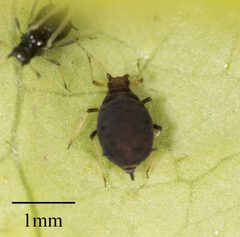
Aphis aurantii is an economically significant known as the Black Citrus Aphid or Camellia Aphid. It is a major pest in commercial tea plantations and gardens in China, where it causes substantial damage to Camellia sinensis. The species exhibits a broad range across multiple plant , with documented specialization on Ficus in sympatric suggesting ongoing host-associated divergence. Population genetic studies reveal high haplotype diversity across Chinese populations with evidence of recent expansion events and isolation-by-distance patterns.


Pronunciation
How to pronounce Aphis aurantii: /ˈeɪfɪs ɔːˈræntiˌaɪ/
These audio files are automatically generated. While they are not always 100% accurate, they are a good starting point.
Images
Habitat
Commercial tea plantations and gardens in China; also found on diverse plants including Ficus in sympatric .
Distribution
China (extensively sampled across 11 locations showing widespread haplotype distribution); also recorded from the Azores (Faial, Flores, Graciosa, Pico, São Jorge). occurs among local Chinese despite geographic structure, with correlating positively with geographic distance.
Diet
Phloem sap-feeding on plants.
Host Associations
- Camellia sinensis - major explicitly identified as primary in commercial tea plantations
- Ficus - specialized shows significant genetic divergence and morphometric differences suggesting incipient speciation
- Citrus - inferred 'Black Citrus ' suggests association, though not explicitly confirmed in sources
Ecological Role
Destructive pest in commercial tea plantations and gardens; significant agricultural and forestry pest with broad plant range.
Human Relevance
Major economic pest affecting tea production in China; subject of genetic research to understand patterns and inform management strategies.
More Details
Population Genetics
Chinese show low diversity (0.00968) but extremely high haplotype diversity (0.9991), with 166 haplotypes identified from 177 individuals. No distinct lineages detected; haplotypes widely distributed across and network. AMOVA indicates genetic differences both within and among populations. Neutral tests and mismatch distribution suggest recent population expansion events.
Host-Associated Divergence
on Ficus exhibit significant genetic divergence from populations on other plants in the same geographical area, supported by five-gene phylogenetic analysis and 38 morphological characters. This suggests specialized evolution on Ficus with potential ongoing , challenging the ' characterization as broadly .
Nomenclature Note
Listed as synonym in Catalogue of Life but accepted in GBIF and NCBI; treated as Aphis (Toxoptera) aurantii in some classifications.
Sources and further reading
- BugGuide
- GBIF taxonomy match
- iNaturalist taxon
- NCBI Taxonomy
- Catalogue of Life
- Incredible Work, and Timely, on 22 Species of Hornets | Bug Squad
- It Takes a Village: Our Continued Efforts to Manage Invasive Species in the U.S.
- Orange and Black II: Milkweed leaf beetle, Labidomera clivicollis; Oleander aphid, Aphis nerii; Milkweed Bug, Oncopeltus fasciatus; Monarch, Danaus plexippus — Bug of the Week
- Orange and Black Bugs- Milkweed leaf beetle, Labidomera clivicollis; Oleander aphid, Aphis nerii; Milkweed Bug - Oncopeltus fasciatus; Monarch butterfly, Danaus plexippus — Bug of the Week
- Got Spotted Lanternfly Eggs? Send 'Em Through the Wood Chipper
- Mandarin Boom Means Citrus Pest Management Must Evolve
- Population Genetics of the Black Citrus Aphid Aphis aurantii (Hemiptera, Aphididae) in China
- Specialization on Ficus Supported by Genetic Divergence and Morphometrics in Sympatric Host-Populations of the Camellia Aphid, Aphis aurantii