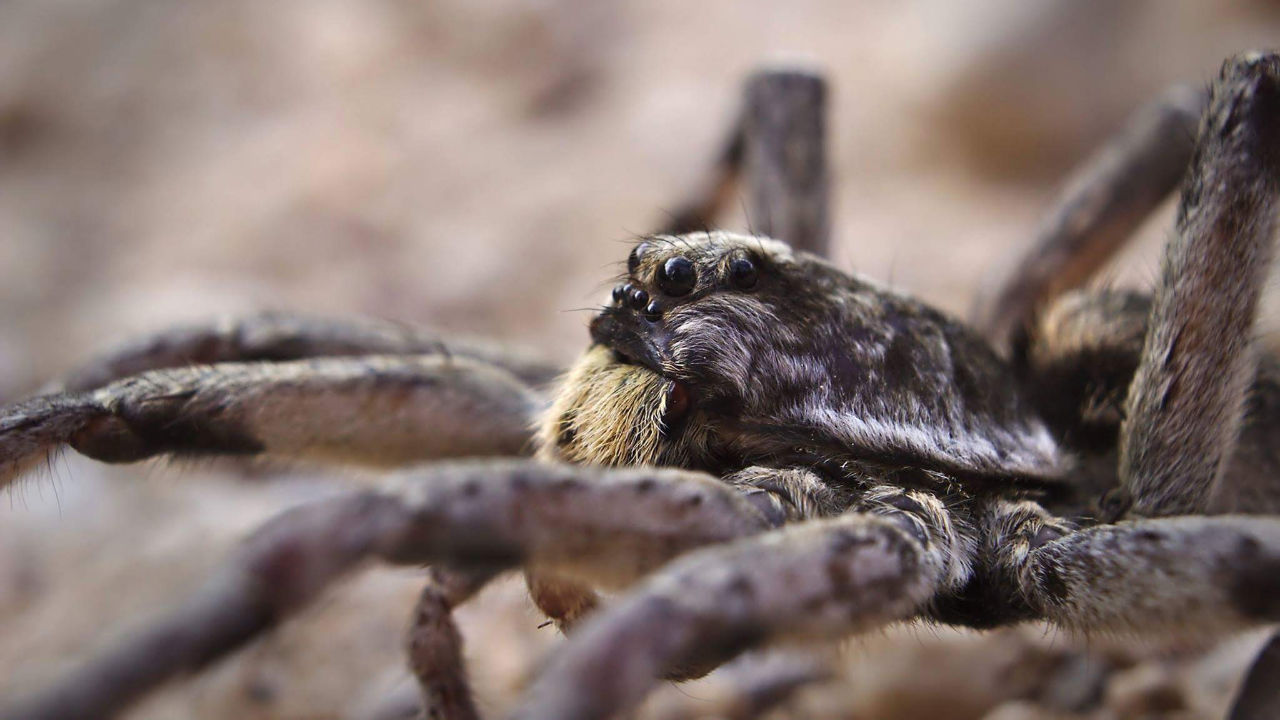
Curicaberis abnormis is a species of huntsman spider (Sparassidae) native to North America. Originally described by Keyserling in 1884 as Olios abnormis, it was transferred to the newly established genus Curicaberis in 2015 based on morphological revision. The species is one of nine former Olios species reclassified into Curicaberis, a genus endemic to North and Central America. Like other sparassids, it is characterized by laterigrade legs and flattened body form adapted for living in narrow spaces.
Peninsular Huntsman Spider
Curicaberis peninsulanus is a huntsman spider in the family Sparassidae, originally described by Banks in 1898 from Olios and transferred to the genus Curicaberis in 2015. The species is distributed across Mexico and the southwestern United States. Like other members of its genus, it belongs to the subfamily Sparassinae and exhibits typical sparassid morphology.
hacklemesh weaver
Cybaeopsis euopla is a species of hacklemesh weaver spider in the family Amaurobiidae. It was originally described as Callioplus euoplus by Bishop and Crosby in 1935. The species is documented from western and central Canada and the United States. Like other Amaurobiidae, it is presumed to construct irregular, tangled webs.
hacklemesh weaver
Cybaeopsis wabritaska is a species of hacklemesh weaver spider in the family Amaurobiidae. It was originally described as Callioplus wabritaskus by Leech in 1972 before being transferred to the genus Cybaeopsis. The species is known from western Canada and potentially adjacent areas of the United States. Records remain sparse, with limited observational data available.
Cybaeota shastae is a small true spider in the family Cybaeidae, first described by Chamberlin & Ivie in 1937. It is known only from the United States, with records from the western region including California. The genus Cybaeota contains diminutive spiders closely related to Cybaeus but distinguished by genitalic and somatic characteristics. Very little is known of its biology.
Owl Woodland Spider
Cybaeus eutypus is a species of true spider in the family Cybaeidae, commonly known as the Owl Woodland Spider. It is found in the United States and Canada. The species was described by Chamberlin and Ivie in 1932. Like other members of the genus Cybaeus, it belongs to the marronoid clade of spiders, a group that has been subject to recent phylogenetic revision.
Common West Coast Woodland Spider
Cybaeus reticulatus is a species of true spider in the family Cybaeidae. It was first described by French arachnologist Eugène Simon in 1886. The species is found in the United States and Canada, with observations concentrated on the West Coast. It belongs to the marronoid clade, a group of spiders united by molecular phylogenetics rather than obvious morphological synapomorphies.
Night-hunting Woodland Spider
Cybaeus signifer is a species of true spider in the family Cybaeidae, described by Eugène Simon in 1886. It is distributed across the United States and Canada. The species belongs to the marronoid group of spiders, a diverse clade that has been subject to recent phylogenetic revision using genetic data from museum specimens.
Trashline Orbweavers
Cyclosa is a genus of orb-weaver spiders commonly known as trashline orbweavers, first described by Anton Menge in 1866. These spiders are distinguished by their unique web decorations consisting of linear arrangements of prey remains, debris, and sometimes egg sacs arranged vertically through the web center. The name derives from Greek 'to move in a circle,' referencing their spiral web construction. Most species face downward in their webs, though some face upward. The genus contains approximately 178 species distributed worldwide.
Cyclosa caroli is a species of orb-weaving spider in the family Araneidae. It is found in the United States and ranges from the Caribbean Sea to Bolivia. As a member of the genus Cyclosa, it is a trashline orb weaver that incorporates debris into its web architecture. The species was described by Hentz in 1850.
Conical Trashline Orbweaver
Cyclosa conica is a small orb-weaving spider known for constructing distinctive vertical webs decorated with debris. Females measure 5.3–7.5 mm in body length, while males are smaller at 3.6–4 mm. The species is recognized by its unique behavior of stringing dead insect bodies and other debris vertically through the center of its web, forming a 'trashline' or stabilimentum. The spider positions itself at the hub of this debris, relying on its cryptic coloration to blend in and avoid detection by predators. When disturbed, it feigns death as a secondary defense.
Humped Trashline Orbweaver, Trashline Orbweaver
Cyclosa turbinata is a small orb-weaving spider (Araneidae) known for its distinctive 'trashline' web decoration, where the spider arranges debris, prey carcasses, and egg sacs in a vertical line through the web hub to camouflage itself from visual predators. Females possess two anterior dorsal humps on the abdomen, distinguishing them from the similar C. conica. The species exhibits an exceptionally short-period circadian clock of approximately 19 hours, regulating its locomotor and web-building activities. Native to North and Central America, it has been introduced to Hawaii and other regions, with spiderlings dispersing via wind-borne silk (ballooning).
Diastema n-sp is a sheetweb weaver spider in the family Linyphiidae, recorded from the exterior of a woodshed in northern Door County, Wisconsin during a nocturnal survey. The specimen was an unidentified male observed on June 24, 2019, in a cool, wet forested area on the shore of Lake Michigan. No further details about this particular species' biology are available from this record.
Dictyna agressa is a species of mesh web weaver spider in the family Dictynidae, described by Wilton Ivie in 1947. As a member of the genus Dictyna, it constructs irregular, mesh-like webs for prey capture. The species is documented from the United States, though specific details about its ecology and behavior remain limited in published literature.
Alaska mesh web weaver
Dictyna alaskae is a small spider species in the family Dictynidae, commonly known as mesh web weavers. The species was described in 1947 and has a Holarctic distribution spanning boreal and subarctic regions. It constructs irregular, mesh-like webs to capture prey. The specific epithet references Alaska, where the species was first described.
Dictyna bellans is a small spider species in the family Dictynidae, first described by Chamberlin in 1919. It belongs to a genus known for constructing irregular, mesh-like webs. The species has been recorded in the southwestern United States and Mexico.
Boston mesh web weaver
Dictyna bostoniensis is a species of mesh web weaver spider in the family Dictynidae, described by Emerton in 1888. It is native to North America and has been recorded in the United States and Canada. The species belongs to a family known for constructing irregular, mesh-like webs.
Dictyna longispina is a small cribellate spider in the family Dictynidae, described by Emerton in 1888. The species is known from northeastern North America, where it constructs irregular, tangled webs to capture prey. Like other Dictyna species, it possesses a cribellum—a silk-producing organ that generates woolly, adhesive silk. The specific epithet 'longispina' refers to the elongated spines characteristic of this species.
mesh web weaver
Dictyna major is a species of mesh web weaving spider in the family Dictynidae, first described by Menge in 1869. It belongs to a family characterized by irregular, mesh-like webs rather than the organized spiral webs of orb-weavers. The species has a notably broad distribution spanning multiple continents, including North America, Europe, and Asia.
mesh web weaver
Dictyna volucripes is a species of mesh web weaver spider in the family Dictynidae, first described by Keyserling in 1881. It is found in North America, with confirmed records from Alberta, British Columbia, and Manitoba in Canada. The species includes two recognized subspecies: D. v. volucripes and D. v. volucripoides.
dwarf spiders
Dicymbium is a genus of dwarf spiders in the family Linyphiidae, established by Anton Menge in 1868. The genus name refers to the distinctive male palpal morphology, specifically a cup-shaped projection on the palpal tibia that surrounds the cymbium dorsally. The genus contains eight species and one subspecies distributed across the Northern Hemisphere, including Europe, Asia, and North America.
Black Dicymbium
Dicymbium nigrum is a dwarf spider in the family Linyphiidae, first described by John Blackwall in 1834. The species exhibits a wide Palearctic distribution spanning Europe, Turkey, the Caucasus, Russia, Central Asia, and China. Two subspecies are recognized: the nominate form D. n. nigrum and D. n. brevisetosum described by Locket in 1962. As a member of the sheet-web weavers, this species constructs characteristic horizontal webs for prey capture.
Desertshrub Spiders, Coneweb Spiders
Diguetia is a genus of haplogyne spiders in the family Diguetidae, first described by Eugène Simon in 1895. These six-eyed spiders are endemic to arid regions of the southwestern United States and Mexico, with one species extending into Argentina. They construct distinctive tent-like conewebs with tubular retreats, often camouflaged with plant debris and insect remains. The genus comprises eleven recognized species, seven of which occur north of Mexico.
desertshrub spider
Diguetia albolineata is a species of desertshrub spider in the family Diguetidae. It is one of seven species in the genus Diguetia occurring north of Mexico. The species is found in the United States and Mexico, inhabiting desert environments where it constructs distinctive horizontal sheet webs with tubular retreats.
desert bush spider
Diguetia canities, commonly known as the desert bush spider, is a species of coneweb spider in the family Diguetidae. It is the most widely distributed species in its genus, occurring across desert and semidesert habitats from California to Oklahoma and Texas. The spider constructs a distinctive dome-shaped sheet web with a tubular retreat, often placed in bushes or cacti less than 60 cm above ground. It produces a potent insect-selective venom peptide called Dc1a.
Desertshrub Spider
Diguetia mojavea is a species of desertshrub spider in the family Diguetidae, endemic to the deserts of the American Southwest. First described by Gertsch in 1958, this species constructs distinctive horizontal sheet webs with dome-shaped retreats amid desert vegetation. As a haplogyne spider, it exhibits relatively primitive reproductive morphology compared to more derived arachnids.
desertshrub spider
Diguetia signata is a species of desertshrub spider in the family Diguetidae, first described by Gertsch in 1958. It inhabits arid regions of the southwestern United States and Mexico, where it constructs distinctive horizontal sheet webs with central tubular retreats. The species belongs to a primitive spider lineage characterized by simple genital structures.
dwarf spiders
Diplocentria is a genus of dwarf spiders in the family Linyphiidae, first described by J. E. Hull in 1911. The genus contains eight recognized species distributed across North America, Europe, and Asia. These small spiders are part of the sheet-web weaving guild within their family.
Diplocentria rectangulata is a sheet web spider in the family Linyphiidae, first described by Emerton in 1915. The species occurs across northern regions of the Northern Hemisphere, including North America and Eurasia. As with other linyphiids, it constructs horizontal sheet webs to capture prey. It is among the smaller spiders, consistent with the dwarf spider morphology typical of this family.
Diplocephalus is a genus of dwarf spiders in the family Linyphiidae, subfamily Erigoninae, first described by Philipp Bertkau in 1883. The genus contains 49 species and one subspecies with a wide geographic distribution. Males of at least some species possess specialized glandular head structures that produce secretions transferred to females during courtship to trigger copulation. The genus is part of the diverse sheet-weaving spider fauna.
tangle-web spiders
Dipoena is a genus of tangle-web spiders (family Theridiidae) containing approximately 162 species distributed worldwide. The genus was established by Tamerlan Thorell in 1869. Males are distinguished by a characteristically high, cylindrical carapace often bearing grooves or depressions on the dorsum, while female carapaces are rarely modified though sometimes elevated. Species occur across Asia, Central America, North America, Africa, the Caribbean, Europe, South America, Australia, and Pacific islands including Vanuatu.
Dipoena dorsata is a species of cobweb spider in the family Theridiidae, first described by Muma in 1944. It has been recorded across a broad geographic range from the United States to Paraguay, spanning North, Central, and South America. As a member of the genus Dipoena, it constructs irregular, tangled webs typical of theridiid spiders. Specific details regarding its biology, ecology, and behavior remain poorly documented in the scientific literature.
Dipoena washougalia is a species of cobweb spider in the family Theridiidae, first described by Levi in 1953. It is known from the United States, with records primarily from the Pacific Northwest region. The genus Dipoena comprises small spiders that construct tangled, irregular webs. Information on this particular species remains limited.
Dirksia cinctipes is a species of true spider in the family Cybaeidae, described by Nathan Banks in 1896. The species has been documented across northern North America including Alaska, Canada, and the contiguous United States. Cybaeidae are wandering spiders typically associated with ground-level habitats rather than web-building.
dwarf spiders
Disembolus is a genus of dwarf spiders in the family Linyphiidae, first described in 1933. The genus contains 24 species distributed across North America, with most species occurring in the United States and some extending into Canada. As members of the sheet-web weaving family Linyphiidae, these spiders construct horizontal webs to capture prey. The type species, Disembolus stridulans, was described in the original genus description.
dwarf spiders
Dismodicus is a genus of dwarf spiders in the family Linyphiidae, first described by Eugène Louis Simon in 1884. The genus contains six species distributed across the Northern Hemisphere, with centers of diversity in Europe and North America. These spiders are part of the sheet-web weaving guild, constructing horizontal webs close to the ground.
Dismodicus decemoculatus is a sheet-web weaving spider in the family Linyphiidae, first described by Emerton in 1882. It is a small-bodied species with a circumboreal distribution across northern North America and Greenland. The specific epithet "decemoculatus" (Latin for "ten-eyed") refers to its eye arrangement. Like other linyphiids, it constructs horizontal sheet webs to capture prey.
Dolichognatha is a genus of long-jawed orb-weaving spiders in the family Tetragnathidae, distributed across tropical and subtropical regions worldwide. The genus was established by Octavius Pickard-Cambridge in 1869 and has undergone several taxonomic revisions, having been placed in Archaeidae, then Araneidae, before its current placement in Tetragnathidae. It contains 32 recognized species found across Africa, Asia, the Americas, and the Pacific.
striped fishing spider
Dolomedes scriptus, the striped fishing spider, is a large semi-aquatic hunting spider native to North America. Females can exceed 6 cm in legspan. The species is distinguished by pale brown coloration with lighter stripes on the legs and a longitudinal stripe along each side of the body. It is closely related to D. tenebrosus and shares the genus's characteristic ability to hunt on and near water surfaces.
Banded Fishing Spider
Dolomedes vittatus is a nursery web spider commonly known as the Banded Fishing Spider. It occurs throughout the United States. As a member of the genus Dolomedes, it is associated with aquatic and semi-aquatic habitats where it hunts prey at the water's surface. The species is among the more frequently observed fishing spiders in North America, with over 5,000 documented observations.
Drassinella modesta is a small spider species in the family Liocranidae, first described by Nathan Banks in 1904. It belongs to a genus of ground-dwelling spiders found in North America. The species is poorly known, with minimal published biological or ecological information available.
Drassodes angulus is a ground spider in the family Gnaphosidae, described by Platnick and Shadab in 1976. It is known from a small number of observations in the United States. As a member of the genus Drassodes, it is presumed to be a nocturnal, ground-dwelling hunter.
Drassodes auriculoides is a ground spider species in the family Gnaphosidae, described by Barrows in 1919. It is known from the United States and belongs to a genus of nocturnal, ground-dwelling hunters that do not build webs to capture prey. The species epithet 'auriculoides' refers to ear-like structures, likely describing a morphological feature of the copulatory organs. As with many Drassodes species, detailed natural history information remains limited.
Drassyllus covensis is a ground spider in the family Gnaphosidae, first described by Exline in 1962. It belongs to a genus of small to medium-sized nocturnal spiders commonly found in leaf litter and soil habitats. The species is known from the United States, though specific details about its biology remain poorly documented.
Drassyllus insularis is a species of ground spider in the family Gnaphosidae. It was first described by Nathan Banks in 1900 as Callilepis insularis and later transferred to the genus Drassyllus. The species is found in North America, with records from Canada, the United States, and Mexico. As a member of the Gnaphosidae family, it belongs to a diverse group of nocturnal hunting spiders commonly known as ground spiders.
Drassyllus mormon is a ground spider species in the family Gnaphosidae, first described by Chamberlin in 1936. It occurs in western North America, with records from the United States and Mexico. As a member of the genus Drassyllus, it is part of a diverse group of small to medium-sized ground-dwelling spiders commonly known as ground spiders or gnaphosids.
Drassyllus niger is a species of ground spider in the family Gnaphosidae. The species was first described by Nathan Banks in 1896. It occurs in the United States and Canada. As a member of Gnaphosidae, it is a nocturnal hunting spider that does not build webs to capture prey.
Drassyllus novus is a species of ground spider in the family Gnaphosidae. First described by Nathan Banks in 1895, this species occurs in the United States and Canada. As a member of the Gnaphosidae family, it belongs to a group commonly known as ground spiders, which are typically nocturnal hunters that do not build webs to capture prey.
woodlouse hunter, sowbug killer, slater-eating spider, woodlouse spider, pillbug hunter
Dysdera is a genus of spiders in the family Dysderidae, first described by Pierre André Latreille in 1804. The genus originated from Central Asia to Central Europe and has since spread globally through human commerce. Members are specialized predators of woodlice (terrestrial isopods), using enlarged chelicerae and long fangs to pierce their armored prey. The genus exhibits remarkable adaptive radiation, particularly on oceanic islands—most notably the Canary Islands, where 48 endemic species occur. Dysdera crocata, the cosmopolitan woodlouse hunter, is the only widespread species outside its native range and the sole representative in North America.
Woodlouse Spider, Woodlouse Hunter, Sowbug Hunter, Sowbug Killer, Pillbug Hunter, Slater Spider
Dysdera crocata is a specialized spider predator native to the Mediterranean region of Europe that has become established worldwide through human commerce. It is the only representative of the family Dysderidae in North America. Despite its formidable appearance—featuring disproportionately large chelicerae and long fangs—it poses no significant danger to humans. The species has been the subject of recurring internet hoaxes falsely claiming it is a new, deadly spider. It is primarily nocturnal and strongly associated with human-modified environments, particularly where its woodlouse prey abounds.