
Dictyna longispina
Emerton, 1888
Dictyna longispina is a small cribellate spider in the Dictynidae, described by Emerton in 1888. The is known from northeastern North America, where it constructs irregular, tangled webs to capture prey. Like other Dictyna species, it possesses a cribellum—a silk-producing organ that generates woolly, adhesive silk. The specific epithet 'longispina' refers to the elongated spines characteristic of this species.
Pronunciation
How to pronounce Dictyna longispina: /dɪkˈtiːnə ˌlɒnɡɪˈspaɪnə/
These audio files are automatically generated. While they are not always 100% accurate, they are a good starting point.
Identification
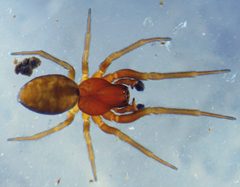
Dictyna longispina can be distinguished from by its notably elongated spines, particularly on the legs and possibly the , which are referenced in its specific epithet. The shows the general Dictyna body plan: small size (approximately 2–3 mm), compact , and relatively short, stout legs compared to body length. Definitive identification requires examination of genitalia; males possess distinctive embolus and conductor structures, while females have characteristic epigynal . Separation from the widespread Dictyna arundinacea and Dictyna uncinata requires microscopic examination of spine length and genitalic features.
Images
Distribution
Northeastern North America: recorded from Canada (Ontario, Quebec, and eastern provinces) and the United States (northeastern states). The appears to have a -nemoral distribution pattern consistent with other Emertonian Dictyna species.
Behavior
Constructs irregular, tangled cribellate webs on vegetation, similar to other Dictyna . The woolly cribellate silk effectively captures small flying insects without the use of sticky droplets. Webs are typically positioned on dead or living plant stems, grasses, and low shrubs.
Ecological Role
Functions as a small in herbaceous and shrub layer , contributing to regulation of tiny dipteran and hymenopteran . Its cribellate webs represent an evolutionary alternative to ecribellate orb-weaving and sheet-web strategies.
Similar Taxa
- Dictyna arundinaceaOverlapping distribution and ; D. arundinacea has shorter spines and differs in male palpal and female epigynal .
- Dictyna uncinataSympatric in eastern North America; distinguished by uncinate (hooked) structures in male genitalia and shorter leg spines.