
Dictynidae
O. Pickard-Cambridge, 1871
Meshweavers
Genus Guides
11Dictynidae is a of cribellate spiders characterized by their ability to produce hackled band silk. Members build irregular, tangled webs on or near the ground, typically among branches or stems of vegetation. The family comprises approximately 45 and 339 as of October 2025. Recent phylogenomic studies have placed Dictynidae within the marronoid clade, a group of spiders previously difficult to classify due to their morphological similarity. The family exhibits notable ecological diversity, including intertidal species, social species, and species associated with artificial structures.
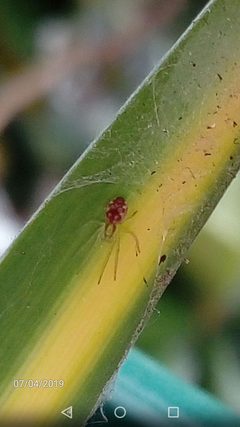
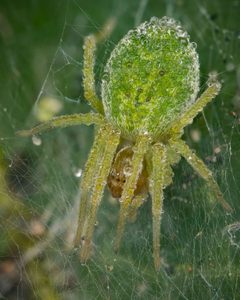
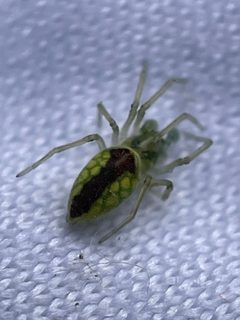
Pronunciation
How to pronounce Dictynidae: /dɪkˈtɪnɪdiː/
These audio files are automatically generated. While they are not always 100% accurate, they are a good starting point.
Identification
Dictynidae spiders are distinguished by their cribellate silk production, creating hackled bands—woolly, adhesive silk threads that entangle prey. This separates them from ecribellate spiders that use only viscid silk. Their webs are irregular mesh structures rather than geometric orb webs. The lacks a single morphological synapomorphy, making identification difficult based on anatomy alone; genetic analysis is often required for definitive placement within the marronoid clade.
Images
Habitat
Most construct webs on or near the ground, creating tangled silken fibers among plant stems and branches. Some species occupy intertidal zones. Others have adapted to artificial environments, including window frames and roadside guardrails, particularly where artificial lighting attracts insect prey. The includes species in diverse climatic conditions, from temperate regions to areas experiencing extreme heat or cold.
Distribution
Worldwide distribution with records from North America (including Vermont), Europe (Denmark, Norway, Sweden), and Asia (China, Japan, Tibet, Qinghai, Hebei, Xinjiang, Hainan). The has been documented in the Samara region of Russia and exhibits broad geographic range across the marronoid clade's distribution.
Diet
Insects captured in irregular hackled band webs. Prey availability is enhanced near artificial light sources that attract flying insects.
Behavior
Social has been documented in at least one , Dictyna foliicola, where females exhibit strong gregariousness with individuals positioned 1–2 mm apart, while males show uniform spatial distribution. Sympatric species such as Emblyna francisca and Emblyna reticulata exhibit behavioral partitioning through differences in web-building behavior and microhabitat use, reducing . Web construction involves two functional components: irregular hackled band threads for prey capture and thin-thread retreats.
Ecological Role
of insects; can form around artificial light sources. Some contribute to intertidal dynamics. The represents a significant component of spider biodiversity within the marronoid clade, which contains approximately half as many species as all known mammals.
Human Relevance
Some have adapted to human-modified environments, establishing on bathroom window frames and roadside guardrails. The 's has been clarified through museum , demonstrating the value of natural history collections for understanding biodiversity. One historically included species, Argyroneta aquatica (the diving bell spider), was transferred to Argyronetidae in 2025.
Similar Taxa
- ArgyronetidaeFormerly included within Dictynidae; separated in 2025 based on phylogenomic evidence. Contains the diving bell spider Argyroneta aquatica, the only fully aquatic spider.
- LathyidaeSeveral transferred from Dictynidae to Lathyidae in 2025 following revised phylogenetic analysis of the marronoid clade.
- CicurinidaeRe-elevated to status from Dictynidae based on genomic data; primarily cave-dwelling spiders.
- MacrobunidaeRecognized as a distinct for the first time in 2025; previously treated as a within Dictynidae.
More Details
Taxonomic instability
The 's composition has changed substantially due to recent phylogenomic research. In 2025, multiple were transferred to Argyronetidae and Lathyidae, and the Macrobuninae was elevated to family rank. These changes reflect improved resolution of relationships within the marronoid clade using ultraconserved elements and low-coverage whole sequencing.
Research methods
Recent advances in Dictynidae rely on low-coverage whole sequencing of museum specimens, enabling extraction of genetic information from small, decades-old specimens with degraded . This approach has been critical for resolving relationships in this morphologically cryptic group.
Sources and further reading
- BugGuide
- Wikipedia
- GBIF taxonomy match
- iNaturalist taxon
- NCBI Taxonomy
- Catalogue of Life
- Marronoids: The (Mostly) Little Brown Spiders With a Big Story to Tell
- A new intertidal genus and species of Dictynidae (Araneae: Dictynoidea) from Hainan, China
- BEHAVIORAL NICHE PARTITIONING IN EMBLYNA FRANCISCA AND EMBLYNA RETICULATA (ARANEAE, DICTYNIDAE)
- Social behavior of Dictyna foliicola Bös. et STR. (Araneae: Dictynidae)
- Water spider Argyroneta aquatica (Clerck, 1757) (Aranea: Dictynidae) in the Samara region
- Developmental Biology of Dictyna Spp. (Araneae: Dictynidae) in the Laboratory and Field
- The first record of Tricholathys Chamberlin & Ivie, 1935 (Araneae, Dictynidae) from China, with a new combination and descriptions of seven new species
- Six new species and a new synonym of the mesh-web spider genus Sudesna Lehtinen, 1967 (Araneae, Dictynidae) from China.