
Emblyna
Chamberlin, 1948
Species Guides
17- Emblyna annulipes(Mesh Web Weaver)
- Emblyna borealis
- Emblyna completa
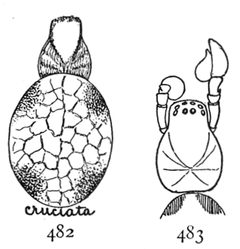
- Emblyna cruciata(mesh web weaver)
- Emblyna decaprini
- Emblyna florens
- Emblyna francisca(mesh web weaver)
- Emblyna hentzi(mesh web weaver)
- Emblyna manitoba(mesh web weaver)
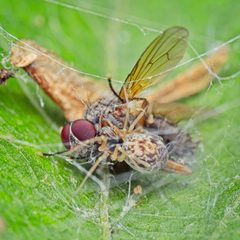
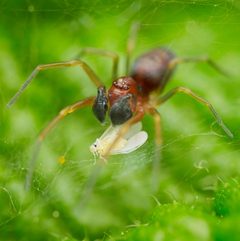
Emblyna is a of cribellate araneomorph spiders in the Dictynidae, first described by R. V. Chamberlin in 1948. The genus contains approximately 76 with a broad geographic distribution spanning North America, Europe, and Asia. Emblyna species are small to medium-sized spiders that construct irregular, tangled webs. Two species, E. francisca and E. reticulata, have been documented to exhibit behavioral partitioning, allowing coexistence in sympatric .
Pronunciation
How to pronounce Emblyna: /ɛmˈblaɪ.nə/
These audio files are automatically generated. While they are not always 100% accurate, they are a good starting point.
Identification
Identification to requires confirmation of cribellate (cribellum and calamistrum present). -level identification relies on examination of male and female . Emblyna species are distinguished from other Dictynidae genera by specific genitalic characters and arrangement patterns. Sympatric species such as E. francisca and E. reticulata may be differentiated by subtle morphological differences and preferences.
Images
Appearance
Small to medium-sized cribellate spiders with the characteristic calamistrum (a row of specialized setae on the of the fourth leg) used to comb silk from the cribellum. Body form typical of Dictynidae with compact and relatively short, robust legs. Coloration and detailed vary among ; specific diagnostic features for the require examination of genitalia and arrangement.
Habitat
varies by . Many North American species occupy diverse terrestrial environments including forests, grasslands, and riparian zones. Some species show specific microhabitat preferences that facilitate partitioning among .
Distribution
Holarctic distribution with primary diversity in North America. Documented from USA, Canada, Mexico, Greenland across North America; Europe including Norway, Germany, Czech Republic, Hungary, Romania; Asia including Russia (European Russia to Far East), Turkey, Caucasus, Kazakhstan, Mongolia, China; and Atlantic islands (Azores, Canary Islands, Galápagos Islands).
Behavior
Web-building spiders that construct irregular, tangled cribellate webs for prey capture. Behavioral partitioning has been documented between sympatric E. francisca and E. reticulata, suggesting that closely related may reduce competition through differential use of or foraging strategies.
Ecological Role
Predatory arthropods that contribute to insect through web-based . partitioning among may reduce and promote local diversity.
Similar Taxa
- DictynaAlso in Dictynidae; both are cribellate with similar web architecture. Emblyna is distinguished by specific genitalic characters and was separated from Dictyna based on morphological differences established by Chamberlin.
- LathysAnother cribellate dictynid ; requires examination of arrangement and genitalic structures for definitive separation from Emblyna.
More Details
Taxonomic History
Chamberlin established Emblyna in 1948 to accommodate previously placed in other , particularly within Dictynidae. The genus has since expanded to approximately 76 species through continued description and revision.
Cribellate Silk
Emblyna produces cribellate silk, which is combed by the calamistrum to create fine, woolly bands that entangle prey. This ancient silk type is phylogenetically informative and distinguishes these spiders from ecribellate relatives.