
Dictyna
Sundevall, 1833
Species Guides
17- Dictyna agressa
- Dictyna alaskae(Alaska mesh web weaver)
- Dictyna bellans
- Dictyna bostoniensis(Boston mesh web weaver)
- Dictyna brevitarsa
- Dictyna calcarata(mesh web weaver)
- Dictyna coloradensis
- Dictyna dauna
- Dictyna foliacea(mesh web weaver)
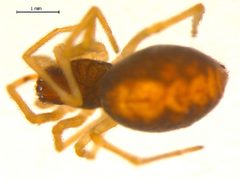
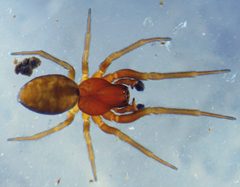
Dictyna is a of cribellate araneomorph spiders in the Dictynidae, comprising approximately 118 . These spiders are characterized by their irregular hackled band webs used for prey capture. Some species exhibit social , with females showing gregarious tendencies in web . The genus serves as for including Zatypota anomala.
Pronunciation
How to pronounce Dictyna: //dɪkˈtaɪ.nə//
These audio files are automatically generated. While they are not always 100% accurate, they are a good starting point.
Identification
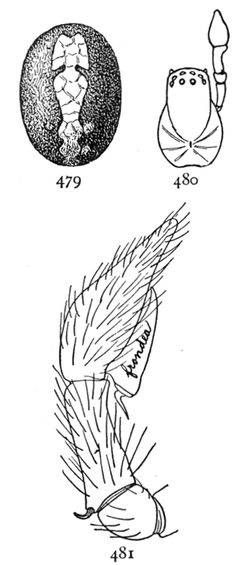
Dictyna possess cribellate silk-producing structures, producing irregular webs with two distinct components: hackled band threads for prey capture and thin-threaded retreats. Species identification often requires examination of genitalia; such as D. armata and D. ottoi form recognized species groups based on morphological similarity.
Images
Habitat
Plant leaves; artificial structures including window frames and roadside guardrails. Specific microhabitat preferences vary by .
Distribution
Documented from Japan, Italy, Ukraine, Azerbaijan, Caucasus region, and parts of North America including Vermont. GBIF records indicate presence in Denmark, Norway, and Sweden.
Diet
Insects snared in webs. Specific prey preferences vary by and .
Host Associations
- Zatypota anomala - Koinobiont ectoparasitoid of Dictyna pusilla, first recorded in Italy
Behavior
Dictyna foliicola exhibits strong gregariousness among females, with individuals positioned 1–2 mm apart; males show uniform spatial distribution. Web is driven by abundance of insects attracted to light sources.
Ecological Role
Prey for ; contributes to insect through .
Human Relevance
Occupies artificial environments such as building structures. Serves as research subject for studies of social in spiders and - relationships.
Similar Taxa
- MallosBoth in Dictynidae; comparative studies document differences in prey capture and predatory . Mallos exhibits more pronounced social colony formation than most Dictyna .
- Dictyna armata closely related to D. ottoi; both belong to the uncinata group and require detailed morphological examination for separation.
Sources and further reading
- BugGuide
- Wikipedia
- GBIF taxonomy match
- iNaturalist taxon
- NCBI Taxonomy
- Catalogue of Life
- Social behavior of Dictyna foliicola Bös. et STR. (Araneae: Dictynidae)
- Developmental Biology of Dictyna Spp. (Araneae: Dictynidae) in the Laboratory and Field
- First record from Italy of Zatypota anomala (Ichneumonidae, Ephialtini), a parasitoid of the cribellate spider Dictyna pusilla (Araneae, Dictynidae)
- On two sibling species of <i>Dictyna</i> (Araneae: Dictynidae) from Ukraine and Caucasus
- Comparative Studies of Dictyna and Mallos (Araneae, Dictynidae):III. Prey And Predatory Behavior