
Zatypota anomala
(Holmgren, 1860)
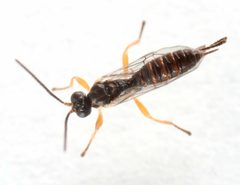
Zatypota anomala is a koinobiont ichneumonid in the tribe Ephialtini that parasitizes mesh web weaving spiders in the Dictynidae. It is strictly specialized on Dictyna and Nigma spiders in Europe, with a distribution concentrated at mid-elevations in central European forest . The exhibits elevation-dependent partitioning, parasitizing Nigma at lower elevations (179–254 m a.s.l.) and Dictyna at higher elevations (361–870 m a.s.l.). First recorded from Italy in 2022, parasitizing Dictyna pusilla.

Pronunciation
How to pronounce Zatypota anomala: /zəˈtɪpoʊtə əˈnɒmələ/
These audio files are automatically generated. While they are not always 100% accurate, they are a good starting point.
Identification
Small ichneumonid ; specific morphological features for field identification are not documented in available sources. Distinguished from other Zatypota by associations and distribution patterns.
Images
Habitat
Forest in central Europe, occurring across an elevation gradient from 179–870 m a.s.l. with highest abundance at mid-elevations ( 712 m a.s.l.).
Distribution
Central Europe (primary range); first recorded from Italy in 2022. Elevation range 179–870 m a.s.l., most abundant at mid-elevations. GBIF records indicate presence in Canada (Alberta: Edmonton, Wagner Natural Area), Norway, and Sweden, though European records represent the core documented distribution.
Seasonality
active in spring and summer following as larvae on . Female oviposition occurs in autumn; offspring overwinter as larvae, reach adulthood in spring, and pass summer as adults.
Host Associations
Life Cycle
synchronized with spiders. Females oviposit in autumn; larvae overwinter on the host, complete development during spring, and emerge to pass summer in reproductive . Strong preference for instars of hosts.
Behavior
Ecological Role
regulating of mesh web weaving spiders (Dictynidae). Contributes to spider in forest .
Sources and further reading
- BugGuide
- GBIF taxonomy match
- iNaturalist taxon
- NCBI Taxonomy
- Catalogue of Life
- Blossom busters: Oriental beetle, Anomala orientalis — Bug of the Week
- Blossom buster: Oriental beetle, Anomala orientalis — Bug of the Week
- Chafer madness: Oriental beetle, Anomala orientalis, and Asiatic garden beetle, Maladera castanea — Bug of the Week
- Archive — Bug of the Week
- Ascalaphidae | Beetles In The Bush
- August | 2022 | Beetles In The Bush
- Elevation gradient affects the distribution and host utilisation of Zatypota anomala (Hymenoptera, Ichneumonidae) associated with mesh web weaving spiders (Araneae, Dictynidae)
- First record from Italy of Zatypota anomala (Ichneumonidae, Ephialtini), a parasitoid of the cribellate spider Dictyna pusilla (Araneae, Dictynidae)
- Figure 2 from: Korenko S, Sýkora J, Černecká Ľ, Gajdoš P, Purgat P, Černecký J, Holý K, Heneberg P, Agnarsson I (2022) Elevation gradient affects the distribution and host utilisation of Zatypota anomala (Hymenoptera, Ichneumonidae) associated with mesh web weaving spiders (Araneae, Dictynidae). Journal of Hymenoptera Research 93: 89-100. https://doi.org/10.3897/jhr.93.91513
- Figure 4 from: Korenko S, Sýkora J, Černecká Ľ, Gajdoš P, Purgat P, Černecký J, Holý K, Heneberg P, Agnarsson I (2022) Elevation gradient affects the distribution and host utilisation of Zatypota anomala (Hymenoptera, Ichneumonidae) associated with mesh web weaving spiders (Araneae, Dictynidae). Journal of Hymenoptera Research 93: 89-100. https://doi.org/10.3897/jhr.93.91513