
Cyclosa conica
(Pallas, 1772)
Conical Trashline Orbweaver
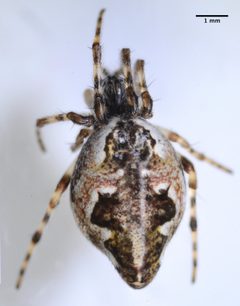
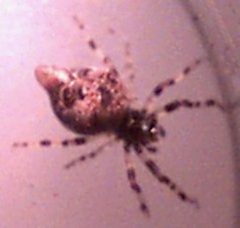
Cyclosa conica is a small orb-weaving spider known for constructing distinctive vertical webs decorated with debris. Females measure 5.3–7.5 mm in body length, while males are smaller at 3.6–4 mm. The is recognized by its unique of stringing dead insect bodies and other debris vertically through the center of its web, forming a 'trashline' or . The spider positions itself at the hub of this debris, relying on its cryptic coloration to blend in and avoid detection by . When disturbed, it feigns death as a secondary defense.

Pronunciation
How to pronounce Cyclosa conica: //saɪˈkloʊsə ˈkɒnɪkə//
These audio files are automatically generated. While they are not always 100% accurate, they are a good starting point.
Identification
Females of Cyclosa conica lack the pair of humps on the present in Cyclosa turbinata, a similar and widespread . Both may display a conical or spatulate abdominal projection, which can be pronounced or reduced. The trashline —composed of old prey, shed , and debris arranged vertically through the web center—is diagnostic for the Cyclosa and present in C. conica. The spider's small size, cryptic coloration resembling bird droppings, and position at the web hub amid debris make visual detection difficult until movement occurs.
Images
Habitat
Open woodlands, shrubs in gardens and yards. Webs are typically constructed well above ground, often at or near human level, attached to vegetation in open or semi-open settings.
Distribution
Widespread across North America; records from Canada, Central Europe, and France.
Seasonality
reach maturity in spring.
Life Cycle
Mature males abandon web-building and wander in search of females. Mated females produce up to five sacs, concealed on twigs or beneath foliage.
Behavior
Constructs a vertical orb web with a central composed of debris and prey remains. Hides at the web hub among this debris, relying on camouflage for avoidance. When disturbed, feigns death (). The debris line may function as a decoy, diverting predator attacks away from the spider.
Ecological Role
of small flying insects; debris accumulation in webs may contribute to nutrient cycling.
Human Relevance
Occasionally found near human dwellings in garden and yard . Not dangerously venomous to humans or pets.
Similar Taxa
- Cyclosa turbinataOverlapping distribution and similar trashline web architecture; distinguished by presence of paired abdominal humps in C. turbinata females, which C. conica females lack.
- Allocyclosa bifurcaAlso constructs trashline webs, but A. bifurca is restricted to southern Texas and Florida, typically builds webs close to the ground in prickly pear cactus, and has a forked () abdominal projection.
Sources and further reading
- BugGuide
- Wikipedia
- GBIF taxonomy match
- iNaturalist taxon
- NCBI Taxonomy
- Catalogue of Life
- Bug Eric: Spider Sunday: Trashline Orb Weavers
- Bug Eric: June 2012
- Pits of despair for ground dwelling insects: Antlions, Family Myrmeleontidae — Bug of the Week
- Orbs, Tangles, and Sheets: Spider Web Styles Linked to Anti-Predator Adaptations
- Bug Eric: One Night, One House, Seventeen Spider Species
- Bug Eric: Spider Sunday: Featherlegged Orb-weavers