
Cyclosa turbinata
(Walckenaer, 1841)
Humped Trashline Orbweaver, Trashline Orbweaver
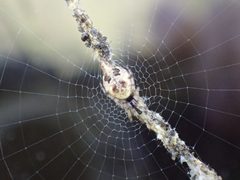
Cyclosa turbinata is a small orb-weaving spider (Araneidae) known for its distinctive 'trashline' web decoration, where the spider arranges debris, prey carcasses, and sacs in a vertical line through the web hub to camouflage itself from visual . Females possess two humps on the , distinguishing them from the similar C. conica. The exhibits an exceptionally short-period circadian clock of approximately 19 hours, regulating its locomotor and web-building activities. Native to North and Central America, it has been introduced to Hawaii and other regions, with spiderlings dispersing via wind-borne silk (ballooning).
Pronunciation
How to pronounce Cyclosa turbinata: /sɪkˈloʊsə ˌtɜrbəˈneɪtə/
These audio files are automatically generated. While they are not always 100% accurate, they are a good starting point.
Identification
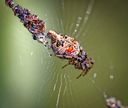
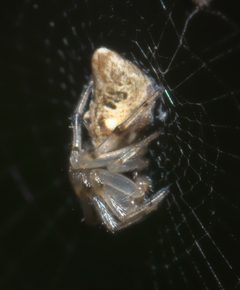
Females distinguished from C. conica by smaller size and presence of two humps on (C. conica lacks humps and is larger: 5.3–7.5 mm). Often misidentified as Mangora gibberosa (lined orbweaver) due to similar appearance and orb web structure. Look for vertical 'trashline' of debris through web hub; spider sits centrally amid debris, extremely cryptic. Web typically small, vertical orb with -like trashline decoration.
Images
Appearance
Small orb-weaver with body length 4–7 mm; females 3.3–5.2 mm, males ~2.5 mm. tapers to rounded point, with two humps present in females (absent in C. conica). Coloration variable mix of browns, blacks, and whites. Overall shape and coloration resembles bird droppings, providing camouflage when positioned among web debris.
Habitat
Found across diverse including forest edges, woodland clearings, shrublands, grassland pastures, sand dunes, and agricultural areas (cotton, peanut crops, pecan orchards). In woodlands, favors live oak (Quercus spp.), elm (Ulmus crassifolia), and hollow sycamore trees; also common on shrubs and fencing. Builds webs at level or above, typically 1–2 m off ground. Juveniles build webs higher above ground than other Cyclosa .
Distribution
Native to continental United States, Mexico, and Central America (Panama, West Indies). Introduced to Hawaii, Galapagos Islands, and Oceania. Widespread across North America north of Mexico; one of five Cyclosa in this region.
Seasonality
Males active March–September; females active March–October. : first matures and reproduces late spring, dies early summer; second generation matures summer, reproduces, dies fall/winter. reach maturity in spring.
Diet
Opportunistic capturing small flying insects in orb web. Prey includes aphids, small dipterans, small hymenopterans, leafhoppers, , small coleopterans, and red fire ants. Spider demonstrates selective prey discrimination based on vibration cues, avoiding dangerous prey that could cause injury. Prey size correlates with spider body size rather than life stage.
Life Cycle
(two per year). Females produce up to five sacs hidden in surrounding foliage. Spiderlings disperse via ballooning: climb perch, release silk line into wind, and become airborne when silk catches sufficient current. Hatchlings build webs immediately; initially lack cribellum and calamistrum, producing webs with additional and retained auxiliary spiral at hub. Normal web architecture resumes after second .
Behavior
Constructs orb webs primarily during darkness. Occupies web hub continuously, conducting sit-and-wait foraging; leaves only to replace web before sunrise or to secure struggling prey. Exhibits (death-feigning) when confronted with , more frequently and for longer durations during daytime. Shakes web back and forth when threatened, possibly to warn larger animals of web presence. Foraging aggression primarily despite daytime web occupation. Possesses exceptionally short-period circadian clock (~19 hours) regulating locomotor and web-building rhythms; does not suffer decreased longevity under desynchronized light-dark cycles.
Ecological Role
of small flying insects; contributes to regulation of pest in agricultural and natural . Prey for sphecid (up to 75% of wasp diet in some areas), other hymenopteran predators, and visual predators including birds. Trashline decoration may inadvertently attract wasps, though camouflage typically prevents successful . Spiderling ballooning enables of new and maintenance of genetic connectivity across landscapes.
Human Relevance
Bites are venomous but not considered dangerous to healthy humans or large animals such as dogs. Occasionally considered nuisance when webs built near human structures; some found on cotton and peanut crops. Subject of scientific research on , -prey interactions, and anti-predator . Not economically significant pest.
Similar Taxa
- Cyclosa conicaSimilar trashline orb web and overall appearance; distinguished by larger female size (5.3–7.5 mm vs. 3.3–5.2 mm) and absence of two humps on
- Mangora gibberosaLined orbweaver commonly misidentified as C. turbinata due to similar body shape and orb web structure; lacks trashline decoration and humps
- Allocyclosa bifurcaOnly Allocyclosa in U.S.; silvery/white females with forked abdominal projection, builds web close to ground in prickly pear cacti, arranges sacs above hub rather than integrated trashline
More Details
Circadian clock research
C. turbinata is the only known spider with a free-running circadian period of approximately 19 hours, significantly shorter than the typical 24-hour period. This trait makes it valuable for studying genetics and the absence of negative consequences from circadian desynchronization.
Web architecture and silk economy
Under poor nutritional conditions, spiders strategically assess silk reserves and produce highly regular webs despite diminished resources. Web diameter varies with silk availability, but trapping depends on presence of /trashline decoration rather than web size.
Predator-prey tradeoffs
Females forage at lower energy reserves during midday when are most abundant, accepting increased risk. Highest foraging aggression occurs at night when prey is most abundant, demonstrating temporal partitioning of foraging effort and predator avoidance.
Sources and further reading
- BugGuide
- Wikipedia
- GBIF taxonomy match
- iNaturalist taxon
- NCBI Taxonomy
- Catalogue of Life
- Bug Eric: Spider Sunday: Trashline Orb Weavers
- Bug Eric: June 2012
- Cyclosa sp. "trash line" orb weaver spider - Entomology Today
- Orbs, Tangles, and Sheets: Spider Web Styles Linked to Anti-Predator Adaptations
- Bug Eric: One Night, One House, Seventeen Spider Species
- Bug Eric: Spider Sunday: Featherlegged Orb-weavers
- Diel patterns of foraging aggression and antipredator behaviour in the trashline orb-weaving spider, Cyclosa turbinata
- Exceptionally short-period circadian clock inCyclosa turbinata: regulation of locomotor and web-building behavior in an orb-weaving spider