
Allocyclosa bifurca
(McCook, 1887)
Bifurcate Trashline Orbweaver, Forked-tail Trashline Orbweaver
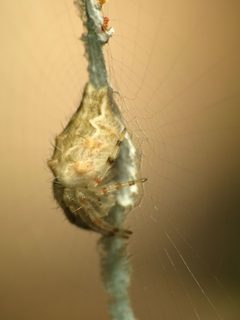
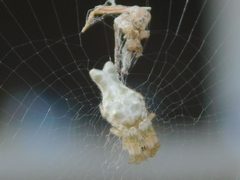
Allocyclosa bifurca is a small orb-weaving spider and the sole in its . females measure 5.1–8.5 mm in body length and are silvery or white in color. The species is distinguished by a forked () projection at the rear of the —two humps shaped like the letter 'M'—giving it the Latin name meaning 'two-forked.' This is the only Cyclosa-like species north of Mexico with this forked tail structure. The spider exhibits remarkable camouflage , arranging debris and sacs in a vertical line through its web to masquerade as bird droppings. Unusually, males are rarely observed, and females possess external genitalia with no external opening, suggesting possible parthenogenic . The species is also notable as a for parasitic that chemically manipulate its web-building behavior.
Pronunciation
How to pronounce Allocyclosa bifurca: /ˌæloʊsaɪˈkloʊsə bɪˈfɜrkə/
These audio files are automatically generated. While they are not always 100% accurate, they are a good starting point.
Identification
Distinguished from and similar trashline orb weavers (Cyclosa ) by the forked () abdominal projection—two distinct humps at the rear of the shaped like 'M.' Cyclosa conica and C. turbinata have conical or spatulate projections but lack the forked structure. Females are silvery or white, lacking the darker markings seen in some Cyclosa. The web structure also differs: A. bifurca builds webs close to the ground amid prickly pear cacti, with trash arranged below the hub and sacs strung above, whereas Cyclosa species typically build webs well off the ground in woodlands and shrubs.
Images
Habitat
Builds webs most commonly amid prickly pear cacti, quite close to the ground. Web location distinguishes it from Cyclosa , which occupy higher .
Distribution
Southern Texas and Florida in the United States; extends south through Mexico and Middle America to Panama, and throughout the Caribbean including Cuba, Hispaniola, and Turks & Caicos.
Seasonality
reach maturity in spring. Observations span multiple seasons, but peak activity timing not explicitly documented.
Host Associations
- Parasitic wasp (Hymenoptera) - larva parasitizes A. bifurca, manipulates its web-building through () administration, induces construction of modified 'cocoon web' with hub-trail decoration, kills the spider, and pupates in a cocoon suspended within this protective structure. This represents the first documented case of ecdysone use by a to manipulate behavior.
Life Cycle
Mated females create multiple sacs (up to five, based on Cyclosa pattern), arranged in a vertical string above the hub of the web. Each egg sac is approximately the same size and color as the female herself, contributing to camouflage. Spiderlings likely emerge and disperse; developmental details otherwise undocumented. The is potentially parthenogenic due to female genitalia and extreme rarity of males.
Behavior
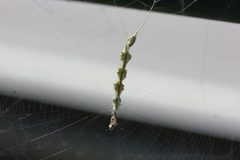
Constructs small vertical orb webs with distinctive 'trashline' architecture: debris and old prey are arranged vertically through the middle of the web, below the hub where the spider sits. Above the hub, the female strings sacs in a line. This arrangement camouflages the spider as bird droppings. When disturbed, the spider's cryptic appearance and placement amid debris make it difficult for visual to detect. Normal web-building can be chemically manipulated by parasitic to create a protective 'cocoon web.'
Ecological Role
Serves as for parasitic ; web modification by parasitized spiders creates protective structures for wasp offspring. As a of small insects, contributes to local dynamics. Camouflage strategy may reduce pressure, influencing predator-prey dynamics in its .
Human Relevance
Not dangerously venomous to humans or pets. Occasionally found near human dwellings in southern Texas and Florida, including on porches and in lanais, where its webs may be considered unsightly. Not known as a significant pest.
Similar Taxa
- Cyclosa conicaBoth are trashline orb weavers with conical abdominal projections and debris-arranging , but C. conica has a single conical projection (not forked), is slightly larger (5.3–7.5 mm), lacks humps, and builds webs well off the ground in woodlands rather than near ground level in cacti.
- Cyclosa turbinataSimilar trashline and size, but C. turbinata females have a pair of humps on top of the (not rear forked projection), lack the tail, and occupy woodland and shrub at level rather than ground-level cactus habitats.
Sources and further reading
- BugGuide
- GBIF taxonomy match
- iNaturalist taxon
- Catalogue of Life
- Marek Borowiec's Awesome Social Insects Award | Bug Squad
- Bug Eric: Spider Sunday: Trashline Orb Weavers
- Bug Eric: June 2012
- Super Crop Challenge #5 | Beetles In The Bush
- Bug Eric: Basket-web Weavers
- Rainforest raiders: Fierce Leptogenys ants — Bug of the Week
- Zombie spiders and ecdysone: manipulation of Allocyclosa bifurca (Araneae: Araneidae) behavior by a parasitic wasp
- A suite of behavioural and morphological traits camouflage Allocyclosa bifurca (McCook, 1887) (Araneae: Araneidae)