
Diguetia
Simon, 1895
Desertshrub Spiders, Coneweb Spiders
Species Guides
4- Diguetia albolineata(desertshrub spider)
- Diguetia canities(desert bush spider)
- Diguetia mojavea(Desertshrub Spider)
- Diguetia signata(desertshrub spider)
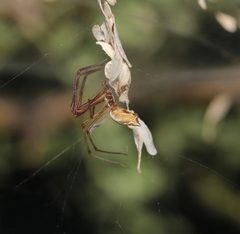
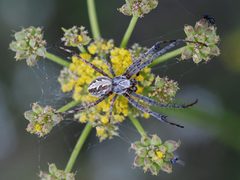
Diguetia is a of haplogyne spiders in the Diguetidae, first described by Eugène Simon in 1895. These six-eyed spiders are to arid regions of the southwestern United States and Mexico, with one extending into Argentina. They construct distinctive tent-like conewebs with tubular retreats, often camouflaged with plant debris and insect remains. The genus comprises eleven recognized species, seven of which occur north of Mexico.
Pronunciation
How to pronounce Diguetia: //daɪˈɡwiːtiə//
These audio files are automatically generated. While they are not always 100% accurate, they are a good starting point.
Identification
The combination of six in three dyads, flat oval , three tarsal claws, and white or patterned distinguishes Diguetia from similar-appearing agelenid funnelweb weavers. The distinctive tent-like web with a central tubular retreat further aids identification. Males and females both stridulate, producing audible sounds during mating and when females are harassed.
Images
Appearance
Mature individuals reach 5–10 mm in body length. The is flat and oval. Six are arranged in three dyads (pairs). The is either white or patterned with markings. Some exhibit banding on the legs. All species possess three tarsal claws.
Habitat
Arid and semi-arid desert environments of the American Southwest and Mexico. Webs are typically constructed less than two feet above ground, often between pads of prickly pear cactus (Opuntia spp.) or other desert vegetation. tend to be localized, with multiple webs found in close proximity.
Distribution
Southwestern United States (Arizona, California, Nevada, New Mexico, Texas, Utah, Colorado) and Mexico. One , D. canities, has three and is the most widely distributed. A single species occurs in Argentina.
Seasonality
Females mature in early summer. First sacs are produced in August, with continued production through September.
Diet
Insects captured in the web. Prey is bitten and injected with venom to immobilize it, then wrapped in silk. The spider may bite prey multiple times during this process.
Life Cycle
Females produce up to 10 disc-shaped sacs, each containing 150–250 eggs, stacked together in the tubular retreat. Total egg production can exceed 1,000 eggs per female. Less than 1% of eggs survive to maturity. Egg sacs are thin and camouflaged within the retreat.
Behavior
Constructs tent-like conewebs with a tubular retreat at the tip, camouflaged with leaf litter, dead plant material, and insect remains. The spider travels on the underside of the horizontal sheet to attack prey caught in surrounding tangle threads. Both sexes stridulate during mating; females also stridulate when harassed, producing sounds audible to humans.
Ecological Role
of insects in desert . Webs can withstand strong winds. Serves as prey for jumping spiders (Metaphidippus manni, Habronattus tranquillus) that feed on , and potentially for clerid larvae (Phyllobaenus discoideus).
Human Relevance
Not medically significant to humans. Webs may be encountered by desert hikers and naturalists.
Similar Taxa
- Agelenidae (funnelweb weavers)Similar coloration, pattern, and web architecture, but possess eight in two rows and lack the distinctive tubular retreat structure of Diguetia.
- Linyphiidae (sheetweb weavers)Similar sheet-like web architecture, but webs lack the central tubular retreat and conical shape of Diguetia webs.
More Details
Predation on eggs
Two of jumping spiders, Metaphidippus manni and Habronattus tranquillus, are known of Diguetia . After the female Diguetia dies, these jumping spiders invade the retreat, lay their own eggs, and their offspring feed on Diguetia eggs and juveniles.
Web architecture
The web includes a horizontal platform stretching from the retreat entrance that the spider uses as a movement platform. Surrounding threads connect to vegetation, stabilizing the structure.