
Diguetia canities
(McCook, 1890)
desert bush spider
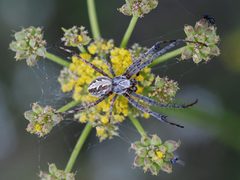
Diguetia canities, commonly known as the desert bush spider, is a of coneweb spider in the Diguetidae. It is the most widely distributed species in its , occurring across desert and semidesert from California to Oklahoma and Texas. The spider constructs a distinctive dome-shaped sheet web with a tubular retreat, often placed in bushes or cacti less than 60 cm above ground. It produces a potent insect-selective venom called Dc1a.
Pronunciation
How to pronounce Diguetia canities: //dɪˈɡwɛtiə kæˈnɪti.iːz//
These audio files are automatically generated. While they are not always 100% accurate, they are a good starting point.
Identification
The can be distinguished from similar-looking funnel-web weavers (Agelenidae) and labyrinth spiders by its distinctive web architecture: a horizontal, slightly dome-shaped sheet with a central tubular retreat positioned vertically above the sheet, surrounded by a tangle of threads on all sides. The retreat is characteristically shrouded in plant debris and prey remains. Within the Diguetia, D. canities is the most widely distributed species and has been divided into three . The web's conical 'house' retreat is often the first visible feature before the rest of the web becomes apparent.
Images
Appearance
A mid-sized spider with body length of approximately 9 mm (range 5-10 mm for mature individuals). The is elongated, orange-brown in color, and covered with short white hairs. The is brown with dark, leaf-like markings bordered by white. Legs are yellow-brown. Sexes are generally similar in appearance. Overall coloration resembles spiders in the Agelenidae (funnel-web weavers).
Habitat
Desert and semidesert environments. Webs are typically constructed less than two feet (60 cm) above ground, often amid the spiny pads of prickly pear cacti (Opuntia spp.) or in bushes. are localized; where one web is found, several others are usually nearby.
Distribution
United States from California eastward to Oklahoma and Texas. The most widely distributed in the Diguetia, with records also from Mexico.
Life Cycle
Females construct an elaborate web with a tubular retreat in which they conceal their sacs. The retreat is camouflaged with incorporated plant material. As haplogyne spiders, females lack a hardened genital plate and males possess relatively simple .
Behavior
The spider travels on the underside of the sheet web to attack prey caught in the tangled threads surrounding the dome. Web construction includes incorporation of plant debris into the tubular retreat, which serves to hide sacs. The is classified as a haplogyne, indicating relatively primitive reproductive .
Ecological Role
in desert and semidesert . The produces Dc1a, a potent 57-residue toxin that is insect-selective and lethal to the German cockroach (Blattella germanica), suggesting a role in controlling insect .
Human Relevance
Produces a potent insect-selective venom (Dc1a) that has been studied for its lethal effects on . Not considered dangerous to humans.
Similar Taxa
- Agelenidae (funnel-web weavers)Similar coloration and pattern; both construct sheet webs, but Diguetia canities has a dome-shaped sheet with a tubular retreat above it rather than a funnel-shaped retreat at the edge, and is surrounded by a tangle of threads on all sides.
- Labyrinth spidersWeb architecture may appear similar at first glance, but D. canities has a distinctive dome-shaped sheet with a central tubular retreat and lacks the complex tunnel systems of labyrinth spiders.
More Details
Taxonomic status
Diguetia canities has been separated into three . The Diguetia is the only genus in the Diguetidae in North America, with seven occurring north of Mexico.
Venom research
The produces Dc1a, a 57-residue toxin that is highly potent and insect-selective, making it lethal to Blattella germanica (German cockroach) but not affecting mammals at comparable concentrations.