
Diguetidae
F. O. Pickard-Cambridge, 1899
coneweb spiders, desertshrub spiders
Genus Guides
1- Diguetia(Desertshrub Spiders)
The Diguetidae are a small of haplogyne spiders commonly known as coneweb or desertshrub spiders. They are to the New World and primarily associated with arid and desert environments. Members construct distinctive webs featuring a horizontal sheet with a central tubular retreat, often camouflaged with plant debris. The family contains only two and approximately 15 , with the genus Diguetia being the sole representative in North America. These spiders are considered relatively primitive among araneomorphs due to their unmodified female genitalia and simple male .
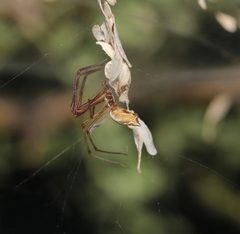
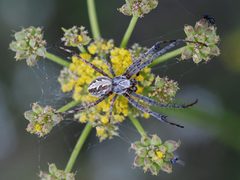
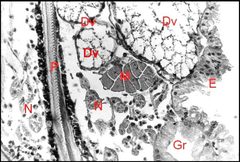
Pronunciation
How to pronounce Diguetidae: /dɪˈɡweɪtɪdaɪ/
These audio files are automatically generated. While they are not always 100% accurate, they are a good starting point.
Identification
Diguetidae spiders are mid-sized arachnids with mature individuals reaching 5–10 millimeters in body length. They resemble funnelweb weavers (Agelenidae) in coloration and pattern, which can cause initial misidentification. The webs provide the most reliable distinguishing feature: a horizontal, slightly domed sheet web with a central tubular retreat positioned vertically above the sheet, surrounded by a tangle of threads on all sides. The conical retreat, often covered in plant debris and prey remains, is frequently the most visible element. Examination of genitalia confirms identification—females lack a hardened epigyne (haplogyne condition), and males possess simple .
Images
Habitat
Arid and desert environments, particularly in association with desert shrubs and cacti. In North America, webs are typically constructed less than two feet above ground, frequently amid the spiny pads of prickly pear cacti (Opuntia spp.). tend to be localized, with multiple webs clustered in suitable microhabitats.
Distribution
New World distribution confined to North and South America. In the United States: recorded from Utah, Colorado, California, Arizona, and Texas. California five , Arizona four species. Mexico shows the highest diversity with eight of ten known species, particularly in Sonora (five species), Chihuahua (four species), Baja California (four species), Baja California Sur (four species), and Coahuila (three species). South American records include Brazil (Rio de Janeiro). Diguetia canities is the most widely distributed North American species with 133 records and three recognized .
Behavior
Spiders travel on the underside of the sheet web to attack prey entangled in the surrounding tangle of threads. Retreats are constructed as conical tubes camouflaged with plant debris, prey remains, and sacs. Web diameter ranges from four to six inches. The spiders are sit-and-wait that remain concealed in their retreats until prey contact signals their attention.
Similar Taxa
- Agelenidae (funnelweb weavers)Similar body coloration, pattern, and sheet-web architecture; distinguished by retreat structure (tubular vertical retreat in Diguetidae versus funnel-shaped retreat in Agelenidae) and haplogyne genitalia
Sources and further reading
- BugGuide
- GBIF taxonomy match
- iNaturalist taxon
- NCBI Taxonomy
- Catalogue of Life
- Bug Eric: August 2011
- Bug Eric: Spider Sunday: Desertshrub Spiders
- Pertica Simon 1903, a junior synonym of Segestrioides Keyserling, 1883 (Araneae, Diguetidae)
- The spider genus Diguetia Simon, 1895 (Araneae: Diguetidae) in North America: a new species, redescriptions, and comments on the distribution of the genus