
Diguetia albolineata
(O. Pickard-Cambridge, 1895)
desertshrub spider
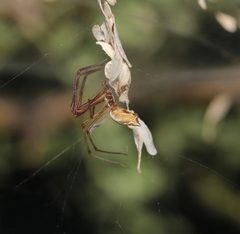
Diguetia albolineata is a of desertshrub spider in the Diguetidae. It is one of seven species in the Diguetia occurring north of Mexico. The species is found in the United States and Mexico, inhabiting desert environments where it constructs distinctive horizontal sheet webs with tubular retreats.
Pronunciation
How to pronounce Diguetia albolineata: /dɪˈɡwɛtiə ælˌboʊlɪˈniːətə/
These audio files are automatically generated. While they are not always 100% accurate, they are a good starting point.
Identification
D. albolineata can be distinguished from other Diguetia by its specific epithet referring to white lines (albolineata = "white-lined"), though detailed diagnostic features require close examination. The Diguetia is recognizable by its mid-size body (5-10 mm in mature individuals), coloration reminiscent of funnelweb weavers ( Agelenidae), and distinctive web architecture. The webs are horizontal sheets, slightly dome-shaped, with a central tubular retreat in the vertical plane above the sheet and tangled threads on all sides.
Images
Habitat
Desert environments of the American Southwest. Webs are typically located less than two feet off the ground, frequently amid the spiny pads of prickly pear cacti (Opuntia spp.). are localized, with multiple webs often found in close proximity.
Distribution
United States and Mexico. The Diguetia collectively ranges from Utah and Colorado to California and Texas; D. albolineata specifically occurs in the southwestern United States and adjacent Mexico.
Behavior
Constructs horizontal sheet webs slightly dome-shaped in form, with a central tubular retreat positioned vertically above the sheet. The spider travels on the underside of the sheet to attack prey caught in the tangled threads surrounding the web. Retreats are shrouded in plant debris and remains of prey insects, and may contain camouflaged sacs.
Similar Taxa
- Diguetia canitiesMost widely distributed in the , separated into three ; distinguished by distribution and subtle morphological differences
- Agelenidae (funnelweb weavers)Similar coloration and pattern; distinguished by web architecture—Agelenidae build funnel-shaped retreats at one edge of a sheet web rather than central tubular retreats above the sheet
- Filistatidae (crevice weavers)May be confused due to similar preferences and web-building in sheltered locations; distinguished by cribellate silk and different web structure
More Details
Taxonomic history
Described by O. Pickard-Cambridge in 1895. The Diguetia is the only representative of the Diguetidae in North America.
Phylogenetic position
Diguetidae are classified as "haplogynes," a primitive group of spiders characterized by females lacking a hardened plate over the genital opening and males having relatively simple . Other familiar haplogyne spiders include tarantulas and cellar spiders.
Web dimensions
The snares are roughly four to six inches in diameter, making them visible to careful observers in the field.